




At first glance, the terms “data sovereignty” and “data residency” can seem interchangeable. But these terms refer to fundamentally different concepts, and misinterpreting them can cause a lot of confusion between teams, leading to serious risk.
For example, many organisations assume that storing data locally is enough to keep them compliant with local regulations. But that assumption isn’t always correct, and it can expose the organisations to fines, especially in the context of handling user data in analytics platforms or cloud infrastructure.
With privacy regulations tightening in multiple jurisdictions and companies now using an average of 101 apps, understanding the difference between data sovereignty and residency is increasingly important.
This article explains important differences between the two terms and what they mean in practice.
Data sovereignty is a term that refers to the legal jurisdiction in which data is governed, regardless of the data’s physical storage location.
Data sovereignty means that the data is subject to the laws of the country where the entity legally responsible for controlling the data is based. This means how an organisation stores and processes data falls under the laws and regulations of that country or jurisdiction.
The storage location of the data is less important than the controlling entity’s location. For example, a company headquartered in the US might use the services of a data centre in France. But the data is still subject to US legal frameworks as well as the European Union, because that’s where the controlling company is based.
Data residency refers to the physical storage or processing location of data. If a US company pays to keep its data on servers located in Ireland, for example, then the data’s residency would be Ireland.
There are lots of reasons a company might choose this set up rather than storing data on local servers within their own legal jurisdiction. Certain client contracts might require it, or a country could dictate that data related to its residents remains within its national borders.
This is why many cloud providers offer region-specific hosting, so organisations can choose where to store their data. It provides flexibility to meet obligations and preferences, whether they’re dictated by business operations or regulations. Some systems even use IP-based geolocation to determine where a user is and store data accordingly.
| Data sovereignty | Data residency | |
|---|---|---|
| Legal jurisdiction | Location of the controlling organisation | Location of the data’s physical storage |
| Regulatory authority and access | Authorities can gain access based on organisation’s legal jurisdiction | Authorities can gain access domestically based on where data is stored |
| Compliance requirements | Defines the core legal frameworks and regulations the company must follow | Potentially defines additional, local requirements |
| Data transfers | Tied to the laws of the data’s jurisdiction (e.g. GDPR transfer rules) | System design decisions based on legal complexity and risk |
| Infrastructure | Influences the structure of systems across jurisdictions | Can require data storage in specific jurisdictions and require regional data centres |
One of the best ways to compare data sovereignty and data residency is to ask: Which country can make legal demands on the data?
Data residency refers to the place where the data is stored (even temporarily). Whether that jurisdiction can enforce compliance with local regulations or assert authority over the data depends on local law.
Data sovereignty is about which country has primary legal authority over the organisation that controls the data.
So, in practice, both sovereignty and residency can determine your legal obligations in relation to storing and processing data.
Legal jurisdiction over a server does not automatically mean a local government has practical access to data. The ability for a local authority to request or compel access often depends on the circumstances.
Data sovereignty is more explicit. Under the US CLOUD Act, for example, the US authorities can compel US companies to provide access to data, even if it’s stored in another country.
But this doesn’t mean that data residency restricts local governments from overriding privacy regulations to gain access. Some countries have local laws that provide mechanisms to compel access under certain circumstances. In Germany, Strafprozessordnung (StPO) gives German authorities the ability to search and seize servers or demand data handover as part of criminal investigations.
Most legal jurisdictions have laws and regulatory bodies that enforce certain standards in the collection and storage of data such as lawful basis and user consent.
Data within the healthcare industry is a good example. In the US, it’s subject to the Health Insurance Portability and Accountability Act (HIPAA). In EU countries, the General Data Protection Regulation (GDPR) has specific subsections that relate to healthcare data handling requirements. Individual countries within the EU may then have their own national regulations, like the Commission Nationale de l’Informatique et des Libertés (CNIL) in France.
When data moves across borders, governance becomes more complicated.
With data sovereignty, internationally transferring data has implications tied to the jurisdiction that governs the data itself. For example, the EU has a set list of countries they deem suitable for transfer of EU resident’s personal data outside the EU known as adequacy decisions. Transferring EU-based data to countries outside this list requires extra safeguards or contractual protections.
Data residency affects transfer possibilities at both the infrastructure and regulatory level. Many organisations choose to keep the processing and storage of regional data within the same jurisdiction, because transferring it elsewhere could mean extra regulatory pressure from data protection laws and changes to physical or digital infrastructure. In one instance in 2024, the Dutch Data Protection Authority issued a €290 million fine for transferring EU user data to the US without proper safeguards.
Both sovereignty and residency affect the location and set-up of an organisation’s data infrastructure. Data residency often creates direct requirements, with organisations legally obligated to store data in a specific jurisdiction. For example, Russia’s data localisation law, Federal Law No. 242-FZ, says that both foreign and domestic companies must use Russian servers to store personal data of Russian citizens.
Data sovereignty plays less of a direct role in infrastructure decisions. Global companies sometimes choose to separate their systems by regions because it can reduce legal complexity and risk.
Just because a company stores data in a specific location doesn’t automatically mean it’s fully compliant with that jurisdiction’s laws or its own country’s laws. Data residency simply refers to where a company keeps data, but it doesn’t remove legal obligations in its home country.
For example, if a company is headquartered in California but stores data in Europe, it’s still subject to federal and state legal frameworks like the California Consumer Privacy Act (CCPA). It’s important to understand the overlapping obligations data sovereignty and residency can introduce, because it affects how organisations store and protect data.
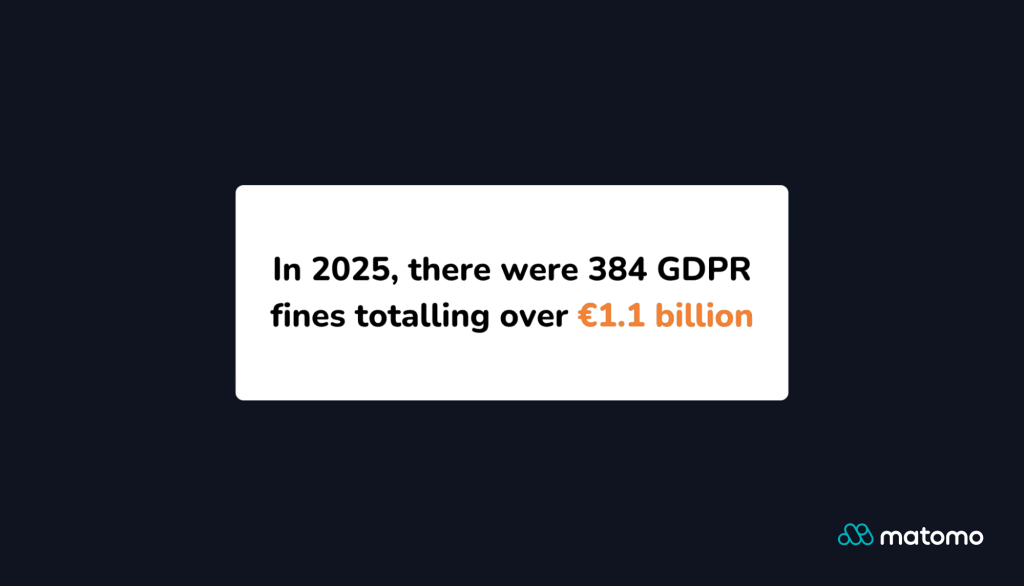
Gaps in these policies and infrastructure decisions can expose the company to legal and financial risk, especially as regulatory pressures increase. In 2025 alone, Enforcement Tracker shows there were 384 GDPR fines totalling over €1.1 billion.
Consumers are also becoming more aware of how companies store and use their data. One Deloitte report found that 70% of consumers in 2025 were concerned about data privacy and security, up from 60% the previous year.
These trends are particularly important for teams dealing with cross-border data storage and infrastructure, as both regulators and consumers look out for compliant and ethical data practices.
Even when the concepts of data sovereignty and residency become clear, the realities are rarely that clear cut.
A marketing team might collect user data from multiple jurisdictions through the company website before storing it in a CRM and various analytics tools. Each of those tools may then store and process the data in different locations, depending on configurations.
So, organisations may think their data storage happens in one place when the complex nature of today’s tech stacks means that isn’t always the case. This underscores the importance of compliance best practices like vendor agreements to specifically address data security obligations or access to audit logs.
Every time an organisation moves or duplicates data, it can trigger new compliance obligations depending on where it happens and the company’s home jurisdiction.
For organisations, this means complying with multiple layers of regulation and complex scenarios. A French resident might receive treatment in a French clinic, but the clinic uses software owned and managed by a US company which stores the data on servers in Ireland.
The data collection happens in France and relates to French residents, making it subject to certified health data hosting (HDS) regulations. Since France is in the EU, the data is also subject to GDPR requirements. Data storage happens in Ireland, making it subject to Irish regulator oversight within EU frameworks.
Scenarios like this place obligations and operational complexities on both the clinic and the software provider, with one Cisco report finding that 85% of organisations say data localisation increases costs, complexities and risks.
Privacy regulations directly impact how much user data an organisation can store and analyse while remaining compliant. This typically starts with consent models, with some regulations like GDPR dictating stringent informed consent structures and “double opt-in” requirements. Cookie tracking and cross-site tracking is another area that introduces complications, as it relates to user-level identification.
Without the correct informed consent, organisations cannot store or analyse this data compliantly which often leads to fragmented or incomplete data sets. Form fields and cookie consent banners are one way to ensure compliance with privacy regulations that relate to privacy and user tracking.
Having data flow across multiple systems and jurisdictions is a common scenario, but it makes it difficult for teams to fully understand where the storage and processing of data happens.
Flexible hosting enables teams to decide where data is stored instead of defaulting to reliance on the infrastructure of third-party platforms to dictate data residency. Analytics platforms can provide configurable hosting options, like choosing specific data centres by location. This is a particularly useful feature for organisations in compliance-heavy industries where regulators may dictate certain data location rules.
Another feature in this area is flexible deployment, enabling teams to deploy the analytics platform within their own on-premise infrastructure or in a secure cloud environment.
Managing data jurisdiction and residency compliantly means being able to demonstrate the flow and access of data during an audit. Teams need to be able to show who has access to data, including different systems and users.
Some analytics platforms support this through granular access controls and advanced data management features. Teams can define user roles and permissions with flexibility rather than simple access tiers and limit access by team or location, for example, or define different retention periods by region.
The movement of data across jurisdictions can mean dealing with different rules and requirements that relate to collecting and using data, particularly when it comes to personally identifiable information (PII).
Some analytics tools enable data anonymisation, either at the point of collection or during a data transfer from one system or jurisdiction to another. This helps teams ensure their data management processes stay compliant regardless of data residency.
At the crux of many data management challenges that relate to sovereignty and residency is control, whether it’s about where you store data or your identity and access management processes. Web analytics, which collects data from multiple locations and often connects it to multiple systems is one area these challenges become most visible.
Matomo gives you that level of control and flexibility to support compliant data management workflows and handle regional data concerns safely.
You can run Matomo’s on-premise deployment options to store and process analytics data within your own infrastructure rather than third-party environments. Or you can choose the cloud deployment option with data stored via AWS servers in Germany rather than distributing it across multiple locations.
The level of control Matomo provides also extends to data ownership. You retain full ownership of all analytics data, with no third-party access or sharing guaranteed. With our open-source model, you always have full transparency into collection and processing protocols and the ability to adapt the platform according to internal policies or regulatory requirements.
At the data level, the platform also provides support for first-party tracking and privacy configurations that allow for data anonymisation. This means teams can limit personal data collection, selectively anonymise data, and configure custom retention periods as needed.
The differences between data sovereignty and data residency have direct implications for how an organisation chooses to design their systems and infrastructure, and manage data workflows. From government-mandated data residency requirements to building user trust around privacy, control and visibility into where you store and process data is essential.
With the right web analytics platform, you can maintain full control over where you store data with the flexibility to customise data flows and access regionally. If you’d like to see how it works, try Matomo for free or book a demo here.
Data sovereignty is a term that applies to the external laws that govern data, meaning the laws of the jurisdiction that is home to the controlling company. Data governance is an internal framework that covers the policies, processes and standards set by an organisation on how data is collected, managed, and used. Data sovereignty is shaped by external laws and regulations, while data governance is an organisation’s internal ‘laws’ for managing its data responsibilities in response to those laws.
Data residency applies to wherever organisations store the data, whereas data localisation means organisations must store the data within a specific region or country by law. Sometimes, this also includes restrictions on transferring the data outside that jurisdiction.
A common example of data sovereignty is US companies hosting data on an EU-based server. While the data lives in the EU, the company is still subject to US legal frameworks around data security and privacy.
No, GDPR does not require personal data to be stored within the EU. However, it does provide a list of countries that are pre-approved to transfer data to. Outside of those countries, organisations must ensure adequate protections are in place before transferring data outside the EU’s jurisdiction.
Data sovereignty causes complications when organisations operate across multiple regions because it often means they must comply with multiple regulations and legal frameworks. This can lead to conflicting guidance on data policies and procedures.
此内容由惯性聚合(RSS阅读器)自动聚合整理,仅供阅读参考。 原文来自 — 版权归原作者所有。