







Here's a look at Google Beam's progress over the last year.
In 2021, we introduced Project Starline with the ambitious goal of making remote communication feel like you’d instantly traveled across distances to be together. This year, our vision became reality with the announcement of Google Beam — our first true-to-life 3D video-communication platform, powered by Google AI. Here’s a look at how Beam progressed this year:
1. Google Beam took center stage at I/O.
At I/O in May, CEO Sundar Pichai unveiled the evolution of Project Starline into a new AI-powered video communication platform, Google Beam. He showed how Google is bringing its AI technology to Google Beam through breakthrough AI-powered video models that transform 2D video streams to 3D experiences, and how we’re paving the way for future features like real-time speech translation.
2. Beam began working with industry leaders in video.
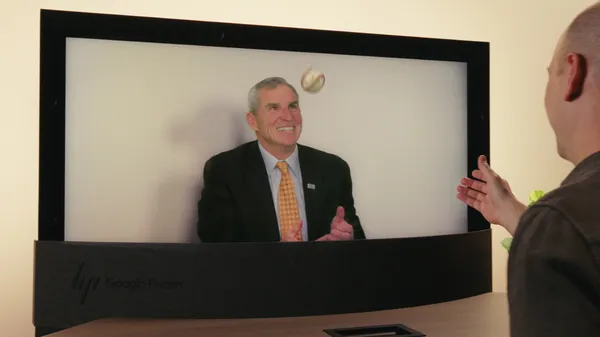
At InfoComm 2025, we announced HP Dimension with Google Beam, the first product specifically for businesses developed in partnership with our partner, HP. Our technology earned a "Best of Show" win at InfoComm, recognized for its broad impact and remote conversation experience that’s far closer to being in the same room. HP Dimension with Google Beam was later named an Honoree in Fast Company's Next Big Things in Tech Awards 2025.
Google Beam was also showcased at Zoomtopia, Zoom's annual user conference, highlighting a partnership to integrate the Google Beam platform with their video conferencing software. To further expand Beam's reach, we collaborated with HP to establish a network of distribution partners like Diversified, AVI-SPL and more.
In October, we co-hosted with industry experts at a WORKTECH event where founder and CEO of UnWork and WORKTECH Philip Ross called Beam “an AI game-changer that connects people and not just pixels, changing the way we enable presence and collaboration.”
3. Workplaces all over the world became early users — including Google.
Organizations globally began using Beam's true-to-life capabilities firsthand in their offices. Workplaces like Schwarz Digits and Huntington Bank were among them.
The list is growing, too: Bain, Duolingo, Salesforce, Citadel, NEC, Hackensack Meridian Health and more are actively embracing Beam.
Here at Google, Googlers testing Beam said they prefer it over typical video conferencing and 90% agreed that using Beam makes it feel like they're in the same space as their meeting partner. Through testing, we’ve identified five key use cases where Beam truly shines: job interviews and recruiting; mentoring and talent development; productivity and collaboration; critical conversations and connecting distributed teams.

4. We announced a pilot program with the USO.
We began work to place Beam devices in select USO centers worldwide, enabling deployed active duty service members to connect with their families.
Learn more about Google Beam and connect with our sales team at beam.google.