





Google’s ATLAS is an expansive look at how people are using AI at work and in day-to-day life.
AI & Economy Lead, Chief Economist's Office
Scott Strand
Head of StratOps and Special Projects, Technology & Society
Your browser does not support the audio element.
Listen to article
[[duration]] minutes
This content is generated by Google AI. Generative AI is experimental
There is broad agreement that AI’s potential to transform the global economy and the way we work is significant. However, the outcomes – what this means for work, for people’s lives, and the economy writ large – are not automatic nor guaranteed. A lot has to happen. To get there, we as a society must work together to positively shape how AI impacts our lives, jobs, and economy. In order for this shared work to be effective, it is critical to have a rich understanding of how AI is being adopted and used in the economy. Society needs empirical insights and evidence-based research to inform decisions, initiatives, and actions.
To help, Google is launching the first iteration of the AI & Economy ATLAS (Activity, Task, Landscape, and Adoption Study), an ongoing, large-scale, de-identified study of how people are using Google’s AI products and tools. ATLAS’s first dataset (v1.0) is built from 15 million aggregated and de-identified human-AI interactions across the Gemini App, AI Mode, and the Gemini API, which together are used by more than 1 billion people monthly. ATLAS v1.0 insights span more than 150 countries, 140 languages, 800 occupations, and 4,000 tasks; ATLAS is the most comprehensive look to date at how real people are using AI at scale.
ATLAS sheds light on how people are using Google’s AI tools for various tasks at work and in their day-to-day lives. The ATLAS v1.0 report provides an early view of a quickly moving landscape: AI’s capabilities are advancing, its use is evolving, and tools for observing its impact on the economy are still a work-in-progress.
What are we learning from ATLAS v1.0?
Here a few of the most interesting observations so far:
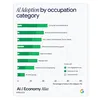
- AI use at work is broad but shallow: Workplace adoption spans all industry sectors and also 68% of all occupations that collectively represent 90% of total U.S. employment. However within jobs, people are using AI selectively: in a typical job AI is used for only ~21% of tasks.
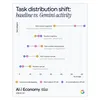
- At work, most AI use is focused on collaboration and assistance with tasks, and so far task automation is uncommon: ATLAS data shows the vast majority of AI interactions at work focus on collaborative uses such as ideation, strategy, information retrieval, and learning. Tasks like creative design and hypothesis testing (categorized in ATLAS as “non-routine cognitive”) show up in AI work interactions at a much higher rate than in the economy as a whole (65% vs 35%). Less than 10% of those interactions fully automate tasks.
- AI use is not limited to white collar workers, it’s also assisting workers in predominantly physical and manual occupations with adjacent tasks: AI use for work is not limited to jobs traditionally seen as knowledge work. While not as prevalent, workers in manual and technical trades (e.g., auto technicians, industrial mechanics) are using conversational AI as a live collaborator for real-time diagnostics, troubleshooting, and on-the-fly learning. When workers in these areas use our AI tools, they’re 2x more likely to use multimodal AI (i.e. using AI to create images or video). For example, automotive technicians and industrial mechanics use AI to interpret complex test results, debug electrical wiring, and inspect machinery for wear.
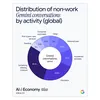
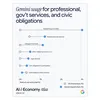
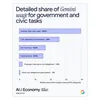
- AI is delivering value at home that may be missed in standard economic metrics, particularly around high-friction administrative tasks: Over 86% of interactions with AI tools in ATLAS occur outside of work. People are using AI in new and interesting ways not captured in standard economic metrics including productive household activities (e.g. researching purchases, help with using appliances, and tools) and high-friction administrative tasks (e.g. navigating government services like taxes, licensing, and fines).
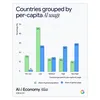
- Global AI adoption is tracking GDP per capita, with notable exceptions: AI usage has diffused globally. ATLAS data shows AI usage in over 150 countries and territories that represent 99% of the world's population. We also see this in the diversity of languages used in ATLAS. English represents only about a third of global AI conversations, and users do not systematically abandon their native languages for complex tasks. Looking more deeply, on a per-capita basis AI usage closely mirrors a country’s relative level of wealth, raising concerns about a persisting digital divide. However this isn’t a universal rule: some middle-income countries in South America and the Middle East are adopting AI at rates comparable to higher-income countries.
Here are some additional findings:
How ATLAS has been developed
ATLAS insights are powered by Google DeepMind’s Observation Clustering and Taxonomy Organisation (OCTO), a tool for transforming massive unstructured text data, like LLM conversations, and distilling them into organized entities. ATLAS has been developed with the highest level of privacy protections. In addition to scrubbing personally identifiable information (PII), we added several additional layers of protection that automatically remove any possible references to sensitive information, remove all linkages between de-identified ATLAS data and underlying user logs, summarize the text data, and aggregate summaries into groups representing multiple users.
What’s next?
This is just the beginning — the ATLAS v1.0 represents the start of a long-term project. AI’s capabilities continue to expand, people are continuing to find new and interesting ways to use it, and research methodologies to understand AI continue to evolve. There are many more questions around AI and the economy where more work will be needed — work that Google’s AI & Economy Research Program is undertaking in collaboration with academic and other researchers.
And there is a much wider range of economically-relevant AI usage not reflected in ATLAS. These include AI-enabled products with billions of users and interactions like Google Workspace, Google Translate, and AI Overviews; enterprise platforms, such as Gemini for Google Cloud and Gemini Enterprise; and frontier capabilities in several key areas, such as agentic coding and world models.
As we continue to build upon ATLAS and expand its scope and capabilities to generate new insights, we aim to provide a sharper understanding of the AI-driven transformation of the economy. We hope it is helpful to researchers, policymakers, businesses, workers, and other participants in the economy as we work together to shape the ways AI can positively support people in their lives.
We’d like to acknowledge Dame Diane Coyle (Cambridge) and Dr. David Autor (MIT) for their contributions to the ATLAS v1.0 report, as well as the entire ATLAS team 1 .
Get the latest news from Google in your inbox
Sign up for our newsletters with product updates, event information, special offers, and more.
Your information will be used in accordance with Google's privacy policy. You may opt out at any time.