





So dancing bugs got upstaged by kpop girls, there’s the whole Bun vs Zig drama, and yesterday’s ChatGPT/Codex superapp launch was bumpier than expected, and the reset button was pressed a couple times to compensate.
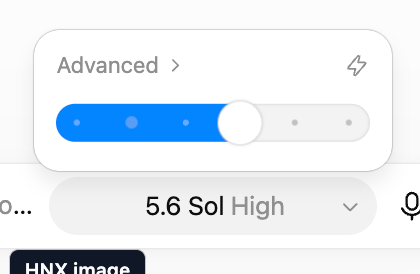
After buying Statsig and making a big deal out of GPT5’s routing/getting rid of the model picker, the main issue now is that GPT 5.6’s extra options are confusing people a bit. Most people just have a single slider:
But API users have literally 36 variants of GPT 5.6 now:
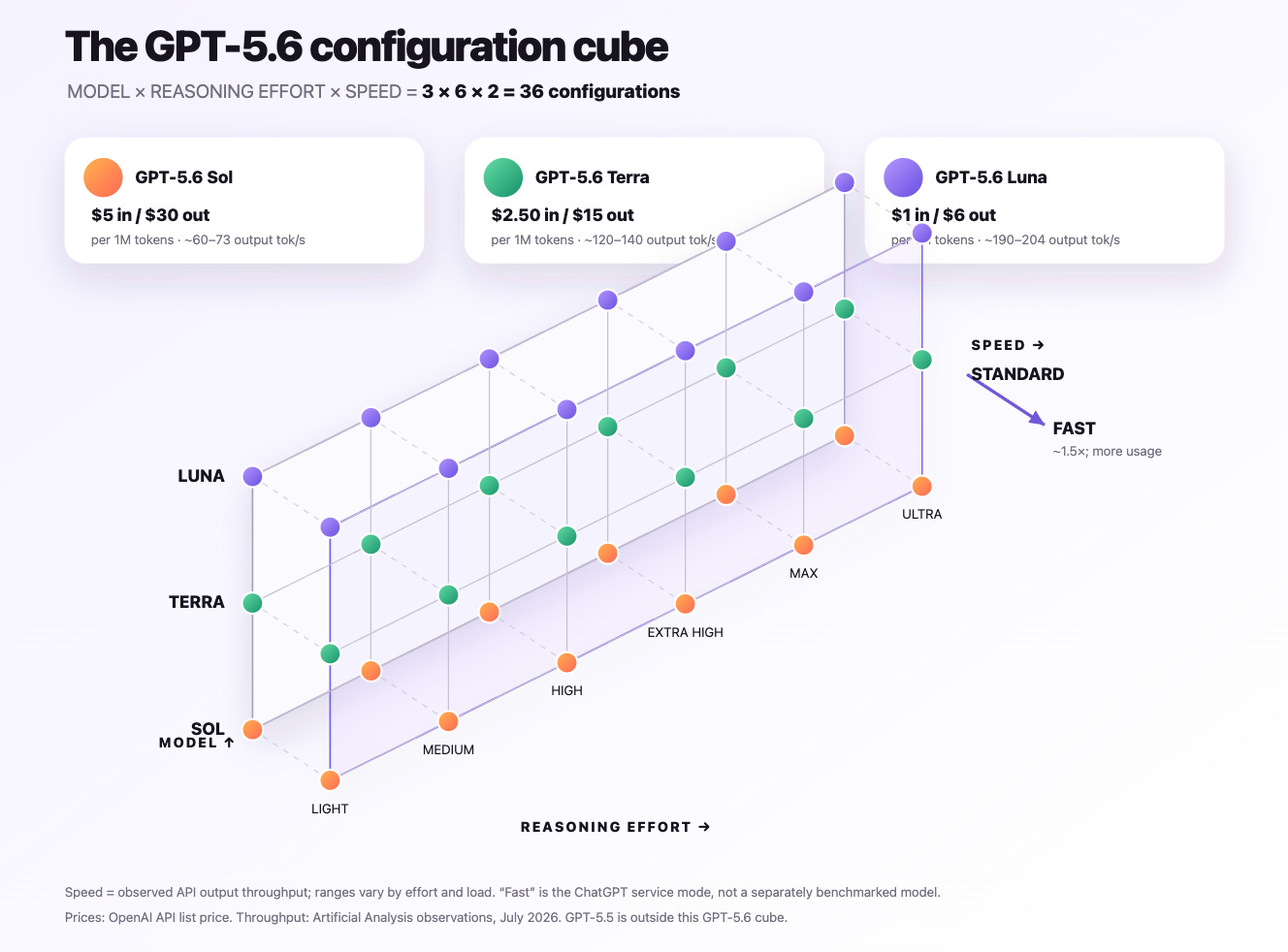
Most people can get by with just 3 rough clusters

JUMPERZ@jumperz
so this is what i've found works best with gpt-5.6 so far.. > luna high, normal everyday coding, fast, capable, doesn't feel wasteful... >luna xhigh better quality without jumping to the expensive models... >terra medium, bigger features >terra high, repo-wide changes.. >

JUMPERZ @jumperz
gpt 5.6 is honestly making the $200 pro plan harder to justify… when 5.5 never made me think about usage.. now you’ve got sol, terra, and luna, all with different limits and usage costs… so Instead of just picking the best model for the job, you’re constantly trying to make https://t.co/eA50elhmLP
4:28 PM · Jul 10, 2026 · 31.5K Views
20 Replies · 18 Reposts · 284 Likes
And many guides are coming up:

Sebastian Raschka@rasbt
For agentic coding, one can say: - Unless you need Terra Ultra perf, it's always better to use a Luna model with higher effort setting (same or better performance but cheaper). - Forget everything below Sol High, use Luna with higher effort settings here - Forget Sol Extra

1:32 PM · Jul 10, 2026 · 459K Views
250 Replies · 272 Reposts · 3.11K Likes
The top AIE talk so far this week has been Theo’s closing keynote, and the last of the online track will be released this weekend.
AI News for 7/09/2026-7/10/2026. We checked 12 subreddits and 544 Twitters. AINews’ website lets you search all past issues. As a reminder, AINews is now a section of Latent Space. You can opt in/out of email frequencies!
OpenAI’s GPT-5.6 rollout: model stratification, agent UX, and early benchmark signals
GPT-5.6 introduced a more explicit model/compute ladder: users are now navigating Luna / Terra / Sol plus multiple effort levels, with community guidance converging around “start lower than you did on 5.5.” OpenAI staff explained that Max means one model spending longer on a hard problem, while Ultra parallelizes work across subagents; they also noted that 5.5→5.6 effort settings are not directly comparable (guidance from @reach_vb, follow-up, practical default suggestion). The community reaction was mixed: many praised the added control, while others criticized the 30+ configuration combinatorics and missing “Auto” routing (@rasbt, @Yuchenj_UW).
The product launch landed with real UX regressions, and OpenAI publicly course-corrected fast: users complained that the new ChatGPT Work / Codex split was confusing, chats/projects became harder to find, and usage burned down faster than expected (@scaling01, @simonw, @kimmonismus). OpenAI responded unusually directly: multiple usage-limit resets, acknowledgements that defaults nudged users toward overly expensive settings, and a commitment to restore familiar sidebar/navigation patterns and clarify positioning between Work and Codex (@thsottiaux reset announcement, second reset, full corrective roadmap).
Initial eval picture: GPT-5.6 appears strongest in agentic coding / presentation / some science tasks, but not unambiguously dominant everywhere. Examples: #1 tie in Code Arena: Frontend with Claude Fable 5 while being ~2× cheaper on listed IO pricing (Arena); best recorded Presentation Elo on AA-Briefcase with a ~500-point jump over GPT-5.5 (Artificial Analysis); CritPt gains over GPT-5.5 and beats Fable 5 by ~4 points (Artificial Analysis); and strong results on WeirdML at lower cost (@htihle). At the same time, users reported instruction-following issues, uneven token efficiency in practice, and some concern about jailbreakability / reward hacking (@teortaxesTex, @Mononofu, @kimmonismus).
Parallel-agent workflows, computer use, and the “harness is the product” theme
GPT-5.6’s biggest perceived leap may be orchestration and computer use rather than pure chat quality. Multiple users highlighted that Sol is unusually strong as a planner / verifier / orchestrator, often using subagents automatically and reacting more quickly to steering (@omarsar0, @Hangsiin). OpenAI also showcased computer use with Sol Ultra and promoted ChatGPT Work as bringing agents to consumer/mobile scale (OpenAI demo via @gdb, Work positioning). Community reports described very high-throughput GUI automation and Blender workflows (@mckbrando, @kimmonismus).
A recurring operational issue is hidden subagent cost explosion: users found that spawned agents may inherit premium settings, draining quotas much faster than expected. One concrete claim was that spawn_agent doesn’t let users choose model/effort, so Sol Ultra spawns more Sol Ultra by default (@evi77ain). This fits the broader pattern of people liking the capability jump but finding the cost model opaque.
The broader systems trend is toward harness-centric competition. This came through in product commentary from Perplexity’s Arav Srinivas (“the real product is now the harness around it”), in LangChain’s launch framing around Deep Agents + Nemotron + OpenShell, and in a growing set of memory / orchestration tools like OpenWiki and OpenSWE (@dee_bosa quoting Arav, @hwchase17, OpenWiki proactive memory, OpenSWE adoption). The meta-point: frontier model parity is tightening, so value is increasingly shifting to routing, memory, tool use, safety rails, and enterprise context.
Meta’s Muse Spark 1.1 and the widening frontier of “good enough, fast, cheap” models
Muse Spark 1.1 was the other major model story of the day, with many practitioners calling it the most surprising release of the week. Reports consistently emphasized strong UI/frontend generation, fast responses, and unusually aggressive pricing, often framing it as near-frontier quality for a large subset of coding/product tasks (@alexandr_wang, @rowancheung, @kimmonismus).
Benchmarking suggests a real step up, but not outright frontier leadership. Artificial Analysis scored Muse Spark 1.1 at 51 on its Intelligence Index, up 8 points from 1.0, roughly tied with GLM-5.2 / GPT-5.4 / GPT-5.6 Luna and behind Grok 4.5 / GPT-5.6 Sol / Claude Fable 5. Notable details: 1M context, median speed ~114 tok/s, pricing $1.25 / $4.25 per 1M input/output tokens, and strong token efficiency (Artificial Analysis). Arena also placed it #9 on Code Arena: Frontend with strong gains in instruction-following and longer-query categories (Arena).
The strategic implication many drew: Meta’s compute-heavy bet is starting to show up as cost-effective inference products, not just talent headlines. Several commentators argued this materially raises competitive pressure on OpenAI/Anthropic, especially if Meta improves distribution and API ergonomics (@scaling01 asking for OpenRouter, @alexandr_wang, @mweinbach).
Open models, infra, and efficiency work
Open-model tooling kept shipping despite the closed-model attention vacuum. Unsloth released Qwen3.6 NVFP4 quants with claims of 2.5× faster inference, including 27B on 24GB VRAM and a 35B-A3B variant hitting 17,561 tok/s on B200 (Unsloth, technical details from @danielhanchen). QuixiAI reported Qwen3.6-35B-A3B-NVFP4 on dual B60 at 65 tok/s and 128k context (QuixiAI).
Inference optimization remains a major live research area. Cohere open-sourced Hardware-aware Dynamic Speculative Decoding in vLLM, addressing the familiar issue where speculative decoding helps at low batch sizes but hurts at high ones (Cohere/vLLM, vLLM commentary). Google/Hugging Face’s Gemma challenge reported up to 5× faster single-A10G inference, with 315 TPS lossless and 491.8 TPS fastest overall (Gemma).
Agent evaluation / self-improvement work is getting more concrete: “LLM-as-a-Verifier” reported SOTA on Terminal-Bench V2, SWE-Bench Verified, RoboRewardBench, and MedAgentBench using repeated sampling plus score-logprob ranking (paper thread); Meta researchers proposed an explicit memory agent to combat behavioral state decay in long-horizon agents (summary).
Science, math, health, and modality-specific systems
Math/science capability claims escalated sharply. OpenAI staff and community members circulated examples of GPT-5.6 Sol Ultra producing a claimed proof of the Cycle Double Cover Conjecture using 64 subagents in under an hour (claim from @eknight, amplified by @gdb). Separately, Bubeck noted a single-person 1M-line Lean formalization effort with GPT-5.6 (@SebastienBubeck). These are still claims pending external scrutiny, but they indicate where labs want the narrative to go: parallelized research agents as a scientific compute primitive.
Health is becoming a first-class benchmark and product vertical. OpenAI said GPT-5.6 is a major step forward for health intelligence, highlighting that Luna at lowest effort beats GPT-5.5 at highest effort while costing 25× less (OpenAI). Karan Singhal added that, in blinded physician comparisons over 20,000 axis ratings, physicians found fewer flaws in GPT-5.6 responses than physician-written responses across a hard task set (details).
Audio/music and creative tooling also moved: Kyutai + Mirelo released MuScriptor, an open model for multi-instrument audio-to-MIDI transcription from full mixes, not stems (MireloAI, Kyutai). Sakana’s new Picbreeder-style work explored open-ended creativity with VLM agents, concluding that diverse agent populations help but still fall short of human open-ended exploration (Sakana).
Security, safety, and policy frictions
Security concerns rose alongside capability gains. OpenAI moved its Bio Bug Bounty into a private ongoing program and doubled rewards to $50K, specifically seeking universal jailbreaks against predefined biosafety challenges (OpenAI). Separately, OpenAI tightened access requirements for its most cyber-capable models, requiring hardware security keys for Trusted Access for Cyber members starting Sept. 1 (@cryps1s).
Evidence of misuse remains salient: a new study reported Boko Haram members using frontier chatbots for bomb-making and related tactical queries (@AntoniaJuelich). That thread sat uncomfortably next to ongoing online discussion that GPT-5.6 may be relatively easy to jailbreak or reward-hack in some settings (@Mononofu).
Policy discourse remains polarized and speculative. The “AI 2040 / Plan A” transparency-and-governance scenario drew both support and ridicule, with Ajeya Cotra emphasizing the centrality of total research transparency while critics questioned feasibility and assumptions about superintelligence/governance capacity (@ajeya_cotra, @binarybits, @banteg satire).
Top tweets (by engagement)
OpenAI launch and rollback management: OpenAI’s product lead acknowledged launch confusion, promised UI fixes, and reset usage twice while clarifying that Codex is here to stay (full thread).
Claude Code desktop browser: Anthropic shipped an in-app browser for Claude Code desktop so Claude can browse docs/sites inside the app (@ClaudeDevs).
OpenAI org update: Fidji Simo announced she is leaving her full-time role at OpenAI and becoming a part-time advisor, citing the need to focus on recovery from chronic illness while continuing work related to AI and health (@fidjissimo).
Perplexity harness expansion: Perplexity added Grok 4.5 as an orchestrator in Computer after internal evals showed strong WANDR performance at roughly half the cost of Opus 4.8 (Perplexity).
此内容由惯性聚合(RSS阅读器)自动聚合整理,仅供阅读参考。 原文来自 — 版权归原作者所有。