


惯性聚合 高效追踪和阅读你感兴趣的博客、新闻、科技资讯
阅读原文 在惯性聚合中打开

推荐订阅源

Blog — PlanetScale
Blog — PlanetScale
博客园_首页
WordPress大学
WordPress大学
博客园 - 聂微东
P
Privacy International News Feed
Forbes - Security
Forbes - Security
Threat Intelligence Blog | Flashpoint
Last Week in AI
Last Week in AI
C
CERT Recently Published Vulnerability Notes
月光博客
月光博客
NISL@THU
NISL@THU
美团技术团队
T
Tailwind CSS Blog
Jina AI
Jina AI
Cyber Security Advisories - MS-ISAC
Apple Machine Learning Research
C
Cisco Blogs
freeCodeCamp Programming Tutorials: Python, JavaScript, Git & More
The Hacker News
The Hacker News
B
Blog
P
Palo Alto Networks Blog
L
Lohrmann on Cybersecurity
有赞技术团队
有赞技术团队
The Register - Security
S
Securelist
A
Arctic Wolf
MyScale Blog
MyScale Blog
H
Help Net Security
N
Netflix TechBlog - Medium
CTFtime.org: upcoming CTF events
T
Threatpost
Recent Commits to openclaw:main
Security Latest
Security Latest
T
Tor Project blog
V
Vulnerabilities – Threatpost
V
V2EX
AI
AI
Hugging Face - Blog
Hugging Face - Blog
大猫的无限游戏
大猫的无限游戏
博客园 - Franky
Simon Willison's Weblog
小众软件
小众软件
OSCHINA 社区最新新闻
OSCHINA 社区最新新闻
H
Hackread – Cybersecurity News, Data Breaches, AI and More
T
Troy Hunt's Blog
Schneier on Security
cs.AI updates on arXiv.org
H
Heimdal Security Blog
Google Online Security Blog
Know Your Adversary
Know Your Adversary

Runpod Blog.

DeepSeek V4 in the wild, and how to run it on Runpod New Runpod datacenter now live: AP-IN-1 Track GPU spend across your team with Cost Centers The GPU supply supercycle is here. Here’s what AI builders need to know. Community Spotlight: One-click AI image and video generation on Runpod with SwarmUI | Runpod Blog Community Spotlight: LoRA Pilot Data Prep to Inference Introducing the Runpod Assistant: Manage Your Cloud GPU Resources with Natural Language OpenAI's Parameter Golf: Train the Best Language Model That Fits in 16MB on Runpod LLM inference optimization: techniques that actually reduce latency and cost Pruna P-Video and Vidu Q3 public endpoints now available on Runpod Runpod brand spelling guide Quickstart - Runpod Documentation The AI market looks nothing like the narrative Training StyleGAN3 with Vision-Aided GAN on Runpod KoboldAI – The Other Roleplay Front End, And Why You May Want to Use It How to Connect Cursor to LLM Pods on Runpod for Seamless AI Dev Community Spotlight: How AnonAI Scaled Its Private Chatbot Platform with Runpod Prompt Scheduling with Disco Diffusion on Runpod Runpod's Latest Innovation: Dockerless CLI for Streamlined AI Development Run Your Own AI from Your iPhone Using Runpod Introducing Flash: Run GPU workloads on Runpod Serverless: No Docker required Use Claude Code with your own model on Runpod: No Anthropic account required Avoid Errors by Selecting the Proper Resources for Your Pod What hackers built on Runpod at TreeHacks 2026 Easily Back Up and Restore Your Pod with Cloud Sync + Backblaze B2 The Complete Guide to GPU Requirements for LLM Fine-Tuning AI Guides, Tutorials & GPU Infrastructure Insights | Runpod Your first Claude Code project within Runpod: a complete setup guide 10 billion Serverless requests and counting Building for resilience: Runpod’s response to the AWS us-east-1 outage How to Connect Google Colab to Runpod Founder Series #1: The Runpod Origin Story AMD MI300X vs. NVIDIA H100: Mixtral 8x7B Inference Benchmark How to Run the FLUX Image Generator with ComfyUI on Runpod Run Llama 3.1 405B with Ollama on Runpod: Step-by-Step Deployment How to Run FLUX Image Generator with Runpod (No Coding Needed) Deploy Llama 3.1 with vLLM on Runpod Serverless: Fast, Scalable Inference in Minutes Open Source Video & LLM Roundup: The Best of What’s New Run vLLM on Runpod Serverless: Deploy Open Source LLMs in Minutes Introduction to vLLM and PagedAttention New update to Github integration: release rollback! | Runpod Blog A note to the developers who built Runpod with us Deploy ComfyUI as a Serverless API Endpoint Setting up Slurm on Runpod Clusters: A Technical Guide Building an OCR System Using Runpod Serverless From No-Code to Pro: Optimizing Mistral-7B on Runpod for Power Users Lessons While Using Generative Language and Audio For Practical Use Cases Runpod RoundUp 3 – AI Music and Stock Sound Effect Creation New Navigational Changes To Runpod UI Use alpha_value To Blast Through Context Limits in LLaMa-2 Models Runpod Roundup 5 – Visual/Language Comprehension, Code-Focused LLMs, and Bias Detection Runpod is Proud to Sponsor the StockDory Chess Engine Runpod Roundup 4 – Open Source LLM Evaluators, 3D Scene Reconstruction, Vector Search Meta and Microsoft Release Llama 2 as Open Source SuperHot 8k Token Context Models Are Here For Text Generation How to Manage Funding Your Runpod Account Encrypted Volumes on Runpod: Protect Your Data at Rest How to Run a "Hello World" on Runpod Serverless Runpod AI field notes: December 2025 Faster GitHub Builds: Major Performance Improvements to Our Automated Integration Partnering with Defined AI to Bridge the Data Wealth Gap How to Run Serverless AI and ML Workloads on Runpod How to fine-tune a model using Axolotl Transcribe and translate audio files with Faster Whisper Runpod Achieves SOC 2 Type II Certification: Continuing Our Compliance Journey Orchestrating GPU workloads on Runpod with dstack Exploring Runpod Serverless: Create Workers From Templates DeepSeek V3.1: A Technical Analysis of Key Changes from V3-0324 Deep Cogito Releases Suite of LLMs Trained with Iterative Policy Improvement Wan 2.2 Releases With a Plethora Of New Features Iterative Refinement Chains with Small Language Models The New Runpod.io: Clearer, Faster, Built for What’s Next Introducing Clusters: On-Demand Multi-Node AI Compute Run DeepSeek R1 on Just 480GB of VRAM How Do I Transfer Data Into My Runpod? Spot vs. On-Demand Instances: What’s the Difference? Deploy GitHub Repos to Runpod with One Click Run GGUF Quantized Models Easily with KoboldCPP on Runpod How to Work with GGUF Quantizations in KoboldCPP Introducing Better Forge: Spin Up Stable Diffusion Pods Faster Supercharge Your LLMs with SGLang: Boost Performance and Customization Mastering Serverless Scaling on Runpod: Optimize Performance and Reduce Costs RAG vs. Fine-Tuning: Which Is Best for Your LLM? Run Larger LLMs on Runpod Serverless Than Ever Before – Llama-3 70B (and beyond!) How to Run vLLM on Runpod Serverless (Beginner-Friendly Guide) Embracing New Beginnings: Welcoming Banana.dev Community to Runpod Stable Diffusion + ComfyUI on Runpod: Easy Setup Guide Runpod RoundUp 2 – 32k Token Context LLMs and New StabilityAI Offerings Runpod Roundup: High-Context LLMs, SDXL, and Llama 2 16k Context LLM Models Now Available On Runpod Savings Plans Are Here For Secure Cloud Pods – How To Purchase a Monthly Plan And Save Big Pygmalion-7b from PygmalionAI has been released, and it's amazing Ada Architecture Pods Are Here – How Do They Stack Up Against Ampere? Spin up a Text Generation Pod with Vicuna and Experience a GPT-4 Rival Using OpenPose to Annotate Poses Within Stable Diffusion Set Up a Chatbot with Oobabooga on Runpod Connect VSCode to Your Runpod Instance (Quick SSH Guide) Deploy a Stable Diffusion UI on Runpod in Minutes Google Colab Pro vs. Runpod: Best GPU Cloud for AI Workloads How to Run a GPU-Accelerated Virtual Desktop on Runpod
How to Use 65B+ Language Models on Runpod
Brendan McKeag · 2026-02-18 · via Runpod Blog.

Many LLMs (such as the classic Pygmalion 6b) are small enough that they can fit easily in almost any Runpod GPU offering. Others such as Guanaco 65B GPTQ are quantized which is a compression method. to reduce memory usage, meaning that you will be able to fit the model into a smaller card. This will give you many of the benefits of being able to use model, but can also reduce the level of performance you might derive from it. The language that the model uses will be less precise compared to using the same model "straight out of the box." If you need the highest level of power possible out of a large model without compromising its quality, then you may need to assign multiple cards to a pod and do some extra configuration to get the model up and running. With unquantized models starting at 65b or so, multi-GPU pods will become necessary as these models will generally not fit in even a single A100 with 80GB of VRAM. (We'll get into how to use quantized models and their benefits and tradeoffs out of the box in another article, but let's look at how to get these huge models up and running with their full, uncompromised precision.)

Why use a larger model?

Using a large language model with more parameters can result in better performance for natural language processing tasks. A larger model has the capacity to capture and represent the complexities of language, allowing it to learn patterns and relationships between words that smaller models may miss. This improved understanding of subtle nuances in word usage helps the model make predictions about unseen data with greater accuracy. Additionally, a larger language model can contain more features than its smaller counterparts, giving it potentially richer representations of text which could be used by downstream applications such as machine translation or sentiment analysis. Your mileage may ultimately vary based on your needs, especially since different models have different training data – and a larger model is not automatically better based on its parameter count – but all other things being equal, a model with more parameters will have more tools in its toolbox for any given prompt.

(If you've only ever used the smaller Pygmalion models, I seriously can't stress how much your experience might be if you can afford to give the higher WizardLM or Guanaco models a spin!)

The rule of 2

Although each model varies slightly with its memory needs, the general rule of thumb is that you will need 2gb of VRAM per billion parameters to use the base model. This means that if you want to mount a 65b model, you'll need to spin up a pod with two A100s at the very least to get the ~130GB of memory you need.
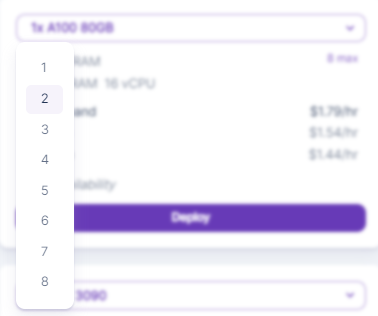
Screenshot from large LLMs tutorial

Alternatively, you can create a pod with other card configurations, such as a pod with 3 to 4 A40s which have 48GB of RAM each. However, due to the way that language inference works, you'll likely see a performance drop-off with each successive card added, as the model will be spread over multiple GPUs and have to search through the memory of each card while doing its computations, which is quite a different experience compared to the performance gain you might experience by assigning multiple GPUs to Stable Diffusion. Long story short, you're going to be better off using a couple of high-powered cards, rather than trying to use, say, eight A4000s, even if the total amount of VRAM is the same.

For some of the largest models, like BLOOMChat with its whopping 176 billion parameters, you may need to assign it even more A100s or other 80gb card offerings.  

Ensure that all the cards are being utilized

Once you have the model downloaded and set up, depending on the model type you'll want to be sure that the model actually uses all of the cards assigned to the pod. Otherwise, it may attempt to use up all the VRAM in a single card and then throw a CUDA out of memory error, even though there are perfectly serviceable cards that it may not see.

For Transformer and GPTQ models, ensure that you have the auto-devices checkbox checked under the Model tab.
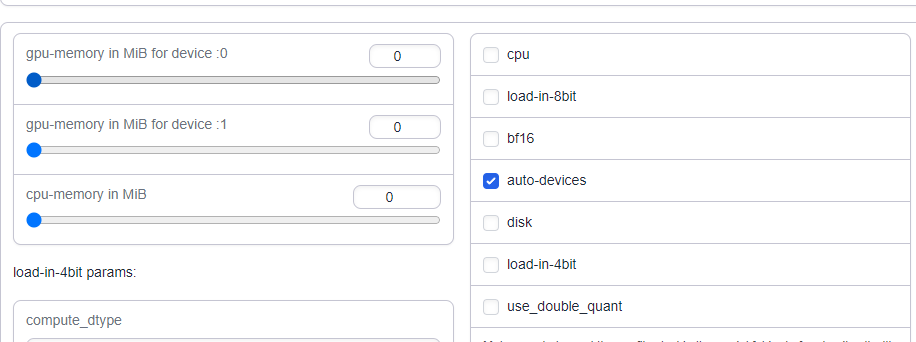
Oobabooga model settings with per-device GPU-memory sliders and the auto-devices option enabled

Oobabooga AutoGPTQ model loader options with wbits, groupsize, and auto-devices settings

For Llama models, you might need to instead manually assign the VRAM amounts under the gpu-split parameter:

Oobabooga ExLlama_HF model loader with GPU-split set to 64,64 GB of VRAM per GPU

Questions?

Feel free to reach out to us on our Discord if you have any trouble getting a model loaded!

Author profile: Brendan McKeag