


惯性聚合 高效追踪和阅读你感兴趣的博客、新闻、科技资讯
阅读原文 在惯性聚合中打开

推荐订阅源

N
News and Events Feed by Topic
爱范儿
爱范儿
Apple Machine Learning Research
博客园 - 叶小钗
Last Week in AI
Last Week in AI
博客园 - 三生石上(FineUI控件)
OSCHINA 社区最新新闻
OSCHINA 社区最新新闻
月光博客
月光博客
大猫的无限游戏
大猫的无限游戏
让小产品的独立变现更简单 - ezindie.com
博客园 - Franky
人人都是产品经理
人人都是产品经理
The Cloudflare Blog
酷 壳 – CoolShell
酷 壳 – CoolShell
博客园 - 司徒正美
罗磊的独立博客
博客园 - 聂微东
T
Troy Hunt's Blog
美团技术团队
IT之家
IT之家
A
Arctic Wolf
腾讯CDC
雷峰网
雷峰网
SecWiki News
SecWiki News
博客园_首页
L
LINUX DO - 最新话题
Cloudbric
Cloudbric
量子位
N
News and Events Feed by Topic
小众软件
小众软件
C
CXSECURITY Database RSS Feed - CXSecurity.com
Cyberwarzone
Cyberwarzone
J
Java Code Geeks
V
V2EX
cs.CL updates on arXiv.org
Latest news
Latest news
Webroot Blog
Webroot Blog
F
Fortinet All Blogs
P
Privacy International News Feed
NISL@THU
NISL@THU
Google Online Security Blog
WordPress大学
WordPress大学
PCI Perspectives
PCI Perspectives
GbyAI
GbyAI
宝玉的分享
宝玉的分享
阮一峰的网络日志
阮一峰的网络日志
S
Secure Thoughts
Simon Willison's Weblog
P
Palo Alto Networks Blog
V
Visual Studio Blog

Runpod Blog.

New Runpod datacenter now live: AP-IN-1 Track GPU spend across your team with Cost Centers The GPU supply supercycle is here. Here’s what AI builders need to know. Community Spotlight: One-click AI image and video generation on Runpod with SwarmUI | Runpod Blog Community Spotlight: LoRA Pilot Data Prep to Inference Introducing the Runpod Assistant: Manage Your Cloud GPU Resources with Natural Language OpenAI's Parameter Golf: Train the Best Language Model That Fits in 16MB on Runpod LLM inference optimization: techniques that actually reduce latency and cost Pruna P-Video and Vidu Q3 public endpoints now available on Runpod Runpod brand spelling guide Quickstart - Runpod Documentation The AI market looks nothing like the narrative Training StyleGAN3 with Vision-Aided GAN on Runpod KoboldAI – The Other Roleplay Front End, And Why You May Want to Use It How to Connect Cursor to LLM Pods on Runpod for Seamless AI Dev Community Spotlight: How AnonAI Scaled Its Private Chatbot Platform with Runpod Prompt Scheduling with Disco Diffusion on Runpod Runpod's Latest Innovation: Dockerless CLI for Streamlined AI Development Run Your Own AI from Your iPhone Using Runpod Introducing Flash: Run GPU workloads on Runpod Serverless: No Docker required Use Claude Code with your own model on Runpod: No Anthropic account required Avoid Errors by Selecting the Proper Resources for Your Pod What hackers built on Runpod at TreeHacks 2026 Easily Back Up and Restore Your Pod with Cloud Sync + Backblaze B2 The Complete Guide to GPU Requirements for LLM Fine-Tuning AI Guides, Tutorials & GPU Infrastructure Insights | Runpod Your first Claude Code project within Runpod: a complete setup guide 10 billion Serverless requests and counting Building for resilience: Runpod’s response to the AWS us-east-1 outage How to Connect Google Colab to Runpod Founder Series #1: The Runpod Origin Story AMD MI300X vs. NVIDIA H100: Mixtral 8x7B Inference Benchmark How to Run the FLUX Image Generator with ComfyUI on Runpod Run Llama 3.1 405B with Ollama on Runpod: Step-by-Step Deployment How to Run FLUX Image Generator with Runpod (No Coding Needed) How to Use 65B+ Language Models on Runpod Deploy Llama 3.1 with vLLM on Runpod Serverless: Fast, Scalable Inference in Minutes Open Source Video & LLM Roundup: The Best of What’s New Run vLLM on Runpod Serverless: Deploy Open Source LLMs in Minutes Introduction to vLLM and PagedAttention New update to Github integration: release rollback! | Runpod Blog A note to the developers who built Runpod with us Deploy ComfyUI as a Serverless API Endpoint Setting up Slurm on Runpod Clusters: A Technical Guide Building an OCR System Using Runpod Serverless From No-Code to Pro: Optimizing Mistral-7B on Runpod for Power Users Lessons While Using Generative Language and Audio For Practical Use Cases Runpod RoundUp 3 – AI Music and Stock Sound Effect Creation New Navigational Changes To Runpod UI Use alpha_value To Blast Through Context Limits in LLaMa-2 Models Runpod Roundup 5 – Visual/Language Comprehension, Code-Focused LLMs, and Bias Detection Runpod is Proud to Sponsor the StockDory Chess Engine Runpod Roundup 4 – Open Source LLM Evaluators, 3D Scene Reconstruction, Vector Search Meta and Microsoft Release Llama 2 as Open Source SuperHot 8k Token Context Models Are Here For Text Generation How to Manage Funding Your Runpod Account Encrypted Volumes on Runpod: Protect Your Data at Rest How to Run a "Hello World" on Runpod Serverless Runpod AI field notes: December 2025 Faster GitHub Builds: Major Performance Improvements to Our Automated Integration Partnering with Defined AI to Bridge the Data Wealth Gap How to Run Serverless AI and ML Workloads on Runpod How to fine-tune a model using Axolotl Transcribe and translate audio files with Faster Whisper Runpod Achieves SOC 2 Type II Certification: Continuing Our Compliance Journey Orchestrating GPU workloads on Runpod with dstack Exploring Runpod Serverless: Create Workers From Templates DeepSeek V3.1: A Technical Analysis of Key Changes from V3-0324 Deep Cogito Releases Suite of LLMs Trained with Iterative Policy Improvement Wan 2.2 Releases With a Plethora Of New Features Iterative Refinement Chains with Small Language Models The New Runpod.io: Clearer, Faster, Built for What’s Next Introducing Clusters: On-Demand Multi-Node AI Compute Run DeepSeek R1 on Just 480GB of VRAM How Do I Transfer Data Into My Runpod? Spot vs. On-Demand Instances: What’s the Difference? Deploy GitHub Repos to Runpod with One Click Run GGUF Quantized Models Easily with KoboldCPP on Runpod How to Work with GGUF Quantizations in KoboldCPP Introducing Better Forge: Spin Up Stable Diffusion Pods Faster Supercharge Your LLMs with SGLang: Boost Performance and Customization Mastering Serverless Scaling on Runpod: Optimize Performance and Reduce Costs RAG vs. Fine-Tuning: Which Is Best for Your LLM? Run Larger LLMs on Runpod Serverless Than Ever Before – Llama-3 70B (and beyond!) How to Run vLLM on Runpod Serverless (Beginner-Friendly Guide) Embracing New Beginnings: Welcoming Banana.dev Community to Runpod Stable Diffusion + ComfyUI on Runpod: Easy Setup Guide Runpod RoundUp 2 – 32k Token Context LLMs and New StabilityAI Offerings Runpod Roundup: High-Context LLMs, SDXL, and Llama 2 16k Context LLM Models Now Available On Runpod Savings Plans Are Here For Secure Cloud Pods – How To Purchase a Monthly Plan And Save Big Pygmalion-7b from PygmalionAI has been released, and it's amazing Ada Architecture Pods Are Here – How Do They Stack Up Against Ampere? Spin up a Text Generation Pod with Vicuna and Experience a GPT-4 Rival Using OpenPose to Annotate Poses Within Stable Diffusion Set Up a Chatbot with Oobabooga on Runpod Connect VSCode to Your Runpod Instance (Quick SSH Guide) Deploy a Stable Diffusion UI on Runpod in Minutes Google Colab Pro vs. Runpod: Best GPU Cloud for AI Workloads How to Run a GPU-Accelerated Virtual Desktop on Runpod
DeepSeek V4 in the wild, and how to run it on Runpod
Brendan McKeag · 2026-04-26 · via Runpod Blog.

DeepSeek's V4 preview landed on April 24, 2026 with two MoE models: V4-Pro (1.6T total / 49B active) and V4-Flash (284B / 13B active), with both shipping under MIT license with a 1M-token context window, with real-world inference costs that pound for pound undercut every frontier lab by roughly an order of magnitude. Two days in, the practitioner verdict is more interesting than the marketing. This guide walks through what people are actually doing with it, where it falls down, and exactly how to stand it up on Runpod with vLLM or SGLang.

What is DeepSeek V4?

DeepSeek V4 is a Mixture-of-Experts release with a genuinely new attention stack. DeepSeek interleaves Compressed Sparse Attention (CSA) with Heavily Compressed Attention (HCA); the first compresses the sequence 4x and uses a top-k indexer, the second compresses 128x into a dense MQA stream and a 128-token sliding window handles recency. The result: at 1M tokens, V4-Pro uses only 27% of the per-token FLOPs and 10% of the KV cache of V3.2; Flash drops those to 10% and 7%. They also replaced standard residuals with Manifold-Constrained Hyper-Connections, swapped AdamW for the Muon optimizer on most parameters, and quantization-aware-trained the MoE experts down to MXFP4 with FP8 for everything else. That's why Pro is "only" 865 GB on disk and Flash fits in 160 GB, being extremely dense for their parameter counts.

Two other facts shape every deployment decision. The API is drop-in for both OpenAI and Anthropic clients. DeepSeek explicitly publishes ANTHROPIC_BASE_URL=https://api.deepseek.com/anthropic so Claude Code can be repointed in one env var; you could simply swap out the URL of your pod if you were to host V4 on Runpod. And both models expose three reasoning modes: Non-think, Think High, and Think Max (the last requires ≥384K context).

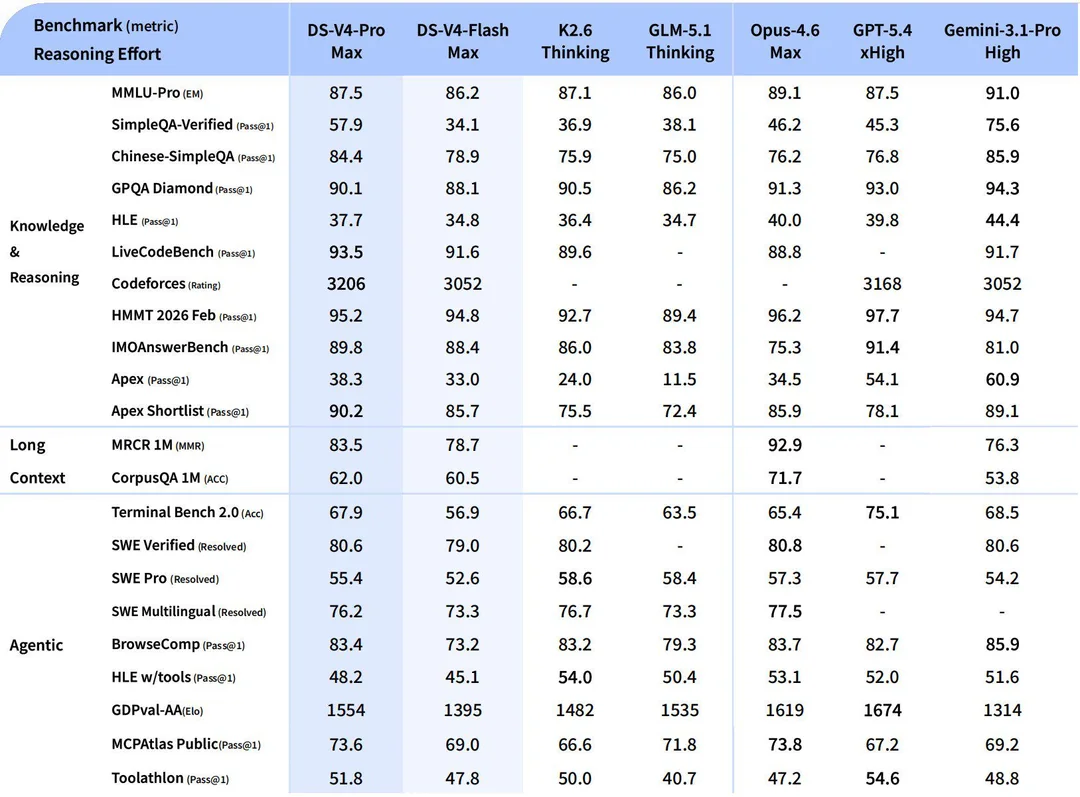
On benchmarks V4-Pro-Max matches Opus 4.6 across the board, beats it on LiveCodeBench (93.5) and Codeforces (3,206, roughly rank 23 among human contestants), and trails GPT-5.4 and Gemini 3.1 Pro on the harder reasoning evals.
__wf_reserved_inherit

Claude Code, but cheaper

The single biggest pattern in launch-week threads is teams keeping the Claude Code (or OpenCode, or OpenClaw) UX they already know and swapping inference to DeepSeek. The full migration is a five-line env block:

We've previously gone into this process on our YouTube channel; this video was released a few months ago, but the process should still hold.

Long-context document grunt work

V4-Flash is fast and cheap enough to stand in for Claude Haiku or Gemini Flash-Lite as the default model in tool-calling pipelines, especially when each call drags a long document along. On MRCR (long-context retrieval), V4-Pro topped the open-source field and beat Opus 4.7, though it does drop to 66% accuracy at the full 1M tokens, so don't confuse "supports 1M" with "reliable at 1M." Sweet spot is 128K–512K, where MRCR holds at 82–94%.

Math, formal reasoning, and competitive programming

This is where V4 quietly looks frontier-ish. V4-Pro hits 3,206 Elo on Codeforces (above Opus 4.6 and Gemini 3.1 Pro), 95.2 on HMMT 2026 February, and 89.8 on IMOAnswerBench. On formal-math benchmarks the numbers are even more striking: V4-Flash-Max scored 81.0 on Putnam-200 Pass@8, an order of magnitude above Seed-2.0-Pro and Gemini-3-Pro, and V4 reached a proof-perfect 120/120 on the Putnam-2025 hybrid setup. If you have a math tutor, theorem-proving harness, or competitive-programming evaluator, this is now the obvious open-weight choice.

Where DeepSeek V4 falls short

The biggest "flaw" (if you want to call it that) is that V4, at least for now, is not a multimodal model; it is text only, and compared to what Gemini, Opus, etc. are able to accomplish that can definitely be inconvenient. However, it's also a problem that can easily be worked around by adding something like a Qwen3-VL model to be called as needed, which is commonly used in a lot of ComfyUI workflows now regardless.

The bigger long-term concern comes from skeptic Mehul Gupta: V4 "stacks techniques to fix scaling limits of earlier techniques ... mHC plus hybrid CSA+HCA plus FP4/FP8 mixed precision all at once, and "Think Max improves scores, but not consistently across tasks." This could be seen as something of a bandaid instead of a robust iteration to correct previous flaws. However, as usual, treat the preview label literally; expect behavior to shift before the final release.

V4-Flash is the practical self-hosting target; its 160 GB FP4+FP8 footprint fits on two H200s with room for KV cache, and decode latency is competitive. V4-Pro is cluster work; the official vLLM recipe wants ~960 GB of mixed-precision footprint, and you'll either fill an 8-GPU H200 or B300 pod or you'll need to step up to a multi-node Cluster.

The engine choice is simple in 2026: pick vLLM or SGLang. Both shipped Day-0 official recipes for V4 with native CSA+HCA support, FP4 MoE backends, MTP speculative decoding, and disaggregated prefill/decode.TGI has no V4 support at preview; Ollama and llama.cpp have unverified community GGUFs only at the moment.

For most teams running V4-Flash, two H200 SXM in a single pod (~$7.18/hr) is the sweet spot — 282 GB of HBM3e fits the model plus comfortable KV for 256K context. If you need full 1M context or high QPS, scale to 8× H200 (~$28.7/hr) and use the disaggregated prefill/decode recipe. For V4-Pro, 8× HGX B300 (~$55.5/hr) is the cleanest single-node deployment — native FP4 execution, full 1M context, no model-len cap. Eight H200s ($28.7/hr) works for V4-Pro if you cap --max-model-len at 800K. Full 1M context on V4-Pro requires a two-node H200 Cluster (~$69/hr).

Here are some templates you can use to get started:

Conclusion

The V4 preview is not a frontier-shifting release in the way R1 was; it doesn't beat GPT-5.5, doesn't beat Opus 4.7, and trails Gemini 3.1 Pro on world knowledge. But that misses the point. V4 is the model that drops the floor of what frontier-adjacent intelligence costs by roughly an order of magnitude, ships open weights under MIT, and slots cleanly into the Claude Code and OpenCode harnesses developers are already using. The practical result is a small handful of workflows like repo-scale code review with prompt caching, long-context document pipelines, formal-math reasoning, and Claude Code redirected at $0.28/M output that simply weren't economical at frontier-lab pricing and are now obvious choices.

For Runpod users, the deployment story is unusually clean for a Day-1 release: Day-0 vLLM and SGLang recipes, LMSYS Org native FP4 MoE on Blackwell, and a sweet-spot configuration (2x H200 for Flash) that runs about $7/hr. The tradeoff to be honest about: V4 is a preview, the long-context retrieval ceiling at 1M is 66% not 99%, and "interleaved thinking across tool calls" is new enough that subtle behavior changes between now and the final release are likely. Treat it as a serious production candidate for the use cases above and a close-to-frontier evaluation target for everything else, and let your next inference invoice settle the rest of the argument.

Author profile: Brendan McKeag