

惯性聚合 高效追踪和阅读你感兴趣的博客、新闻、科技资讯
阅读原文 在惯性聚合中打开

推荐订阅源

Apple Machine Learning Research
Recent Announcements
IT之家
IT之家
人人都是产品经理
人人都是产品经理
G
Google Developers Blog
Microsoft Azure Blog
博客园_首页
大猫的无限游戏
大猫的无限游戏
U
Unit 42
罗磊的独立博客
博客园 - Franky
WordPress大学
WordPress大学
CTFtime.org: upcoming CTF events
M
MIT News - Artificial intelligence
SecWiki News
SecWiki News
V
Vulnerabilities – Threatpost
P
Privacy International News Feed
P
Palo Alto Networks Blog
F
Fortinet All Blogs
P
Proofpoint News Feed
博客园 - 叶小钗
C
CERT Recently Published Vulnerability Notes
T
Tor Project blog
Spread Privacy
Spread Privacy
S
Securelist
C
Cisco Blogs
I
Intezer
D
Darknet – Hacking Tools, Hacker News & Cyber Security
Cyberwarzone
Cyberwarzone
钛媒体:引领未来商业与生活新知
钛媒体:引领未来商业与生活新知
P
Privacy & Cybersecurity Law Blog
宝玉的分享
宝玉的分享
OSCHINA 社区最新新闻
OSCHINA 社区最新新闻
Engineering at Meta
Engineering at Meta
S
Schneier on Security
C
CXSECURITY Database RSS Feed - CXSecurity.com
GbyAI
GbyAI
T
Troy Hunt's Blog
T
Threatpost
博客园 - 司徒正美
Y
Y Combinator Blog
Hugging Face - Blog
Hugging Face - Blog
AWS News Blog
AWS News Blog
T
The Blog of Author Tim Ferriss
G
GRAHAM CLULEY
N
Netflix TechBlog - Medium
酷 壳 – CoolShell
酷 壳 – CoolShell
Google DeepMind News
Know Your Adversary
Know Your Adversary
S
SegmentFault 最新的问题

Runpod Blog.

DeepSeek V4 in the wild, and how to run it on Runpod New Runpod datacenter now live: AP-IN-1 Track GPU spend across your team with Cost Centers The GPU supply supercycle is here. Here’s what AI builders need to know. Community Spotlight: One-click AI image and video generation on Runpod with SwarmUI | Runpod Blog Community Spotlight: LoRA Pilot Data Prep to Inference Introducing the Runpod Assistant: Manage Your Cloud GPU Resources with Natural Language OpenAI's Parameter Golf: Train the Best Language Model That Fits in 16MB on Runpod LLM inference optimization: techniques that actually reduce latency and cost Pruna P-Video and Vidu Q3 public endpoints now available on Runpod Runpod brand spelling guide Quickstart - Runpod Documentation The AI market looks nothing like the narrative Training StyleGAN3 with Vision-Aided GAN on Runpod KoboldAI – The Other Roleplay Front End, And Why You May Want to Use It Community Spotlight: How AnonAI Scaled Its Private Chatbot Platform with Runpod Prompt Scheduling with Disco Diffusion on Runpod Runpod's Latest Innovation: Dockerless CLI for Streamlined AI Development Run Your Own AI from Your iPhone Using Runpod Introducing Flash: Run GPU workloads on Runpod Serverless: No Docker required Use Claude Code with your own model on Runpod: No Anthropic account required Avoid Errors by Selecting the Proper Resources for Your Pod What hackers built on Runpod at TreeHacks 2026 Easily Back Up and Restore Your Pod with Cloud Sync + Backblaze B2 The Complete Guide to GPU Requirements for LLM Fine-Tuning AI Guides, Tutorials & GPU Infrastructure Insights | Runpod Your first Claude Code project within Runpod: a complete setup guide 10 billion Serverless requests and counting Building for resilience: Runpod’s response to the AWS us-east-1 outage How to Connect Google Colab to Runpod Founder Series #1: The Runpod Origin Story AMD MI300X vs. NVIDIA H100: Mixtral 8x7B Inference Benchmark How to Run the FLUX Image Generator with ComfyUI on Runpod Run Llama 3.1 405B with Ollama on Runpod: Step-by-Step Deployment How to Run FLUX Image Generator with Runpod (No Coding Needed) How to Use 65B+ Language Models on Runpod Deploy Llama 3.1 with vLLM on Runpod Serverless: Fast, Scalable Inference in Minutes Open Source Video & LLM Roundup: The Best of What’s New Run vLLM on Runpod Serverless: Deploy Open Source LLMs in Minutes Introduction to vLLM and PagedAttention New update to Github integration: release rollback! | Runpod Blog A note to the developers who built Runpod with us Deploy ComfyUI as a Serverless API Endpoint Setting up Slurm on Runpod Clusters: A Technical Guide Building an OCR System Using Runpod Serverless From No-Code to Pro: Optimizing Mistral-7B on Runpod for Power Users Lessons While Using Generative Language and Audio For Practical Use Cases Runpod RoundUp 3 – AI Music and Stock Sound Effect Creation New Navigational Changes To Runpod UI Use alpha_value To Blast Through Context Limits in LLaMa-2 Models Runpod Roundup 5 – Visual/Language Comprehension, Code-Focused LLMs, and Bias Detection Runpod is Proud to Sponsor the StockDory Chess Engine Runpod Roundup 4 – Open Source LLM Evaluators, 3D Scene Reconstruction, Vector Search Meta and Microsoft Release Llama 2 as Open Source SuperHot 8k Token Context Models Are Here For Text Generation How to Manage Funding Your Runpod Account Encrypted Volumes on Runpod: Protect Your Data at Rest How to Run a "Hello World" on Runpod Serverless Runpod AI field notes: December 2025 Faster GitHub Builds: Major Performance Improvements to Our Automated Integration Partnering with Defined AI to Bridge the Data Wealth Gap How to Run Serverless AI and ML Workloads on Runpod How to fine-tune a model using Axolotl Transcribe and translate audio files with Faster Whisper Runpod Achieves SOC 2 Type II Certification: Continuing Our Compliance Journey Orchestrating GPU workloads on Runpod with dstack Exploring Runpod Serverless: Create Workers From Templates DeepSeek V3.1: A Technical Analysis of Key Changes from V3-0324 Deep Cogito Releases Suite of LLMs Trained with Iterative Policy Improvement Wan 2.2 Releases With a Plethora Of New Features Iterative Refinement Chains with Small Language Models The New Runpod.io: Clearer, Faster, Built for What’s Next Introducing Clusters: On-Demand Multi-Node AI Compute Run DeepSeek R1 on Just 480GB of VRAM How Do I Transfer Data Into My Runpod? Spot vs. On-Demand Instances: What’s the Difference? Deploy GitHub Repos to Runpod with One Click Run GGUF Quantized Models Easily with KoboldCPP on Runpod How to Work with GGUF Quantizations in KoboldCPP Introducing Better Forge: Spin Up Stable Diffusion Pods Faster Supercharge Your LLMs with SGLang: Boost Performance and Customization Mastering Serverless Scaling on Runpod: Optimize Performance and Reduce Costs RAG vs. Fine-Tuning: Which Is Best for Your LLM? Run Larger LLMs on Runpod Serverless Than Ever Before – Llama-3 70B (and beyond!) How to Run vLLM on Runpod Serverless (Beginner-Friendly Guide) Embracing New Beginnings: Welcoming Banana.dev Community to Runpod Stable Diffusion + ComfyUI on Runpod: Easy Setup Guide Runpod RoundUp 2 – 32k Token Context LLMs and New StabilityAI Offerings Runpod Roundup: High-Context LLMs, SDXL, and Llama 2 16k Context LLM Models Now Available On Runpod Savings Plans Are Here For Secure Cloud Pods – How To Purchase a Monthly Plan And Save Big Pygmalion-7b from PygmalionAI has been released, and it's amazing Ada Architecture Pods Are Here – How Do They Stack Up Against Ampere? Spin up a Text Generation Pod with Vicuna and Experience a GPT-4 Rival Using OpenPose to Annotate Poses Within Stable Diffusion Set Up a Chatbot with Oobabooga on Runpod Connect VSCode to Your Runpod Instance (Quick SSH Guide) Deploy a Stable Diffusion UI on Runpod in Minutes Google Colab Pro vs. Runpod: Best GPU Cloud for AI Workloads How to Run a GPU-Accelerated Virtual Desktop on Runpod
How to Connect Cursor to LLM Pods on Runpod for Seamless AI Dev
Brendan McKeag · 2026-03-11 · via Runpod Blog.

In this comprehensive walkthrough, we'll show you how to set up and configure Cursor AI to connect to a Large Language Model (LLM) running on Runpod. This setup gives you the power of high-performance GPUs for your AI-assisted coding while maintaining the familiar Cursor interface. Not only that, but you'll be able to maintain complete privacy with your data, keeping it entirely on the Runpod platform in a controlled, secure network environment - no concerns about 'free' APIs quietly scraping and training on the potentially sensitive information you send their way.

Model Context Protocol

MCP provides an excellent way to extend Cursor's context and functionality, making it aware of your specific data and workflows. We've written about this before - though there is an important clarification to make.

While MCP servers can run securely on Runpod, the underlying LLM processing your code and queries in that setup can still occur through external providers like OpenAI or Anthropic. For organizations and developers who require complete data privacy—ensuring that no code, comments, or context ever leaves their controlled infrastructure—hosting the LLMs themselves on Runpod is essential. This approach guarantees that your intellectual property, sensitive algorithms, and proprietary code remain entirely within your own computing environment. MCP is an incredibly useful framework, but it is still just a framework - for privacy-conscious developers, you'll need to also host the model in a controlled environment and that's where also setting up a pod to host the model itself comes in.

Installing and Configuring Your LLM In a Pod

We have an handy guide on setting up text-generation-webui (oobabooga) on how to download and run an LLM within a convenient UI. This is an extremely quick way to get a model up and running so you can begin tinkering ASAP. Although the GUI and extra features may add some overhead, if you want to test out your connection or work in Cursor, as a single user there is definitely something to be said for this option's simplicity. If you need instructions on how to set up the pod, check out the enclosed guide.

Once the pod is up and running, obtain the URL that the API is running. This is port 5000 on our official template and most community templates.
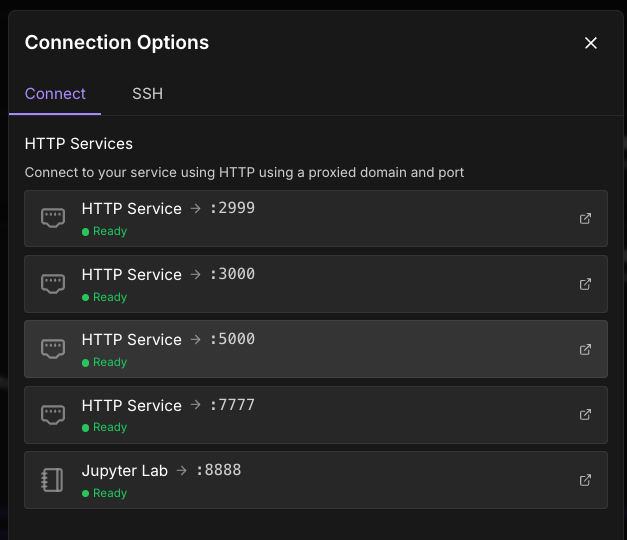
Runpod connection options listing HTTP services on several ports and Jupyter Lab on port 8888

The format for the URL is https://[pod ID]-port].proxy.runpod.net, but if you want a URL to copy and paste going forward you can just click on port 5000 and copy and paste the URL that pops up - in this case, https://im049ethtsiqgb-5000.proxy.runpod.net/

You can then go to Settings -> Cursor Settings -> Models and under OpenAI API Key, enter the proxy URL with /v1 added to the end - e.g. https://u7bkoxnnl0va98-5000.proxy.runpod.net/v1 (no trailing slash - this is important.)
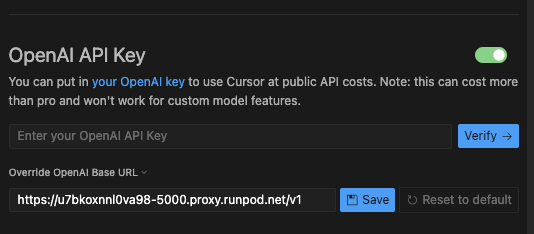
Cursor OpenAI API key settings with the base URL overridden to a Runpod proxy endpoint

You can then ask Cursor a Hello World question under Ask to verify the connection is working.
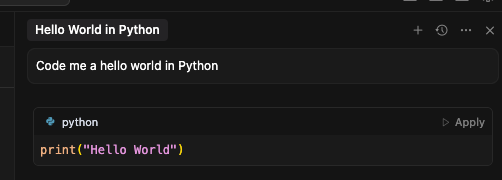
Cursor chat answering a hello world prompt with the Python code print("Hello World")

If you'd prefer to use a GGUF model, you can also use kobold.cpp in the same way, and we have a guide for that. Quantizations allow you to use a much larger model in the same GPU spec for a pretty manageable performance (perplexity) hit, so if you're experimenting with larger models this may be something you want to explore.

Troubleshooting Common Issues

Connection Problems

If you're experiencing connection timeouts, first ensure your pod is active, and that that the URL format provided to Cursor ncludes /v1 but has no trailing slash, and check that the proper port (again, usually 5000) is properly exposed in your pod configuration. If you've used one of our community templates, all the ports should be automatically exposed, but if you are experimenting with setting up your own server remember to expose the HTTP ports in the pod configuration.

Model Loading Difficulties

When encountering model loading errors, confirm that your chosen model fits within your GPU's VRAM limits. Larger models require more memory and take longer to initialize, so allow extra time for the loading process to complete. Monitor your pod's logs through the Runpod interface for specific error messages that can help diagnose the issue.

Performance Concerns

If you're experiencing slow response times, consider switching to quantized models in GGUF format to reduce memory usage and improve inference speed. Alternatively, upgrading to a higher-tier GPU can significantly improve performance. Experiment with different model sizes to find the right balance between capability and speed for your specific use case.

Security and Privacy Benefits

By hosting your LLM on Runpod, you achieve complete data isolation where your code never leaves your controlled infrastructure. All traffic remains within Runpod's secure environment, providing network security that's superior to cloud-based API services. You maintain a full audit trail with complete visibility into where your data is processed, making it easier to meet regulatory requirements for sensitive codebases. This approach is particularly compliance-friendly for organizations operating under strict data governance policies.

Start Up an LLM Pod on Runpod Today

Conclusion

Running LLMs on Runpod pods provides the perfect balance of performance, privacy, and cost-effectiveness for AI-assisted development. Whether you're a solo developer working on sensitive projects or part of an organization with strict data governance requirements, this setup ensures your code remains private while still leveraging the power of modern AI assistance.

The initial setup investment pays dividends in both peace of mind and performance, giving you complete control over your development AI stack. Start with the Text Generation WebUI approach to get familiar with the workflow, then explore more advanced configurations as your needs evolve.

Ready to get started? Deploy your first Runpod instance and experience truly private AI-assisted coding with Cursor.

Author profile: Brendan McKeag