






It’s ironic that the man who invented the word metaverse describes himself as a “sociomediapath.” While never explicitly defined, its etymology and Neal Stephenson’s article tracing its shadow make it clear: He has anti-social media tendencies, but is present and active there nonetheless, putting forth a facade of participation for self promotion.
“Somewhat perversely, using social media has now become part of a novelist's job,” he observed a full decade before BookTok earned itself a Wikipedia entry. “I should devote as many of my waking hours as possible to doing what I'm good at, and to minimize time spent reading comment threads and viewing pictures of other people's cats.” So, like a character in one of his books, Stephenson hacked together a system to support his sociomediapathy.
When he publishes a newsletter, a software deliverator posts it wherever he wants. “I'm rigging up a way to do automated cross-posting…Some people find this off-putting, but it's the best way for me to make this work.” For the 94,000 people on X and 70,000 on Facebook who follow him, it isn’t off-putting at all. It’s a publishing workflow that frees Stephenson up to finish more books (what fans want most) without forcing him into wholesale luddism.
The source of The Feed
Every workflow needs a catalyst, a falling domino that hits the next in line. In a publishing context, it might be an article added to your blog, a newsletter sent to your list, or a social media post to your profile. Pick the medium you most enjoy working on and build out from there.

If a blog is your favorite place to write, for example, focus entirely on that with an RSS-to-email automation that converts new articles into newsletters. WordPress, Wix, Medium, Squarespace, and most other website builders provide built-in RSS support. Find your blog’s RSS feed URL, connect it to your newsletter, and publish on your blog consistently to hit your preferred newsletter cadence (just remember to add newsletter signup forms to your website!).
Next, you’d automate cross-posting from the blog or newsletter to social media platforms that allow it. Any time something is published, integrations would immediately share it to places like Discord, Bluesky, Mastodon, Medium, and LinkedIn. For walled-garden platforms like Instagram, Facebook, Threads, and X, social media automation app Buffer has a free plan that automatically converts blogs and newsletters into new social-friendly posts and then posts them to up to three platforms, with zero input from you.
“Consistency matters over individual posts taking off,” notes self-published author Marie Violet. “I cross-post all my content (i.e. it's the same for both Tiktok and Instagram) and I reuse templates and content ideas all the time to make it easier.” Her posts seldom break 1,000 views but “it hasn't stopped me from finding readers, some who have become my most vocal supporters…The vast majority of my ARC readers came from [social media], and my engagement has drastically ramped up now they're reading their ARCs.”
Or, if you enjoy writing specifically for social media, you could flip the whole process on its head, starting there and automating everything that comes after.
Avocation into inspiration
Former Microsoft exec Steven Sinofsky is known for short, thought-provoking tweets on tech leadership. Later, he’ll collect a handful that are related, drop them into a blank document, and go one by one expanding each missive into more detail until he has a longform article.
James Clear uses a similar strategy. “He wants to know how to package the ideas in his book so that people will pay attention to them…He uses Twitter as a tool to throw compressed versions of his ideas out into the world to see what sticks,” according to an interview with the author of Atomic Habits. “His process is all about figuring out where his readers currently are—what resonates with them, what they care about—and bringing them where he wants them to go.”
These are different kinds of escape hatches than Stephenson’s sociomediapathic tendencies. Sinofsky’s is breaking free from the tyranny of blank pages and Clear’s from wasted time on conjectural ideas. Regardless of which strikes your fancy, having a less “efficient” publishing workflow is always going to be better than having no workflow at all.
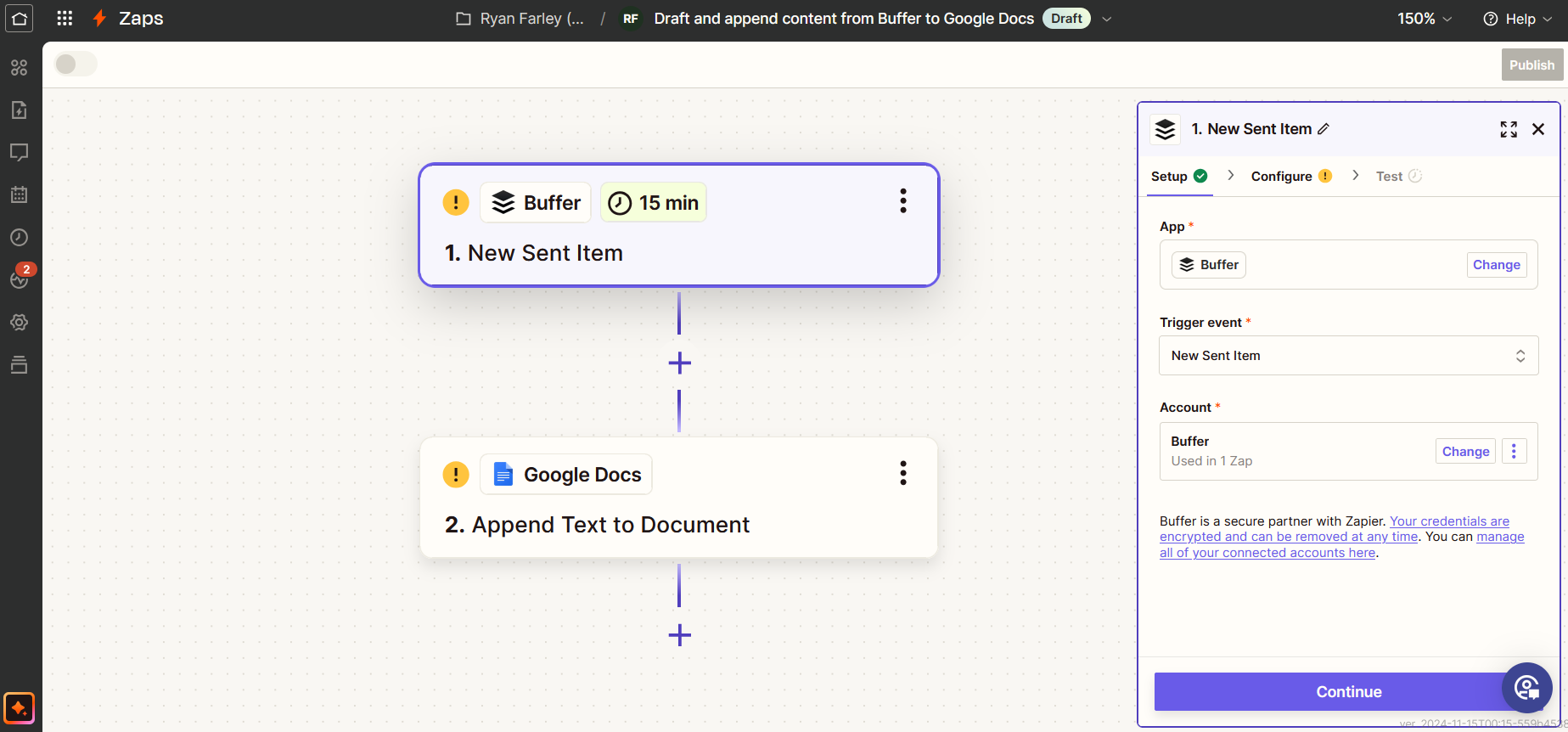
This time, the first domino would be something you write for social media that integrations and/or Buffer pushes to all of your profiles. Then, with the help of a service like Zapier or IFTTT, you’d collect all of your posts–from all channels–into a single document. The trigger would be any New Sent Item and the action would be Append Text to Document. Every week or two, you’d open the doc and start connecting the dots between popular posts, expanding individual ideas into a single coherent overview. You could even publish without leaving the editor.
You could, for example, create a zap that turns an email into a new WordPress post. Or use your newsletter’s magic email address to convert the document into a newsletter simply by clicking Email from the File menu, complete with embedded tweets. That would get you as close as possible to a frictionless version of Sinofsky’s uber-popular Writing is Thinking article.
Social media platforms (and social media automation platforms) shutter all the time. The tweets referenced in Writing is Thinking, for instance, are nowhere to be found except for Sinofsky’s article. So at the very least, collecting them in a doc after posting them creates a backup for posterity. It doesn’t hurt that a bird's eye view of everything you’ve shared is also a tremendous help when brainstorming new topics and ideas to write about.
Build a reliable, sustainable publishing workflow. It doesn’t matter whether it starts with social media, finishes there, or keeps you off of social media entirely, as long as it helps you spend more time on the writing you love.
Sociomediapathy over reclusiveness
In another post from Stephenson’s website, he chides the off-the-grid author. “Authors are participants in a kind of colloquy that joins together all literate persons, and so it seems only reasonable that they should from time to time stop writing fiction for a few hours or days, and attend public events, such as conventions, signings, panels, seminars, etc., where they should exchange ideas with other authors and with other members of society.” But in the same breath, he reiterates that productivity is non-linear.
Another hour added to the end of a three-hour writing session will always be more productive than a standalone hour on self-promotion. So make every second count.
Cut anything out of your publishing workflow that is little more than copying and pasting. Anything that is rephrasing what’s already written. Anything that is showing up merely to check off a box.
Computers can do those things for you.
Header image uploaded to Wikipedia via Cmichel67.