


惯性聚合 高效追踪和阅读你感兴趣的博客、新闻、科技资讯
阅读原文 在惯性聚合中打开

推荐订阅源

博客园 - 三生石上(FineUI控件)
G
Google Developers Blog
Vercel News
Vercel News
Cyber Security Advisories - MS-ISAC
N
Netflix TechBlog - Medium
奇客Solidot–传递最新科技情报
奇客Solidot–传递最新科技情报
钛媒体:引领未来商业与生活新知
钛媒体:引领未来商业与生活新知
Engineering at Meta
Engineering at Meta
B
Blog
博客园_首页
量子位
博客园 - 叶小钗
L
LangChain Blog
T
The Blog of Author Tim Ferriss
云风的 BLOG
云风的 BLOG
Blog — PlanetScale
Blog — PlanetScale
F
Fortinet All Blogs
S
SegmentFault 最新的问题
宝玉的分享
宝玉的分享
D
DataBreaches.Net
雷峰网
雷峰网
The Cloudflare Blog
freeCodeCamp Programming Tutorials: Python, JavaScript, Git & More
Threat Intelligence Blog | Flashpoint
Last Week in AI
Last Week in AI
P
Proofpoint News Feed
TaoSecurity Blog
TaoSecurity Blog
罗磊的独立博客
MongoDB | Blog
MongoDB | Blog
The GitHub Blog
The GitHub Blog
I
Intezer
H
Help Net Security
The Hacker News
The Hacker News
The Register - Security
cs.CL updates on arXiv.org
AWS News Blog
AWS News Blog
V
V2EX
Microsoft Security Blog
T
Tenable Blog
Spread Privacy
Spread Privacy
A
Arctic Wolf
P
Proofpoint News Feed
T
Threat Research - Cisco Blogs
Schneier on Security
C
CERT Recently Published Vulnerability Notes
让小产品的独立变现更简单 - ezindie.com
The Last Watchdog
The Last Watchdog
Latest news
Latest news
T
Troy Hunt's Blog
L
LINUX DO - 热门话题

Catchpoint Blog

SRE Report: AI optimism and the economics of effort SRE Report: Why fast is what users trust SRE Report 2026: What surprised us, what didn't, and why the gaps matter most The SRE Report 2026: Defensible Ns Why Synthetic Tracing Delivers Better Data, Not Just More Data A New Chapter: LogicMonitor + Catchpoint – A Personal Note from Mehdi Mezmo + Catchpoint deliver observability SREs can rely on The four pillars holding up your digital business, and what happens when they crumble When payments pause: lessons from a global payments outage Observability 2025 Decoded: What the DZone Report Means for SLO-Driven Ops The next evolution of WebPageTest has arrived, and it’s a game-changer The Monitoring Blind Spot That Could Cost You Black Friday Powering Mexico’s Digital Future: Expanded Internet Observability with Catchpoint The Next Chapter of WebPageTest: Your New Experience Starts Soon When BGP becomes UX: The inside story of a SaaS routing decision gone wrong (or right) Session Replay explained: A guide to seeing digital experience through your user’s eyes Making the invisible visible: Are your cloud firewalls and DDoS protection really working? Why it’s time to move beyond APM: Monitoring from the user’s perspective When metrics mislead: Inside the 2025 Retail Web Performance Benchmark The vendor trap: why your next outage won’t be your fault—but will be your problem LLMs don’t stand still: How to monitor and trust the models powering your AI Semantic Caching: What We Measured, Why It Matters The Annual SRE Survey Is Open—We Want to Hear from You Observability isn’t about the tool. It’s about the truth Invisible dependencies, visible impact: Lessons from the Google Cloud outage Real-time detection of BGP blackholing and prefix hijacks Leading analyst firm reveals the real cost of internet disruptions The Power of Over 3000 Intelligent Observability Agents Monitoring in the Age of Complexity: 5 Assumptions CIOs Need to Rethink Why Intelligent Traffic Steering is Critical for Performance and Cost Optimization Retail digital performance event recap: Key insights from IBM & Catchpoint Zendesk outage: A case for proactive monitoring and faster incident response Silence during chaos: Why the X outage is a call to arms for proactive monitoring The $1 Million Lesson: Building a Culture of Quality Through SLAs When AI tools fail: How to map your AI dependencies for proactive visibility Why Super Bowl 2025 was a triumph for Internet Resilience Why Internet Performance Monitoring is the new health check for IT organizations Why use Playwright in Catchpoint for synthetic monitoring Introducing WebPageTest Expert Plan: Real-Time Insights, Synthetic + RUM together in One Platform The shift to digital: How businesses are reshaping their priorities for 2025 The SRE Report 2025's Call to Action Monitoring in the Age of the Internet: DEM, IPM, and APM—What You Need to Know SSL Monitoring, Trust, and McLOVIN Performing for the holidays: Look beyond uptime for season sales success Lessons from Microsoft’s office 365 Outage: The Importance of third-party monitoring Web Performance Experts Look into the Future of Web Performance The hidden challenges of Internet Resilience: Key insights from 2024 report When SSL Issues aren’t just about SSL: A deep dive into the TIBCO Mashery outage The curious case of Marriott and the untold impact of web performance on revenue Preparing for the unexpected: Lessons from the AJIO and Jio Outage It’s time to stop neglecting the elephant in the room: Performance Matters! The Need for Speed: Highlights from IBM and Catchpoint’s Global DNS Performance Study Learnings from ServiceNow’s Proactive Response to a Network Breakdown Webinar Recap: Taking Web Performance to the Next Level Use the Catchpoint Terraform Provider in your CI/CD workflows Is the Internet ready for L4S? Takeaways from the CrowdStrike outage: third-parties can pose risk July 19th global IT outage reminds us of digital complexity 5 Actions you can take to improve digital performance 2024: A banner year for Internet Resilience APM vs Observability: Both-and, not either-or AppAssure: Ensuring the resilience of your Tier-1 applications just became easier APM vs observability: why your definitions are broken APM vs Observability: What comes next? APM vs Observability: Observing beyond APM Achieving stability with agility in your CI/CD pipeline AWS Outage: How do you prepare for the failure of your own safety net? Agentic AI: Powerful But Fragile—What You Need to Know Catch frustration before it costs you: New tools for a better user experience Catchpoint Expands Observability Network to Barcelona: A Growing Internet Hub Catchpoint Peak Performance Summit 2025: Redefining Observability for the Outcome Economy Catchpoint named a leader in the 2024 Gartner® Magic Quadrant™ for Digital Experience Monitoring Consolidation and Modernization in Enterprise Observability Connected Devices: Unlocking the next frontier of Internet Performance Monitoring Cloud Monitoring's Blind Spot: The User Perspective Cloudflare’s Resolver Outage: More Than Just DNS Cloudflare outage: another wake-up call for resilience planning Demystifying API Monitoring and Testing with IPM Creating the IPM Category: Catchpoint’s Journey to Leadership and the LogicMonitor Era Critical Requirements for Modern API Monitoring Customer Survey 2024: Unveiling insights and impact Did Delta's slow web performance signal trouble before CrowdStrike? Diagnosing Wi-Fi failures that traditional tools miss: a case study DNS misconfiguration can happen to anyone - the question is how fast can you detect it? ECN explained: Navigate congestion for faster, smoother data delivery Don’t get caught in the dark: Lessons from a Lumen & AWS micro-outage Escalating risk, shrinking margins: The 2025 Internet Resilience Report From refresh to results: the metrics that shaped Election Day 2024 coverage Fast and furious: The importance of performance in the digital age Getting Started with Traceroute From the source to the edge: the six agent types you can’t ignore From SEO to AEO: Why Web Performance Is the Key to AI Search Success Going for gold: Testing the resilience of Olympic websites Here’s the proof: What the fastest sites on the web have in common Google’s Agent-to-Agent (A2A) Protocol is here—Now Let’s Make it Observable How IPM helped a top tech brand catch an OpenAI outage before it became a crisis How AI Turns Monitoring From “What Now?” Into “What’s Next?” How SAP achieved world-class uptime through modern observability How to Monitor AI Agents in Commerce Systems
SRE Report Retrospectives — Have AIOps Predictions Held Up?
2025-10-07 · via Catchpoint Blog

in this blog post

Welcome to a new blog series where we take a candid look at the predictions, insights, and bold claims we've made in previous SRE Reports and ask the uncomfortable question: How did we do?

For the uninitiated, Catchpoint's SRE Report is our annual, practitioner-driven effort to capture the pulse of the global reliability community. Each year, we survey SREs, reliability engineers, and operations leaders worldwide to understand the current state of our profession, including the challenges we face, the tools we use, and the trends shaping our work. The reports serve as both a snapshot of where we are and a compass for where we're heading.

But here's the thing about predictions: they have this pesky habit of aging poorly. Technology evolves, markets shift, and what seemed revolutionary three years ago might be gathering dust in the corner of someone's Kubernetes cluster today. So we thought it would be fascinating, and perhaps a little humbling, to revisit our past claims and see how they've held up against the brutal reality of production environments.

First up in this retrospective series: AIOps. Buckle up, because this journey is equal parts vindication and "well, that didn't age well."

AIOps: The Promise That Wouldn't Die

Let's start with a bit of history. The term "AIOps" was coined by Gartner in 2017, defined as the application of artificial intelligence and machine learning to enhance IT operations through big data, analytics, and automation. Gartner positioned it as the future of IT operations—a way to handle the exponential growth in data volume, velocity, and variety that traditional monitoring tools simply couldn't manage.

The promise was intoxicating: imagine AI systems that could automatically detect anomalies, correlate events across your entire stack, predict failures before they happened, and even remediate issues without human intervention. It sounded like the holy grail of operations—finally, we could move from reactive firefighting to proactive, intelligent infrastructure management.

What we said then: the SRE Report take on AIOps

A colorful background with circles and textAI-generated content may be incorrect.

Our 2021 SRE Report gave AIOps significant attention, reflecting the industry enthusiasm we were seeing everywhere. The potential was undeniable. AIOps promised to help us manage increasing data volumes and extract actionable insights that could transform how we approached monitoring and incident response.

But while the industry was buzzing with excitement, our survey respondents told a different story. Real-world adoption among SREs was surprisingly slow. The gap between promise and practice was... significant.
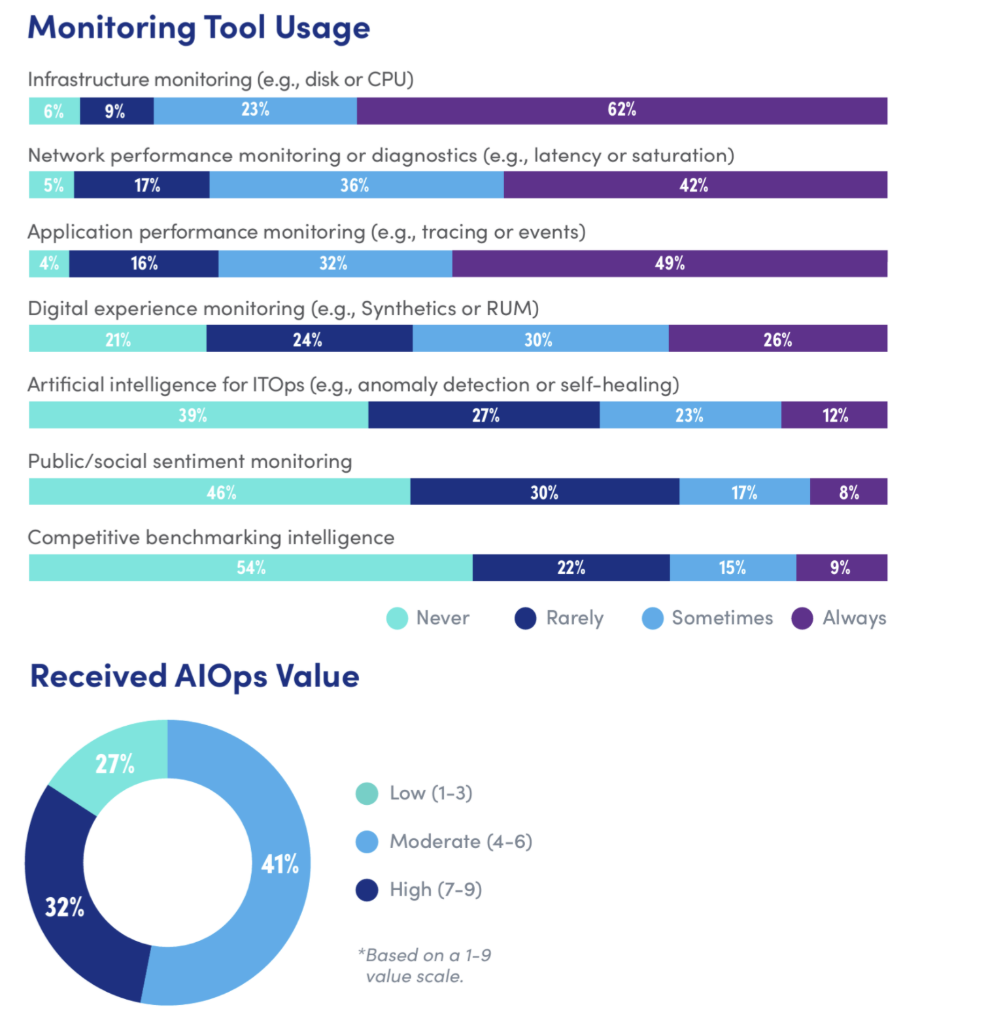
Monitoring tool usage: The SRE Report 2021

Our recommendation then was pragmatic: break down AIOps into individual components rather than chasing the buzzword. Don't buy into the hype wholesale. Instead, evaluate specific capabilities like anomaly detection, event correlation, or automated remediation on their own merits. We also emphasized the need for AI and ML training within SRE teams, positioning this as a long-term investment rather than a quick fix.
2023: The Plot Thickens

A group of men sitting at a tableAI-generated content may be incorrect.

The SRE Report 2023

By the time our 2023 SRE Report rolled around, we had a year of additional data to work with. We asked respondents to rate the "value received" from AIOps for a second year running, and the results were... illuminating.

The majority of reliability practitioners continued to report that the value they received from AIOps was low or nonexistent. But when we broke down responses by organizational level, a fascinating pattern emerged. 59% of executives said they received moderate or high value from AIOps, while only 20% of individual practitioners said the same.

Read that again. Let it sink in.
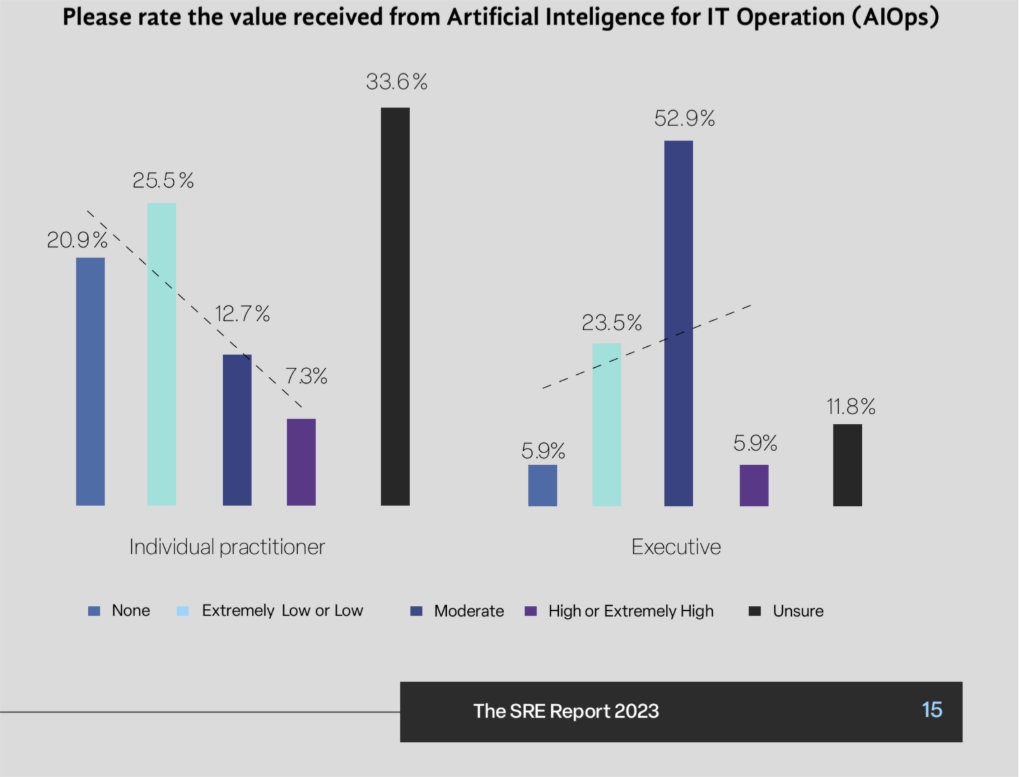
Value received from AIOps: The SRE Report 2023

We had a classic case of the people making the purchasing decisions seeing tremendous value, while the people actually using the tools in production were largely unimpressed. The gap in perception between leadership and practitioners was huge!

Our advice remained consistent: don't ignore AIOps entirely, but decompose it into specific capabilities that meaningfully support your observability and reliability operations. Focus on pragmatic use cases, not vendor promises.

2024-2025: The pivot

In 2024 we broadened our survey questions from "AIOps specifically" to "AI in general," adding qualifiers about expectations "within the next two years." This shift reflected the rapidly evolving AI landscape and the rise of generative AI.

As one of our field contributors noted: "It's hard to know whether this is another AI hype cycle or an intensification of the previous one, but it feels like there is something genuinely different between the (rather short on detail) promotion of AIOps, and what's happening with GenAI."

The distinction was crucial: traditional AIOps remained narrowly focused on anomaly detection and analysis within existing command-and-control frameworks—essentially "business-as-usual, with go-faster stripes." GenAI, however, represented something fundamentally different: "more like dealing with a very early-stage co-worker, who needs training and investment and constant review, but can occasionally be really valuable."

That was then, this is now: the Google Trends reality check

So that was our take from the SRE trenches. But how do you actually measure adoption of something like AIOps in the broader market? It's crude, but you could do worse than looking at Google search trend data.

Why Google Trends? Two compelling reasons:

  • First, it tracks real search interest, not just hype. Google Trends shows how many people are actively searching for information on a topic, a direct window into what the market, professionals, and the curious want to learn or evaluate.
  • Second, it's unbiased and vendor-neutral. Unlike vendor surveys or analyst reports, Trends is independent. It's not produced by a stakeholder seeking to sell or promote something. It reflects organic search behaviors from millions of users across the world.

So, what do we learn from Google’s search trend data?  

The AIOps search interest explosion (2024-2025)

The most striking finding is the dramatic spike in "AIOps" searches starting in late 2023/early 2024, reaching peak interest by 2025.  
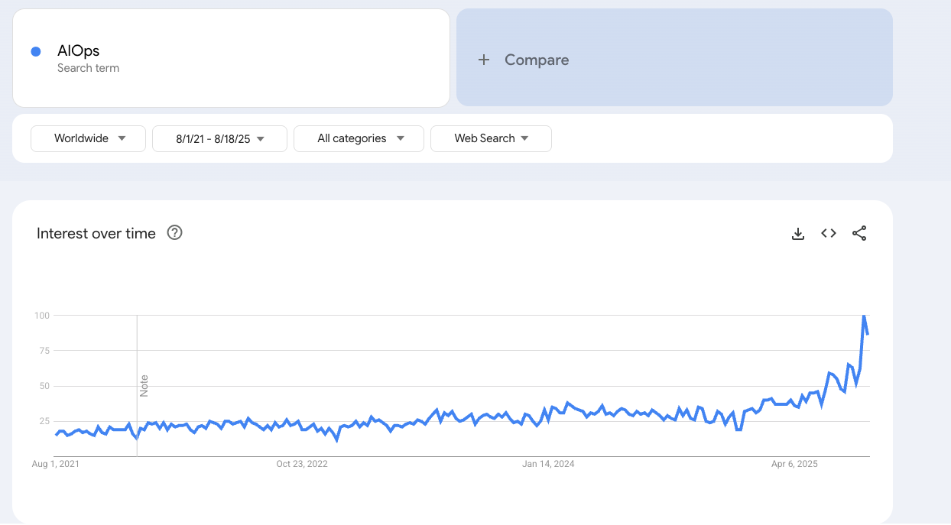
A graph on a computer screenAI-generated content may be incorrect.

Global Google search interest over time for the term "AIOps" (August 2021 – August 2025)

Regional concentration in Asia-Pacific

A screenshot of a computerAI-generated content may be incorrect.

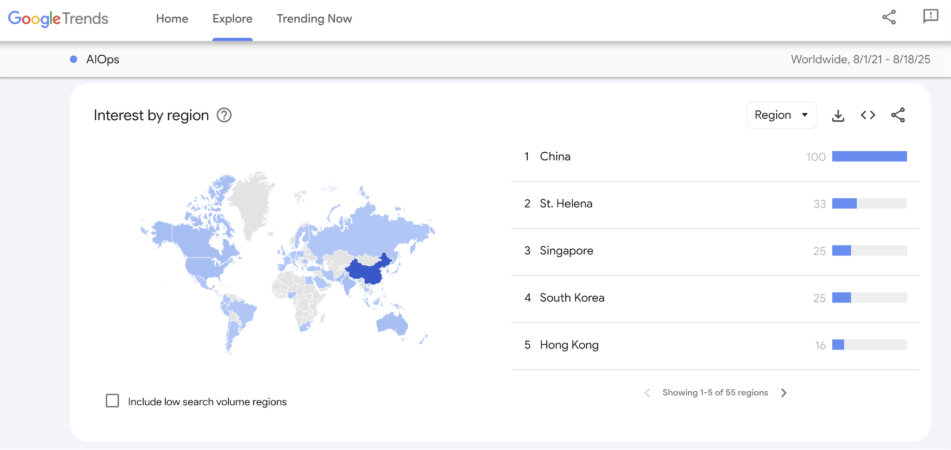
Regional interest in "AIOps" based on global Google search volume (August 2021 – August 2025)

The geographic data reveals AIOps interest is heavily concentrated in:

  • China (100% relative interest)
  • Singapore, South Korea, Hong Kong (13-21% relative interest)

This suggests either different IT infrastructure challenges in APAC markets, varying technology adoption patterns, or perhaps different expectations around AI-driven operations.

The educational curve

A screenshot of a chatAI-generated content may be incorrect.

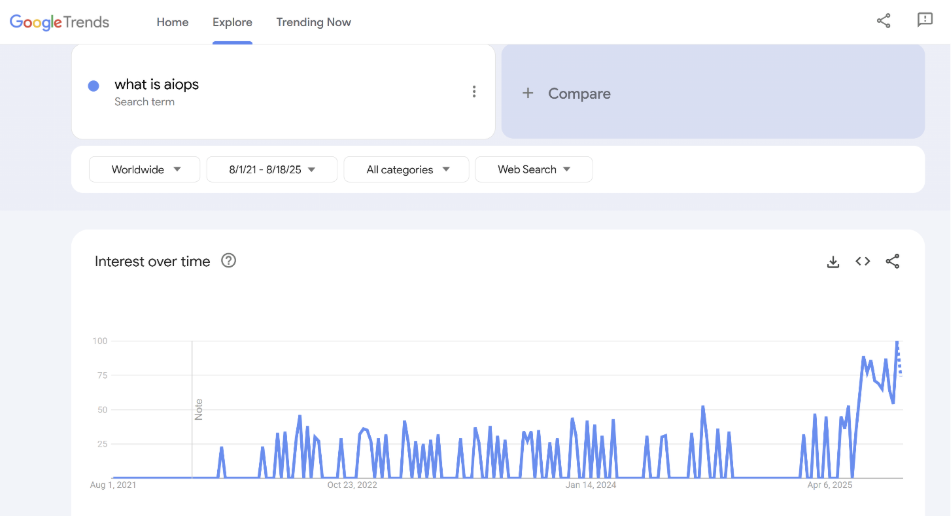
Global Google Search Interest Over Time for the Phrase "What is AIOps" (August 2021 – August 2025)


The "what is AIOps" search trend shows cyclical spikes rather than sustained growth, suggesting periodic waves of discovery rather than consistent adoption. People are still learning about AIOps rather than implementing it—the concept remains nascent despite years of industry discussion.

The October 2024 inflection point

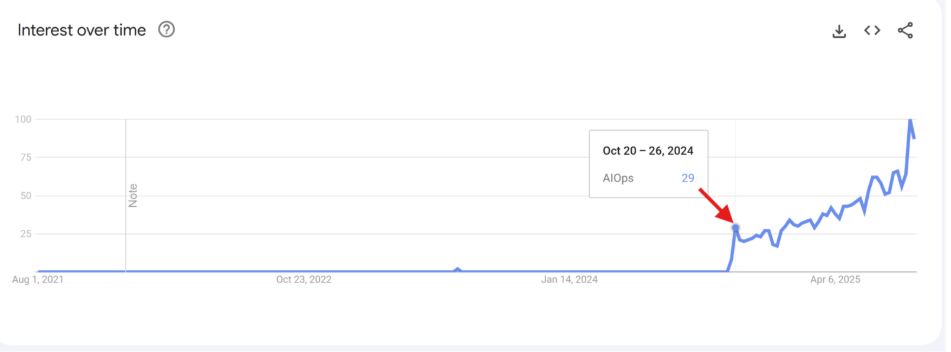
But here's where the story gets really fascinating. Search interest for AIOps absolutely exploded in October 2024.  

A screenshot of a computerAI-generated content may be incorrect.

Inflection Point in Global Search Interest for "AIOps"—October 2024

What happened?

The perfect storm

October 2024 created a perfect storm for AIOps interest:

  • Gartner Magic Quadrant for Digital Experience Monitoring (October 21, 2024): For the first time ever, Gartner published a Magic Quadrant for Digital Experience Monitoring, which includes AIOps capabilities as evaluated criteria. Companies like Dynatrace and Catchpoint were named Leaders, generating significant industry attention and validating the AIOps space.
  • IBM Cloud Pak for AIOps v4.7 Release (October 11, 2024): IBM announced a major update with production-ready Linux deployment capabilities, signaling enterprise readiness.
  • Nokia's AIOps Integration (October 18, 2024): Nokia integrated AI-driven operations into its Altiplano Access Controller, showing AIOps expanding beyond traditional IT into network infrastructure.
  • ServiceNow Educational Push: Dedicated AIOps workshops and training, indicating vendors were investing heavily in market education.
  • Multiple Vendor Milestones: From Motadata's next-gen platform to Keep raising $2.7M for their open-source AIOps platform, the entire ecosystem seemed to mature simultaneously.

This convergence explains why Google Trends shows such a dramatic spike. October 2024 represented the moment when AIOps moved from "emerging technology" to "mainstream enterprise solution" with multiple validation points occurring simultaneously.

And what does the market actually say?

The numbers are impressive: the global AIOps market is expanding at a compound annual growth rate of more than 25%, projected to grow from $11.16B in 2025 to over $32B by 2029. Around 40% of enterprises now employ AIOps to some extent, with adoption rates especially high in regulated and data-intensive industries.

But here's the million-dollar question: are we seeing hype cycles that don't align with practitioner reality, or is the early promise of AIOps finally materializing?

Putting it all together: what we got right (and what we missed)

Our 2021 and 2023 recommendations still hold water:

  • Break down AIOps into discrete components: The market has largely validated this approach. Successful AIOps implementations focus on specific capabilities, such as anomaly detection, event correlation, and automated remediation, rather than attempting to solve everything at once.
  • Focus on pragmatic use cases: Organizations seeing value from AIOps are those that identified clear, measurable problems and applied AI/ML tools strategically to solve them.
  • Invest in training: The most successful teams we've observed have invested in AI and ML literacy for their SRE teams, treating it as a long-term capability rather than a silver bullet.

What we perhaps underestimated was the patience required for the market to mature and the role that broader AI developments (particularly GenAI) would play in legitimizing and advancing AIOps capabilities.

What’s Next: SRE and AI at an inflection point

The 2026 SRE Report, coming in January, will carry forward the story of AIOps and reveal how AI itself is changing the DNA of site reliability. Without revealing too much, we can share that sentiment around AI in SRE has shifted dramatically, and the numbers will surprise you. Is 2026 poised to be the year where belief in AI moves beyond theory? Watch this space, and subscribe to our email insights to get the report first.

Welcome to a new blog series where we take a candid look at the predictions, insights, and bold claims we've made in previous SRE Reports and ask the uncomfortable question: How did we do?

For the uninitiated, Catchpoint's SRE Report is our annual, practitioner-driven effort to capture the pulse of the global reliability community. Each year, we survey SREs, reliability engineers, and operations leaders worldwide to understand the current state of our profession, including the challenges we face, the tools we use, and the trends shaping our work. The reports serve as both a snapshot of where we are and a compass for where we're heading.

But here's the thing about predictions: they have this pesky habit of aging poorly. Technology evolves, markets shift, and what seemed revolutionary three years ago might be gathering dust in the corner of someone's Kubernetes cluster today. So we thought it would be fascinating, and perhaps a little humbling, to revisit our past claims and see how they've held up against the brutal reality of production environments.

First up in this retrospective series: AIOps. Buckle up, because this journey is equal parts vindication and "well, that didn't age well."

AIOps: The Promise That Wouldn't Die

Let's start with a bit of history. The term "AIOps" was coined by Gartner in 2017, defined as the application of artificial intelligence and machine learning to enhance IT operations through big data, analytics, and automation. Gartner positioned it as the future of IT operations—a way to handle the exponential growth in data volume, velocity, and variety that traditional monitoring tools simply couldn't manage.

The promise was intoxicating: imagine AI systems that could automatically detect anomalies, correlate events across your entire stack, predict failures before they happened, and even remediate issues without human intervention. It sounded like the holy grail of operations—finally, we could move from reactive firefighting to proactive, intelligent infrastructure management.

What we said then: the SRE Report take on AIOps

A colorful background with circles and textAI-generated content may be incorrect.

Our 2021 SRE Report gave AIOps significant attention, reflecting the industry enthusiasm we were seeing everywhere. The potential was undeniable. AIOps promised to help us manage increasing data volumes and extract actionable insights that could transform how we approached monitoring and incident response.

But while the industry was buzzing with excitement, our survey respondents told a different story. Real-world adoption among SREs was surprisingly slow. The gap between promise and practice was... significant.

Monitoring tool usage: The SRE Report 2021

Our recommendation then was pragmatic: break down AIOps into individual components rather than chasing the buzzword. Don't buy into the hype wholesale. Instead, evaluate specific capabilities like anomaly detection, event correlation, or automated remediation on their own merits. We also emphasized the need for AI and ML training within SRE teams, positioning this as a long-term investment rather than a quick fix.

2023: The Plot Thickens

A group of men sitting at a tableAI-generated content may be incorrect.

The SRE Report 2023

By the time our 2023 SRE Report rolled around, we had a year of additional data to work with. We asked respondents to rate the "value received" from AIOps for a second year running, and the results were... illuminating.

The majority of reliability practitioners continued to report that the value they received from AIOps was low or nonexistent. But when we broke down responses by organizational level, a fascinating pattern emerged. 59% of executives said they received moderate or high value from AIOps, while only 20% of individual practitioners said the same.

Read that again. Let it sink in.

Value received from AIOps: The SRE Report 2023

We had a classic case of the people making the purchasing decisions seeing tremendous value, while the people actually using the tools in production were largely unimpressed. The gap in perception between leadership and practitioners was huge!

Our advice remained consistent: don't ignore AIOps entirely, but decompose it into specific capabilities that meaningfully support your observability and reliability operations. Focus on pragmatic use cases, not vendor promises.

2024-2025: The pivot

In 2024 we broadened our survey questions from "AIOps specifically" to "AI in general," adding qualifiers about expectations "within the next two years." This shift reflected the rapidly evolving AI landscape and the rise of generative AI.

As one of our field contributors noted: "It's hard to know whether this is another AI hype cycle or an intensification of the previous one, but it feels like there is something genuinely different between the (rather short on detail) promotion of AIOps, and what's happening with GenAI."

The distinction was crucial: traditional AIOps remained narrowly focused on anomaly detection and analysis within existing command-and-control frameworks—essentially "business-as-usual, with go-faster stripes." GenAI, however, represented something fundamentally different: "more like dealing with a very early-stage co-worker, who needs training and investment and constant review, but can occasionally be really valuable."

That was then, this is now: the Google Trends reality check

So that was our take from the SRE trenches. But how do you actually measure adoption of something like AIOps in the broader market? It's crude, but you could do worse than looking at Google search trend data.

Why Google Trends? Two compelling reasons:

  • First, it tracks real search interest, not just hype. Google Trends shows how many people are actively searching for information on a topic, a direct window into what the market, professionals, and the curious want to learn or evaluate.
  • Second, it's unbiased and vendor-neutral. Unlike vendor surveys or analyst reports, Trends is independent. It's not produced by a stakeholder seeking to sell or promote something. It reflects organic search behaviors from millions of users across the world.

So, what do we learn from Google’s search trend data?  

The AIOps search interest explosion (2024-2025)

The most striking finding is the dramatic spike in "AIOps" searches starting in late 2023/early 2024, reaching peak interest by 2025.  
A graph on a computer screenAI-generated content may be incorrect.

Global Google search interest over time for the term "AIOps" (August 2021 – August 2025)

Regional concentration in Asia-Pacific

A screenshot of a computerAI-generated content may be incorrect.

Regional interest in "AIOps" based on global Google search volume (August 2021 – August 2025)

The geographic data reveals AIOps interest is heavily concentrated in:

  • China (100% relative interest)
  • Singapore, South Korea, Hong Kong (13-21% relative interest)

This suggests either different IT infrastructure challenges in APAC markets, varying technology adoption patterns, or perhaps different expectations around AI-driven operations.
The educational curve

A screenshot of a chatAI-generated content may be incorrect.

Global Google Search Interest Over Time for the Phrase "What is AIOps" (August 2021 – August 2025)


The "what is AIOps" search trend shows cyclical spikes rather than sustained growth, suggesting periodic waves of discovery rather than consistent adoption. People are still learning about AIOps rather than implementing it—the concept remains nascent despite years of industry discussion.

The October 2024 inflection point

But here's where the story gets really fascinating. Search interest for AIOps absolutely exploded in October 2024.  
A screenshot of a computerAI-generated content may be incorrect.

Inflection Point in Global Search Interest for "AIOps"—October 2024

What happened?

The perfect storm

October 2024 created a perfect storm for AIOps interest:

  • Gartner Magic Quadrant for Digital Experience Monitoring (October 21, 2024): For the first time ever, Gartner published a Magic Quadrant for Digital Experience Monitoring, which includes AIOps capabilities as evaluated criteria. Companies like Dynatrace and Catchpoint were named Leaders, generating significant industry attention and validating the AIOps space.
  • IBM Cloud Pak for AIOps v4.7 Release (October 11, 2024): IBM announced a major update with production-ready Linux deployment capabilities, signaling enterprise readiness.
  • Nokia's AIOps Integration (October 18, 2024): Nokia integrated AI-driven operations into its Altiplano Access Controller, showing AIOps expanding beyond traditional IT into network infrastructure.
  • ServiceNow Educational Push: Dedicated AIOps workshops and training, indicating vendors were investing heavily in market education.
  • Multiple Vendor Milestones: From Motadata's next-gen platform to Keep raising $2.7M for their open-source AIOps platform, the entire ecosystem seemed to mature simultaneously.

This convergence explains why Google Trends shows such a dramatic spike. October 2024 represented the moment when AIOps moved from "emerging technology" to "mainstream enterprise solution" with multiple validation points occurring simultaneously.

And what does the market actually say?

The numbers are impressive: the global AIOps market is expanding at a compound annual growth rate of more than 25%, projected to grow from $11.16B in 2025 to over $32B by 2029. Around 40% of enterprises now employ AIOps to some extent, with adoption rates especially high in regulated and data-intensive industries.

But here's the million-dollar question: are we seeing hype cycles that don't align with practitioner reality, or is the early promise of AIOps finally materializing?

Putting it all together: what we got right (and what we missed)

Our 2021 and 2023 recommendations still hold water:

  • Break down AIOps into discrete components: The market has largely validated this approach. Successful AIOps implementations focus on specific capabilities, such as anomaly detection, event correlation, and automated remediation, rather than attempting to solve everything at once.
  • Focus on pragmatic use cases: Organizations seeing value from AIOps are those that identified clear, measurable problems and applied AI/ML tools strategically to solve them.
  • Invest in training: The most successful teams we've observed have invested in AI and ML literacy for their SRE teams, treating it as a long-term capability rather than a silver bullet.

What we perhaps underestimated was the patience required for the market to mature and the role that broader AI developments (particularly GenAI) would play in legitimizing and advancing AIOps capabilities.

What’s Next: SRE and AI at an inflection point

The 2026 SRE Report, coming in January, will carry forward the story of AIOps and reveal how AI itself is changing the DNA of site reliability. Without revealing too much, we can share that sentiment around AI in SRE has shifted dramatically, and the numbers will surprise you. Is 2026 poised to be the year where belief in AI moves beyond theory? Watch this space, and subscribe to our email insights to get the report first.