



惯性聚合 高效追踪和阅读你感兴趣的博客、新闻、科技资讯
阅读原文 在惯性聚合中打开

推荐订阅源

J
Java Code Geeks
freeCodeCamp Programming Tutorials: Python, JavaScript, Git & More
S
SegmentFault 最新的问题
博客园 - 三生石上(FineUI控件)
Hugging Face - Blog
Hugging Face - Blog
博客园 - Franky
云风的 BLOG
云风的 BLOG
I
InfoQ
小众软件
小众软件
Last Week in AI
Last Week in AI
钛媒体:引领未来商业与生活新知
钛媒体:引领未来商业与生活新知
大猫的无限游戏
大猫的无限游戏
A
About on SuperTechFans
Stack Overflow Blog
Stack Overflow Blog
The Cloudflare Blog
雷峰网
雷峰网
P
Proofpoint News Feed
腾讯CDC
H
Help Net Security
V
Visual Studio Blog
美团技术团队
F
Fortinet All Blogs
MongoDB | Blog
MongoDB | Blog
阮一峰的网络日志
阮一峰的网络日志

Replicate's blog

How to make remarkable videos with Seedance 2.0 – Replicate blog How to prompt Seedream 5.0 – Replicate blog Recraft V4: image generation with design taste – Replicate blog Run Isaac 0.1 on Replicate – Replicate blog Run FLUX.2 on Replicate – Replicate blog How to prompt Nano Banana Pro – Replicate blog Retro Diffusion's pixel art models are now on Replicate – Replicate blog Replicate is joining Cloudflare – Replicate blog Extract text from documents and images with Datalab Marker and OCR – Replicate blog How to prompt Veo 3.1 – Replicate blog IBM's Granite 4.0 is now on Replicate – Replicate blog Which image editing model should I use? – Replicate blog Introducing our new search API – Replicate blog Announcing Replicate's remote MCP server – Replicate blog How to prompt Veo 3 with images – Replicate blog Open source video is back – Replicate blog Generate consistent characters – Replicate blog Bria is now on Replicate – Replicate blog How we optimized FLUX.1 Kontext [dev] – Replicate blog Compare AI video models – Replicate blog The FLUX.1 Kontext hackathon – Replicate blog How to prompt Veo 3 for the best results – Replicate blog Get the most from Google Veo 3 – Replicate blog FLUX.1 Kontext from the community – Replicate blog Use FLUX.1 Kontext to edit images with words – Replicate blog Generate incredible images with Google's Imagen 4 – Replicate blog Run OpenAI’s latest models on Replicate – Replicate blog NVIDIA H100 GPUs are here – Replicate blog Run 30,000+ LoRAs on Hugging Face with Replicate – Replicate blog Ideogram 3.0 on Replicate – Replicate blog
Torch compile caching for inference speed – Replicate blog
2025-09-08 · via Replicate's blog

Posted September 8, 2025 by

We now cache torch.compile artifacts to reduce boot times for models that use PyTorch.

Models like black-forest-labs/flux-kontext-dev, prunaai/flux-schnell, and prunaai/flux.1-dev-lora now start 2-3x faster.

We’ve published a guide to improving model performance with torch.compile that covers more of the details.

What is torch.compile?

Many models, particularly those in the FLUX family, apply various torch.compile technique/tricks to improve inference speed.

The first call to a compiled function traces and compiles the code, which adds overhead. Subsequent calls run the optimized code and are significantly faster.

Performance improvements

By caching the compiled artifacts across model container lifecycles, we’ve seen dramatic improvements in cold boot times:

The cache also improves time from container startup to first prediction success across all models using torch.compile.
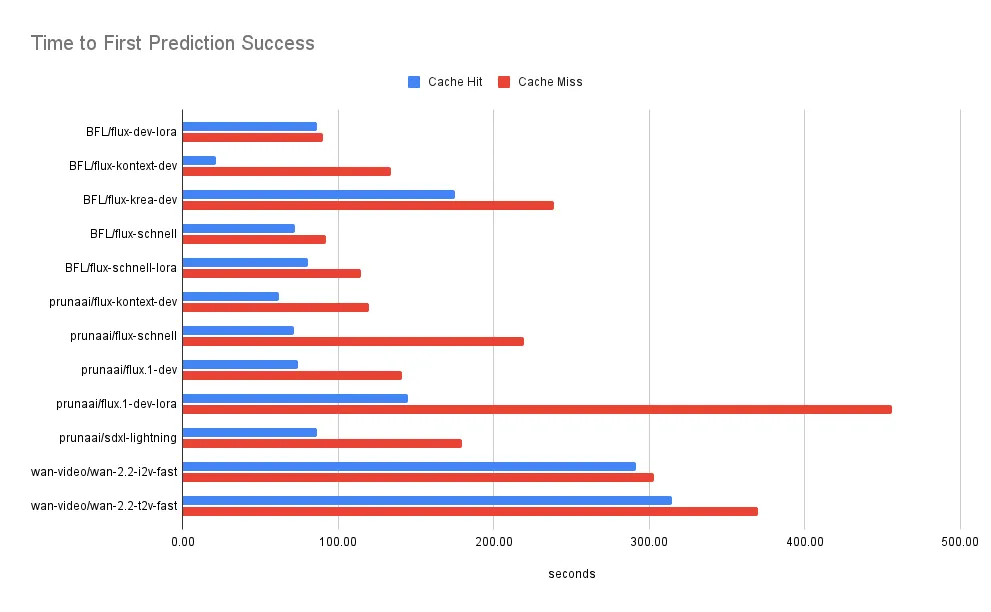
Torch Compile Cache Speedup

How it works

The caching system works like many CI/CD cache systems:

  1. When a model container starts, it looks for cached compiled artifacts
  2. If found, Torch reuses them instead of re-compiling from scratch
  3. When containers shut down gracefully, they update the cache if needed
  4. Cache files are keyed on model version and stored close to GPU nodes

Learn more

To learn more about how to use torch.compile, check out the our own documentation and the official PyTorch torch.compile tutorial.