






Deno 1.39 marks a significant update in the Deno ecosystem, featuring the much-anticipated return of WebGPU, enhancing capabilities for graphics, gaming, and machine learning. We’ve also introduced new deno coverage reporters for improved codebase analytics and made substantial strides in Node.js compatibility, easing the transition for Node.js developers. Finally, this release includes updates to the Standard Library, performance optimizations, and the latest TypeScript 5.3 support.
If you already have Deno installed, upgrade to version 1.39 in your terminal with:
If you don’t yet have Deno installed, you can install it with one of the following commands, or many other ways.
MacOS / Linux Install
curl -fsSL https://deno.land/x/install/install.sh | shWindows Install
irm https://deno.land/install.ps1 | iexHere’s an overview of what’s new in Deno 1.39:
deno coverage reportersdeno compilenode_modules/.bin/ executables in deno tasknode_modulesObject.prototype.__proto__Deno APIsDeno.serve() support for Unix sockets is now stableDeno.HttpServer.shutdown() is now stableDeno.HttpClient can now be declared with using keywordDeno.cronAbortSignal.any()ImageDataReadableStream.read min optionURLPattern performancestd/webgpustd/expectstd/inistd/data_structuresstd/textstd/clistd/netThe WebGPU API gives developers a low level, high performance, cross architecture way to program GPU hardware from JavaScript. It is the effective successor to WebGL on the Web. The spec has been finalized and Chrome has already shipped the API. Support is underway in Firefox and Safari.
Deno first introduced WebGPU back in early 2021 but it was removed earlier this year due to performance problems. With this release, we are happy to re-introduce it with all the performance issues worked out.
GPUs have the ability to compute certain numerical operations with extreme parallelism as compared to CPUs. This is useful for a variety of applications, beyond just rendering and games. For example, machine learning algorithms can often be expressed as a series of matrix operations, which can be computed extremely efficiently on a GPU.
Our WebGPU implementation is based on the same underlying system as the upcoming WebGPU implementation in Firefox, so we’re confident that it’s a solid foundation for developers to build on.
A basic example of getting information about the GPU via WebGPU:
const adapter = await navigator.gpu.requestAdapter();
if (adapter) {

  const adapterInfo = await adapter.requestAdapterInfo();
  console.log(`Found adapter: ${adapterInfo.device}`);
  const features = [...adapter.features.values()];
  console.log(`Supported features: ${features.join(", ")}`);
} else {
  console.error("No adapter found");
}
Further examples can be viewed over at our webgpu-examples repository.
Although the specification is stable, WebGPU is still considered unstable in
Deno. To access it in Deno use the --unstable-webgpu flag. We’re planning to
stabilize it soon, after we’ve had a chance to get more feedback from the
community and more time to verify the implementation against the
specification test suite.
For more webgpu functionalities, we’ve also added std/webgpu
(more info below).
Thanks to the wgpu team for the help provided to achieve this.
deno coverage reportersIn this release, deno coverage received two new reporters: summary and
html. You can now also omit the directory value for the --coverage flag in
deno test, as we now default to using ./coverage/ directory.
The summary reporter is the new default reporter. It outputs the coverage
summary in a concise table giving you information about coverage in particular
files and overall summary:
$ deno coverage
----------------------------------
File         | Branch % | Line % |
----------------------------------
 bar.ts      |      0.0 |   57.1 |
 baz/quux.ts |      0.0 |   28.6 |
 baz/qux.ts  |    100.0 |  100.0 |
 foo.ts      |     50.0 |   76.9 |
----------------------------------
 All files   |     40.0 |   61.0 |
----------------------------------
The previously default reporter that prints uncovered lines in all files to the
terminal is still available using the --detailed flag.
You can also specify --html flag to get the detailed coverage report in HTML
format.
$ deno test --coverage
$ deno coverage --html
HTML coverage report has been generated at file:///path/to/project/coverage/html/index.html
The examples of the coverage report look like the below:
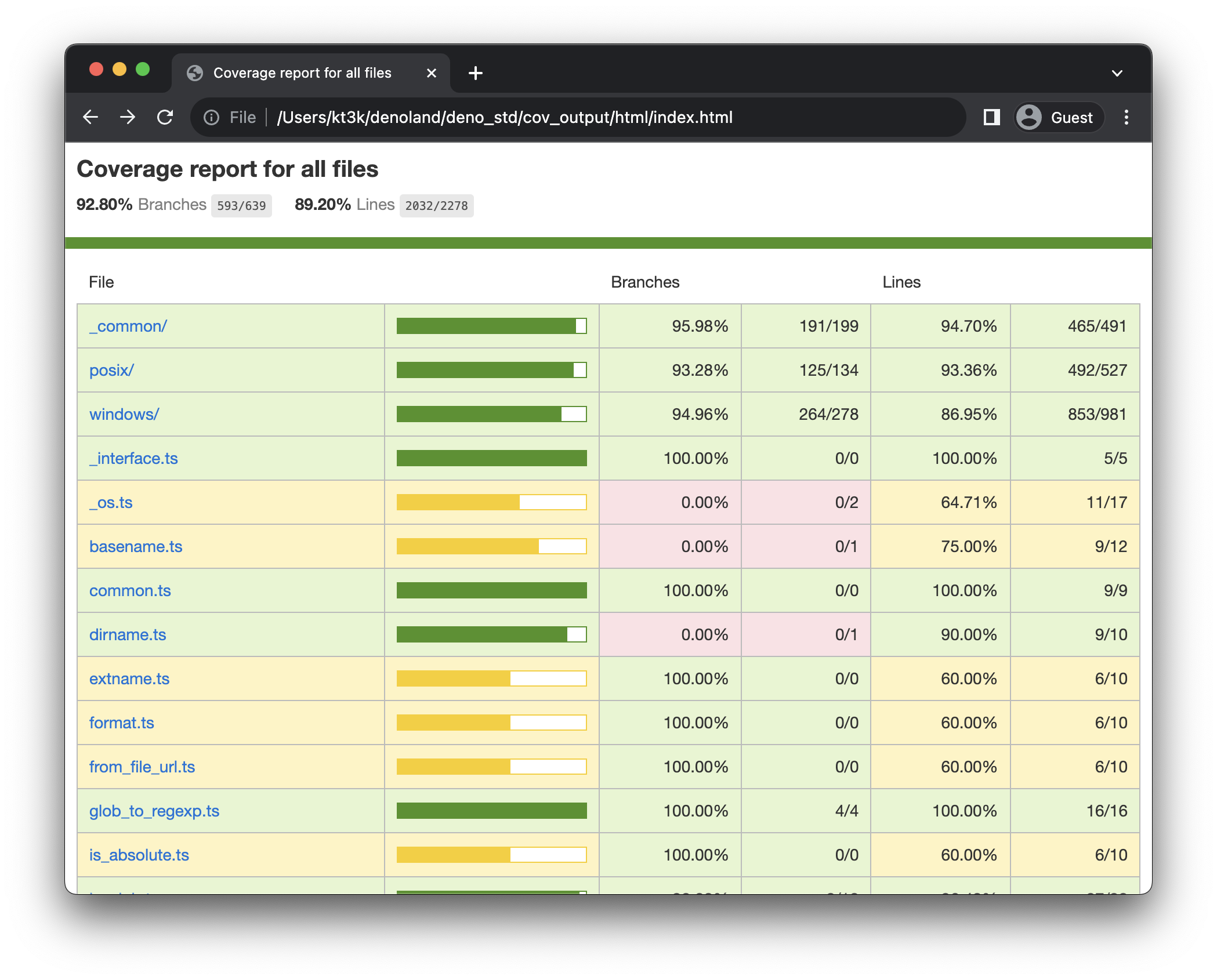
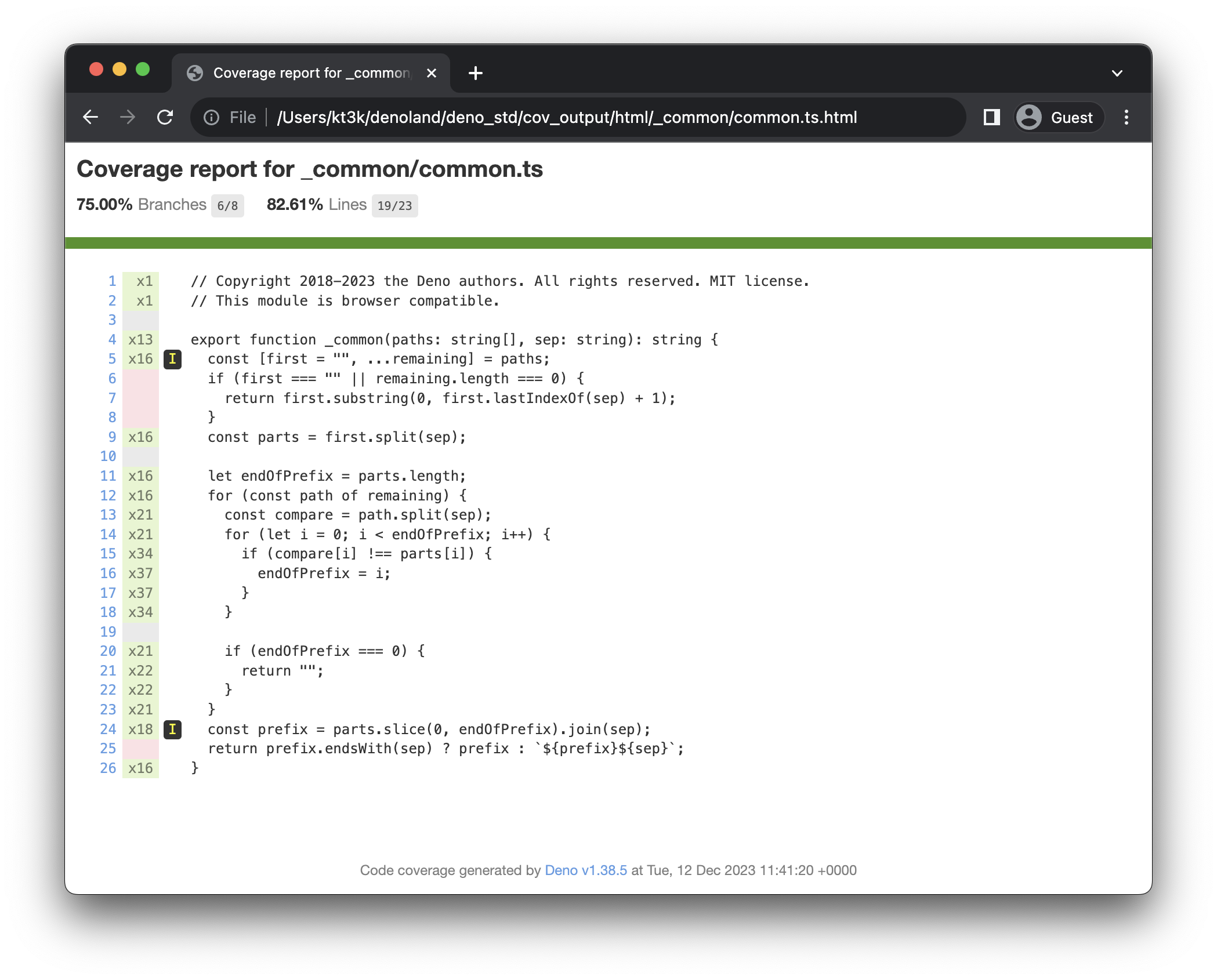
The output of deno coverage --html is completely static and can be hosted on
any static file server, such as GitHub Pages.
We still support the --lcov flag, which outputs the coverage report in the
LCOV format, which is useful for
integrating with other tools such as Codecov or
Coveralls.
We have further plans to improve deno coverage and make it more useful. If you
have feedback you’d like to share, please comment on
this issue.
deno compileDeno 1.39 introduces significant advancements in the deno compile feature:
Better node_modules support: With the --unstable-byonm flag,
deno compile now supports “bring your own node_modules”, enhancing Node.js
compatibility. This feature allows you to use npm packages directly in your Deno
projects, bridging the gap between Deno and the extensive npm ecosystem. Learn
more about this feature in
our previous blog post.
Flexible Naming for Executables: Deno has removed restrictions on executable
naming. You can now name your compiled programs with leading digits, such as
3d_modeler, offering more flexibility in naming conventions.
More Dynamic Import Support: More dynamic import patterns are now supported
in deno compile. This is interesting because Deno needs to statically include
all modules that may be imported at runtime in the binary produced by
deno compile. Because of this, dynamic imports can be problematic. Now, Deno
can handle more dynamic import patterns, such as:
await import(`./dir/${expr}`);
In this example, Deno will include all modules from ./dir/ and its
subdirectories into the compiled binary. This allows you to import any of these
files at runtime. This update simplifies dependency management by ensuring that
all modules referenced dynamically are available at runtime.
In our ongoing commitment to improving the Deno Language Server (LSP), this release introduces significant performance enhancements.
Responsive Typing Experience: We’ve optimized the handling of rapid request bursts during fast typing, ensuring a smoother and more responsive editing experience in your IDE.
Shutdown Timeout: To tackle the issue of lingering ‘zombie’ LSP instances, we’ve implemented a shutdown-timeout mechanism. This feature forcefully terminates LSP processes when you close your editor after a set timeout, promoting efficient resource utilization.
Update Notifications: The language server now actively informs you of the latest Deno updates. This feature aims to simplify the process of keeping your Deno installation current, ensuring you always have access to the latest features and fixes.
Enhanced Diagnostics: We’ve introduced a new deno.logFile setting in
VSCode. When used alongside deno.internalDebug, this feature allows for the
capture of detailed diagnostic data, aiding in performance analysis and
troubleshooting.
We are dedicated to continuously enhancing the Deno LSP. Should you encounter any performance issues with the LSP or within VSCode Deno, your feedback is invaluable. Please let us know about your experience here.
Migrating existing TypeScript codebases to Deno can be a daunting task. One of the biggest hurdles is the fact that Deno requires you to explicitly specify file extensions in the import statements.
Imagine a TypeScript project that had a file foo.ts that imported bar.ts:
import { Example } from "./bar";
console.log(Example);


export const Example = "Example";
In previous versions of Deno, this would error out with an unhelpful message:
$ deno run foo.ts
error: Module not found "file:///dev/bar"
  at file:///dev/foo.ts:1:25
Now in Deno 1.39 this error message is improved and an escape hatch made available:
$ deno run foo.ts
error: Module not found "file:///dev/bar". Maybe add a '.ts' extension or run with --unstable-sloppy-imports
    at file:///dev/foo.ts:1:25
Running with the --unstable-sloppy-imports flag will execute the code without
any changes:
$ deno run --unstable-sloppy-imports foo.ts
Warning Sloppy imports are not recommended and have a negative impact on performance.
Warning Sloppy module resolution (hint: add .ts extension)
    at file:///dev/foo.ts:1:25
Example
In addition to resolving imports without file extension, this feature also
allows to resolve “directory” imports, as well as importing .ts files using
.js extension:
export default {
  "/": () => "Hello World",
  "/example": () => "Example",
};


export const bar = "bar";


import routes from "./routes";
import { bar } from "./bar.js";

console.log(routes);
console.log(bar);
$ deno run --unstable-sloppy-imports foo.ts
Warning Sloppy imports are not recommended and have a negative impact on performance.
Warning Sloppy module resolution (hint: specify path to index.ts file in directory instead)
    at file:///Users/ib/dev/deno/foo.ts:1:20
Warning Sloppy module resolution (hint: update .js extension to .ts)
    at file:///Users/ib/dev/deno/foo.ts:2:21
{ "/": [Function: /], "/example": [Function: /example] }
bar
As seen above, using this flag will print warnings that guide you towards migrating the code to the recommended import syntax. You will also get diagnostics in your editor, along with “quick fixes” that will make it easier to apply necessary changes.
We hope this feature will make it much easier to try out and migrate existing projects to Deno.
node_modules/.bin/ executables in deno taskdeno task can run tasks defined in deno.json, as well as scripts defined
in package.json. This release adds support for running executables in
node_modules/.bin/ directory in deno task.
If you have package.json that looks like this:
{
  "scripts": {
    "dev": "vite dev"
  }
}
You can run vite dev with deno task:
$ deno task devDeno will look for vite executable in node_modules/.bin/ directory and run
it using Deno - even if the node_modules/.bin/vite uses shebang defining
Node.js as an interpreter.
node_modulesDeno will now correctly handle CommonJS entrypoints in node_modules,
respecting the type setting from package.json for the relevant package. This
should greatly improve compatibility with packages that still haven’t migrated
to ESM.
Object.prototype.__proto__Deno made a conscious decision to not support Object.prototype.__proto__ for
security reasons. However there are still many packages on npm that rely on
this property to work correctly.
In this release we introduced a new --unstable-unsafe-proto flag that allows
you to enable this property. It is not recommended to use this flag, but if you
really need to use a package that relies on it, the escape hatch is now
available to you.
Following Node.js APIs are now available:
crypto.createPrivateKeyhttp.ClientRequest.setTimeouthttp.globalAgentperf_hooks.performanceprocess.geteuidprocess.reportutil.parseArgsvm.runInNewContextAdditionally we fixed several bugs in already supported Node.js APIs:
child_process.spawnSync handling of status was incorrectchild_process.spawnSync properly normalizes stdiochild_process can handle IPC pipes on Unix systems (Windows support coming
soon)crypto.sign now works with PEM private keysfs.existsSync is now faster when file does not existprocess.exitCode should change exit code of processnull value for http.OutgoingMessage.setHeaderBuffer.copy when sourceStart > source.lengthos.freememstream.Writableprocess.stdin more than onceDeno APIsThis release includes several changes to the Deno APIs:
Deno.serve() support for Unix sockets is now stableDeno.serve( { transport: "unix", address: "/tmp/my.sock" }, (req) => new Response("Hello!"), );
Deno.HttpServer.shutdown() is now stableconst server = Deno.serve((req) => new Response("Hello!")); Deno.addSignalListener("SIGINT", () => { server.shutdown(); }); await server.finished;
Deno.HttpClient can now be declared with using keywordFollowing up on
Explicit Resource Management
introduced to Deno APIs
in the previous release, this release brings
support for using keyword to Deno.HttpClient:
{
  using client = Deno.createHttpClient({});
  const response = await fetch("http://localhost:4545/assets/fixture.json", {
    client,
  });
  const json = await response.json();
}
The new, unstable Deno.Kv.watch() API to watch for changes to the given keys
in the given database. This API returns a ReadableStream that emits a new
value whenever any of the watched keys change their versionstamp. The emitted
value is an array Deno.KvEntryMaybeobjects, with the same length and order as
thekeys array. Read more about the KV watch feature here.
const db = await Deno.openKv();

const stream = db.watch([["foo"], ["bar"]]);
for await (const entries of stream) {
  entries[0].key;
  entries[0].value;
  entries[0].versionstamp;
  entries[1].key;
  entries[1].value;
  entries[1].versionstamp;
}
The Deno.cron function, introduced recently, has seen an exciting update in
this release. It now supports an intuitive JSON format for defining schedules,
making it easier to understand and implement cron jobs. For more in-depth
information,
explore our detailed blog post about the cron feature.
Traditional Unix Cron Format
Previously, setting up a task to run every 20 minutes required the Unix cron format:
Deno.cron("myCron", "*/20 * * * *", () => {
  console.log("Running every 20 minutes");
});
New JSON Format
Now, you can achieve the same with a more readable JSON format:
Deno.cron("myCron", {
  minutes: { every: 20 },
}, () => {
  console.log("Running every 20 minutes");
});
We’ve been pushing Deno APIs to use
Web Streams API
for multiple months now and to finalize this change the v1.39 release brings a
deprecation to the various IO interfaces in Deno.
The following interfaces are now deprecated and are slated to be removed in Deno 2:
Deno.ReaderDeno.ReaderSyncDeno.WriterDeno.WriterSyncDeno.CloserYou will now get a warning in your editor when using these interfaces, with suggestions to use Web Streams APIs instead.
AbortSignal.any()This API allows for listening to multiple
AbortSignals,
and will abort if any of the specified signals is aborted.
This can be useful if you have an API that provides an AbortSignal (for
example, Request),
and you want to additionally depend on another AbortSignal.
ImageDataThe ImageData Web API is a class that can be used to represent an image in a
standardized format.
A quick example of creating a 1x2 pixels red image:
const rawImage = new Uint8ClampedArray([255, 0, 0, 1, 255, 0, 0, 1]);
new ImageData(rawImage, 1, 2);
Thanks to @jamsinclair who contributed this
feature.
ReadableStream.read min optionThe min option for ReadableStreamBYOBReader.read allows for specifying the
minimum amount of bytes to read. This is useful for various encoding formats
that require reading an n amount of bytes, which can be achieved by setting the
min option to the same length as the byte length of the buffer.
For example:
const response = await fetch("https://example.com");
const reader = response.body!.getReader({ mode: "byob" });
const buffer = new Uint8Array(10);

const { value } = await reader.read(buffer, { min: 5 });
URLPattern performanceThe URLPattern API has received performance improvements that make it 6 to 8
times faster when matching against multiple patterns, this is an optimization
directed towards a popular scenario of using URLPattern in an HTTP router.
std/webgpuAlongside releasing WebGPU in the CLI, we also added std/webgpu in this
release.
This module adds some additional functionalities, including
createTextureWithData
for creating a GPUTexture with existing data,
describeTextureFormat
to get information about a texture format, and
createCapture
to take a “capture” using a texture, among others.
Some of these functionalities have been ported/based on
wgpu features, and further functionalities
are planned.
std/expectIn this release std/expect has been added. The
module exports two functions:
expect and
fn. These are designed to be
compatible with Jest.
import { expect } from "https://deno.land/std@0.209.0/expect/mod.ts";

expect(Math.max(5, 8)).not.toEqual(5);
expect(Math.max(5, 8)).toEqual(8);

expect(Math.pow(3, 5)).toBeGreaterThan(100);
expect(Math.pow(3, 5)).toBeLessThan(300);
Currently expect supports the following matcher and modifier APIs: not,
resolves, rejects, toBe, toEqual, toStrictEqual, toMatch,
toMatchObject, toBeDefined, toBeUndefined, toBeNull, toBeNaN,
toBeTruthy, toBeFalsy, toContain, toContainEqual, toHaveLength,
toBeGreaterThan, toBeGreaterThanOrEqual, toBeLessThan,
toBeLessThanOrEqual, toBeCloseTo, toBeInstanceOf, toThrow,
toHaveProperty, toHaveLength.
The module also provides mock related util and assertions:
import { expect, fn } from "https://deno.land/std@0.209.0/expect/mod.ts";

const mockFn = fn();

mockFn();
mockFn();
mockFn();

expect(mockFn).toHaveBeenCalled();
expect(mockFn).not.toHaveBeenCalledTimes(1);
expect(mockFn).toHaveBeenCalledTimes(3);
The following mock related matchers are implemented: toHaveBeenCalled,
toHaveBeenCalledTimes, toHaveBeenCalledWith, toHaveBeenLastCalledWith,
toHaveBeenNthCalledWith, toHaveReturned, toHaveReturnedTimes,
toHaveReturnedWith, toHaveLastReturnedWith, toHaveNthReturnedWith.
The module is not completely compatible with expect API of Jest. The following
APIs are not implemented yet: toMatchSnapShot, toMatchInlineSnapShot,
toThrowErrorMatchingSnapShot, toThrowErrorMatchingInlineSnapShot,
expect.anything, expect.any, expect.arrayContaining,
expect.not.arrayContaining, expect.closedTo, expect.objectContaining,
expect.not.objectContaining, expect.stringContaining,
expect.not.stringContaining, expect.stringMatching,
expect.not.stringMatching, expect.assertions, expect.hasAssertions,
expect.addEqualityTester, expect.addSnapshotSerializer, expect.extend.
Standard Library also has
std/testing/bdd module. Now you can
write your test cases in BDD style using Standard Library.
import { describe, it } from "https://deno.land/std@0.209.0/testing/bdd.ts";
import { expect } from "https://deno.land/std@0.209.0/expect/mod.ts";

describe("Math", () => {
  describe("max", () => {
    it("returns max value from the given args", () => {
      expect(Math.max(1, 2, 3)).toEqual(3);
      expect(Math.max(-3, -2, -1)).toEqual(-1);
    });
  });
});
Save this file as my_test.ts and you can execute it with the command:
$ deno test my_test.ts
Check file:///path/to/my_test.ts
running 1 test from ./my_test.ts
Math ...
  max ...
    returns max value from the given args ... ok (1ms)
  max ... ok (1ms)
Math ... ok (1ms)

ok | 1 passed (2 steps) | 0 failed (1ms)
Thanks Thomas Cruveilher for contributing to this feature.
std/iniIn this release std/ini has been added. The
module provides the parser and serializer for working with
INI files.
Thanks Aaron Huggins for contributing to this feature.
std/data_structuresstd/data_structures has been added in
this release. This module exports classes that implements
data structure algorithms.
Currently RedBlackTree, BinarySearchTree, and BinaryHeap classes are
available.
std/textstd/text has been added in this release. This
module exports utility functions for comparing/sorting/choosing texts with
certain criteria:
import {
  closestString,
  levenshteinDistance,
} from "https://deno.land/std@0.209.0/text/mod.ts";


console.log(levenshteinDistance("hello", "halo"));
console.log(levenshteinDistance("hello", "world"));

console.log(closestString("puhs", ["commit", "pull", "push"]));
Thanks Jeff Hykin for contributing these features.
std/clistd/cli has been added in this release. This
module currently exports 2 APIs: parseArgs and promptSecret.
import {
  parseArgs,
  promptSecret,
} from "https://deno.land/std@0.209.0/cli/mod.ts";

const parsedArgs = parseArgs(["--foo", "--bar=baz", "./quux.txt"]);
console.log(parsedArgs);


const credential = promptSecret("Enter the credential ");
Note: parseArgs is the same as parse in std/flags, but we realized the
scope of std/flags is too limited, and decided to explore more CLI-related
features under std/cli.
Thanks Alisue for proposing and implementing
promptSecret.
std/netstd/net has been added in this release. This
module exports 1 API: getAvailablePort, which is useful for choosing available
TCP port.
import { getAvailablePort } from "https://deno.land/std@0.209.0/net/mod.ts";

const port = await getAvailablePort();
Thanks Harry Solovay for contributing to this feature.
Deno v1.39 ships with latest release of TypeScript 5.3, read more in Announcing TypeScript 5.3 blog post.
Currently, Deno enables experimental TypeScript decorators by default. Due to the TC39 Decorator proposal being at Stage 3 and a popular request we’ve decided to change the default setting for decorators in the upcoming Deno v1.40 release.
In the next release the experimental TypeScript decorators will be disabled by default and the TC39 Decorators will be enabled by default.
If you are using experimental TS decorators, prepare yourself for this change by
adding this configuration to your deno.json:
{
  "compilerOptions": {
    "experimentalDecorators": true
  }
}
We couldn’t build Deno without the help of our community! Whether by answering questions in our community Discord server or reporting bugs, we are incredibly grateful for your support. In particular, we’d like to thank the following people for their contributions to Deno 1.39: Aravind, Birk Skyum, Bolat Azamat, Chen Su, Daniel Mizerski, Florian Schwalm, Gasman, Ian Bull, Jacob Hummer, Jakub Jirutka, Jamie, Jesse Jackson, John Spurlock, Jordan Harband, Julien Cayzac, Jérôme Benoit, Kenta Moriuchi, Laurence Rowe, Max Goodhart, Raashid Anwar, Tareque Md Hanif, btoo, citrusmunch, lionel-rowe, liruifengv, pk, scarf, ud2, and 林炳权.
Would you like to join the ranks of Deno contributors? Check out our contribution docs here, and we’ll see you on the list next time.
Believe it or not, the changes listed above still don’t tell you everything that got better in 1.39. You can view the full list of pull requests merged in Deno 1.39 on GitHub here.
Thank you for catching up with our 1.39 release, and we hope you love building with Deno!
🍋 Fresh 1.6 is out.
Fresh v1.6 apps have expanded plugin APIs, faster route matching, and official Tailwind CSS support.
此内容由惯性聚合(RSS阅读器)自动聚合整理,仅供阅读参考。 原文来自 — 版权归原作者所有。