






Deno 1.22 has been tagged and released with the following new features and changes:
Deno.emit(), Deno.formatDiagnostics() and Deno.applySourceMap() APIsDeno namespace is available in workers by default--no-config flagNavigator.userAgentDeno.resolveDns() APIResponse.json() static methodDeno.spawn() APIperformance.timeOrigin and performance.toJSONIf you already have Deno installed, you can upgrade to 1.22 by running:
If you are installing Deno for the first time, you can use one of the methods listed below:
curl -fsSL https://deno.land/x/install/install.sh | sh


iwr https://deno.land/x/install/install.ps1 -useb | iex


brew install deno


scoop install deno


choco install deno
Deno currently supports three type checking modes:
Previously, Deno used a default type checking mode of Full. This meant that
you would get type errors reported for code outside of your direct control (your
dependencies). We have found this to be an inadequate default, and are thus
changing the default mode to Local. This is inline with tsc, which
also uses a local typechecking mode.
| Subcommand | v1.21 | v1.22 | v1.23 (Proposed) |
|---|---|---|---|
deno bench |
🌐 Full | 📁 Local | 📁 Local |
deno bundle |
🌐 Full | 📁 Local | 📁 Local |
deno cache |
🌐 Full | 📁 Local | ❌ None |
deno check |
📁 Local | 📁 Local | 📁 Local |
deno compile |
🌐 Full | 📁 Local | 📁 Local |
deno eval |
❌ None | ❌ None | ❌ None |
deno repl |
❌ None | ❌ None | ❌ None |
deno run |
🌐 Full | 📁 Local | ❌ None |
deno test |
🌐 Full | 📁 Local | 📁 Local |
Note: the proposed changes for the 1.23 release are in line with our goal to
disable type checking by default in deno run. See
the 1.21 release notes for more details and the rationale for
this change.
The Full type checking mode is still available if you want to use it. To
perform a Full type check, run deno check --remote main.ts.
You can force a specific type checking mode in any subcommand by using the following flags:
| Flag | Mode |
|---|---|
--no-check |
❌ None |
--no-check=remote¹ |
📁 Local |
--check=all |
🌐 Full |
¹: --no-check=remote will be replaced by --check in an upcoming release.
Deno.emit(), Deno.formatDiagnostics() and Deno.applySourceMap() APIsDeno shipped with the Deno.emit() API that allowed transpiling and bundling
source code programmatically. This was an unstable API that, in our opinion,
never fit well in the Deno namespace. Supporting this API added a lot of
complexity to our already complex transpilation pipeline, introducing many
subtle edge cases and holding back some of refactors we wanted to do for the
longest time. After many discussions we have decided that to remove this API
from the Deno namespace and instead provide it as a userland module:
deno_emit. This allows us to develop an API
that better suits user needs.
Deno namespace is available in workers by defaultDeno has supported the
Worker Web API
since the v1.0 release. However, by default the Deno namespace was not
available in the worker context, unless it was explicitly enabled in the option
bag:
new Worker(new URL("./worker_without_deno.js", import.meta.url));


new Worker(new URL("./worker_without_deno.js", import.meta.url), {
  deno: true,
});
In this release we are updating web workers to have the Deno namespace enabled
by default, better matching user expectations. This means that you can now use
Deno namespace APIs in your web workers by default, provided the required
permissions are set.
new Worker(new URL("./worker_without_deno.js", import.meta.url));
You can still use WorkerOptions.deno option to apply additional settings, like
custom permissions:
new Worker(new URL("./worker_without_deno.js", import.meta.url), {
  deno: {
    permissions: {
      read: true,
    },
  },
});
Thank you Nayeem Rahman for contributing this feature!
--no-config flagStarting with Deno v1.18, the runtime can automatically discover config files. While this feature is convenient and useful in most cases, there are situations where it is not desirable.
For example, you might be developing a frontend project that uses non-standard
TypeScript type declarations, that are defined in configuration files. If you
also have some standalone third party tools (like
udd) in your project directory, it’s undesirable to
apply the same configuration files to those tools, because they may require
different type declarations.
This release adds a --no-config flag, which disables auto-discovery of the
config file. With this flag passed, all configuration has to be explicitly
passed via CLI flags for configuration.
Navigator.userAgentThis release adds the userAgent property to the global navigator object.
This property is set to the same value as the User-Agent header that is set on
outgoing HTTP requests.
console.log(navigator.userAgent);
Thank you @randomicon00 for contributing this feature!
Deno.resolveDns() APIThis release brings an update to the Deno.resolveDns() API. The following
record types can now be resolved:
NSCAASOANAPTRFor example:
const [ns, caa, soa, naptr] = await Promise.all([
  Deno.resolveDns("example.com", "NS", nameServer),
  Deno.resolveDns("example.com", "CAA", nameServer),
  Deno.resolveDns("example.com", "SOA", nameServer),
  Deno.resolveDns("example.com", "NAPTR", nameServer),
]);

console.log("NS", ns);

console.log("CAA", caa);


console.log("SOA", soa);


console.log("NAPTR", naptr);
Thank you to Thanapat Chotipun and Craig Morten for contributing this feature!
Response.json() static methodThis release adds a new static json() method to the Response global. It
allows the easy creation of Response objects from JSON structures.
const json = { hello: "world" };


const body = JSON.stringify(json);
const response = new Response(body, {
  headers: { "content-type": "application/json" },
});


const response = Response.json(json);
The first argument of the new method is the JSON structure to be encoded. The
second argument is an optional options bag that is identical to the one used in
the new Response() constructor.
This addition to the Fetch specification was specifically designed with server side runtimes in mind. Deno is the first runtime to implement this new API in stable, but other runtimes should follow suit soon. Chromium already has an implementation of this API in review.
Deno v1.22 enables linting in IDE/editors using deno lsp by default. This
setting can still be disabled, but in most projects this will mean that less
IDE/editor configuration is required, as most projects have linting enabled.
Deno.spawn() APIAn AbortSignal can now be passed as a signal argument in the options bag to
Deno.spawn() and Deno.spawnChild(). When the signal is aborted, the
subprocess is terminated with a SIGTERM signal.
The return type for ProcessStatus has also been updated: signal is now set
to a string representing the signal that caused the process to exit. For
example, if a process is terminated with SIGTERM, the signal property will
be set to "SIGTERM". Using a string instead of a number is consistent with the
Deno.Child#kill API.
Deno.spawn, Deno.spawnChild, and Deno.spawnSync are still unstable APIs as
of this release. We want to stabilize the API in the next release (v1.23.0).
Please try out the new APIs, and provide any feedback via our issue tracker.
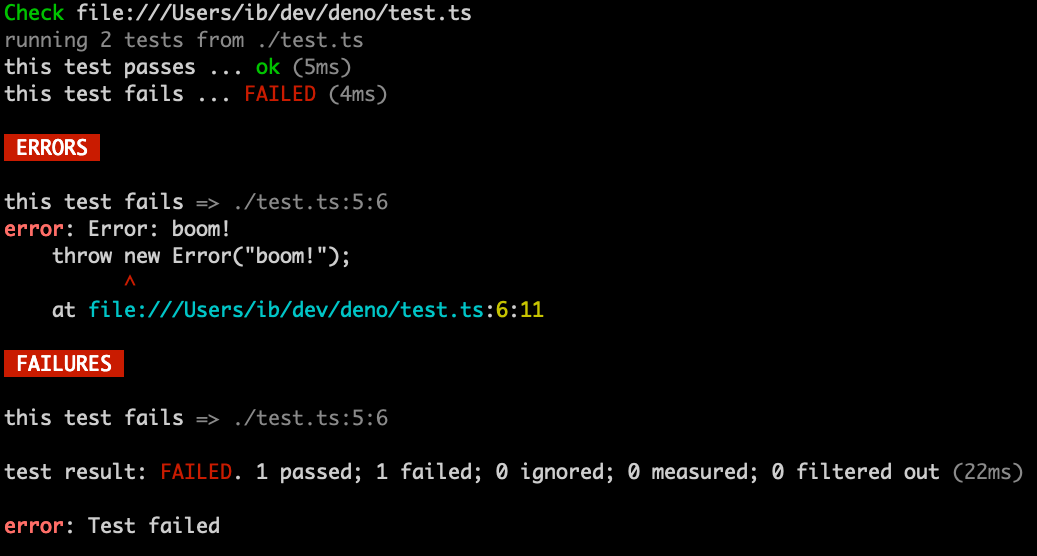
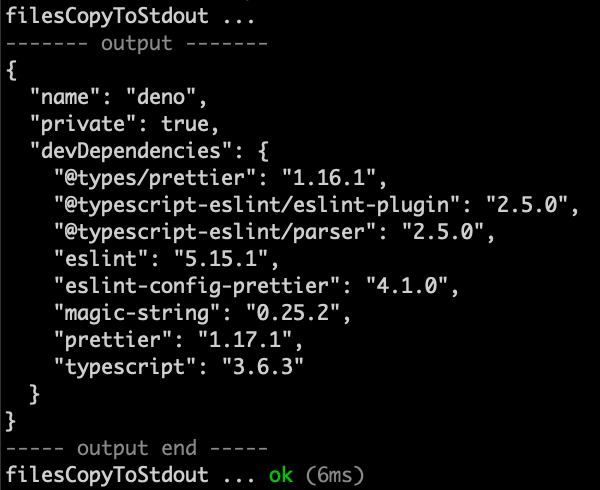
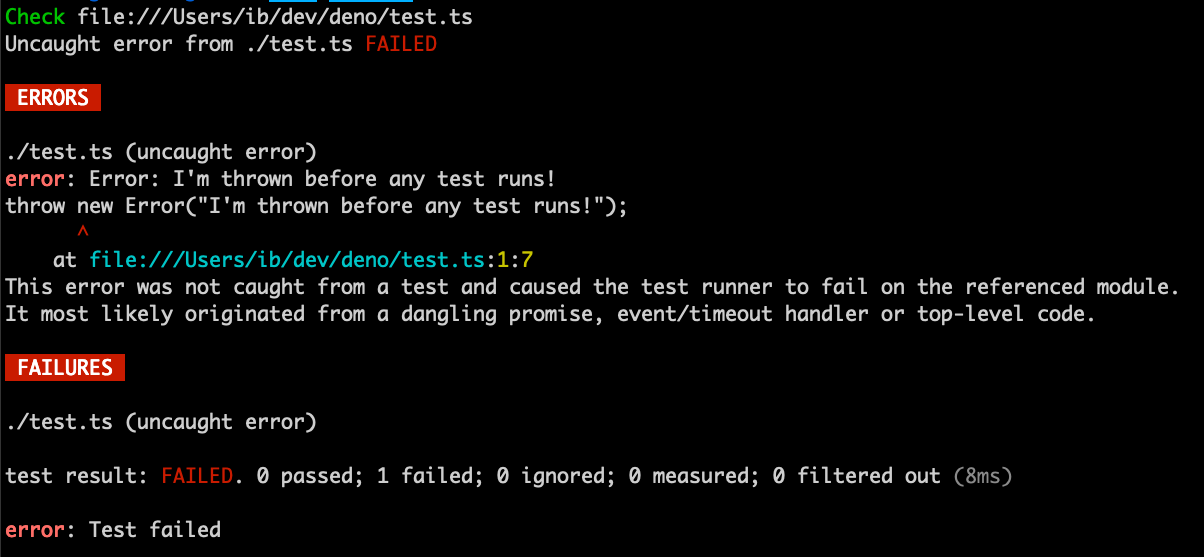
This release brings another handful of updates to the test runner. We are still iterating on the reporter output to make it more readable.
Headers for the “ERRORS” and “FAILURES” sections are now more visible, and
failed tests now show the file name and line number of the Deno.test() call:
If a test prints output, it’s name is repeated on the line following the output, to make figuring out which test failed / passed easier:
Uncaught errors have a better representation now, and show a hint to what might have gone wrong:
Thank you Nayeem Rahman for contributing these changes!
performance.timeOrigin and performance.toJSONThe performance global is getting a new property this release: timeOrigin.
This is set to the high resolution UNIX timestamp of the time the worker was
started. It can be used in combination with performance.now() to calculate a
high resolution UNIX timestamp of the current time.
const timestamp = performance.timeOrigin + performance.now();
Additionally, the performance.toJSON() method now exists and behaves
identically to browsers.
Thank you Geert-Jan Zwiers for contributing this feature!
此内容由惯性聚合(RSS阅读器)自动聚合整理,仅供阅读参考。 原文来自 — 版权归原作者所有。