


惯性聚合 高效追踪和阅读你感兴趣的博客、新闻、科技资讯
阅读原文 在惯性聚合中打开

推荐订阅源

www.infosecurity-magazine.com
Vercel News
Vercel News
G
Google Developers Blog
MyScale Blog
MyScale Blog
The Register - Security
I
InfoQ
Blog — PlanetScale
Blog — PlanetScale
D
DataBreaches.Net
Microsoft Security Blog
V
Visual Studio Blog
V2EX - 技术
V2EX - 技术
F
Fortinet All Blogs
博客园_首页
S
Secure Thoughts
GbyAI
GbyAI
S
Security Affairs
N
News | PayPal Newsroom
Forbes - Security
Forbes - Security
Recent Announcements
H
Hackread – Cybersecurity News, Data Breaches, AI and More
Security Archives - TechRepublic
宝玉的分享
宝玉的分享
Hugging Face - Blog
Hugging Face - Blog
Hacker News - Newest:
Hacker News - Newest: "LLM"
H
Heimdal Security Blog
A
About on SuperTechFans
P
Proofpoint News Feed
H
Help Net Security
Application and Cybersecurity Blog
Exploit-DB.com RSS Feed
Y
Y Combinator Blog
L
LINUX DO - 最新话题
Apple Machine Learning Research
L
LangChain Blog
博客园 - 叶小钗
A
Arctic Wolf
Cisco Talos Blog
Cisco Talos Blog
T
The Exploit Database - CXSecurity.com
人人都是产品经理
人人都是产品经理
T
Threat Research - Cisco Blogs
N
News and Events Feed by Topic
Security Latest
Security Latest
The Hacker News
The Hacker News
T
Tor Project blog
O
OpenAI News
博客园 - 三生石上(FineUI控件)
PCI Perspectives
PCI Perspectives
量子位
大猫的无限游戏
大猫的无限游戏
Stack Overflow Blog
Stack Overflow Blog

Deno

Deno 2.8 | Deno Claw Patrol: an open-source security firewall for agents | Deno Fresh 2.3: Zero JS by default, View Transitions, and Temporal support | Deno Deno 2.7: Temporal API, Windows ARM, and npm overrides | Deno Build a dinosaur runner game with Deno, pt. 6 | Deno Build a dinosaur runner game with Deno, pt. 5 | Deno Deno Deploy is Generally Available | Deno Introducing Deno Sandbox | Deno Build a dinosaur runner game with Deno, pt. 4 | Deno Build a dinosaur runner game with Deno, pt. 3 | Deno Build a dinosaur runner game with Deno, pt. 2 | Deno React / Next.js Denial-of-Service Vulnerability: Deno Deploy users protected | Deno Deno 2.6: dx is the new npx | Deno Build a dinosaur runner game with Deno, pt. 1 | Deno React Server Functions / Next.js Vulnerability: Deno Deploy users protected | Deno My highlights from the new Deno Deploy | Deno Deno's Other Open Source Projects | Deno How Deno protects against npm exploits | Deno Help Us Raise $200k to Free JavaScript from Oracle | Deno Deno 2.5: Permissions in the config file | Deno Fresh 2.0 Graduates to Beta, Adds Vite Support | Deno Deno 2.4: deno bundle is back | Deno JavaScript™ Trademark Update | Deno What's coming to JavaScript | Deno A brief history of JavaScript | Deno Reports of Deno's Demise Have Been Greatly Exaggerated | Deno An Update on Fresh | Deno How Plaid migrated 100 services to a new database platform 5x faster with Deno | Deno Deno 2.3: Improved deno compile, local npm packages, and more | Deno Add JSR packages with pnpm and Yarn | Deno Zero-config Debugging with Deno and OpenTelemetry | Deno Exploring Art with TypeScript, Jupyter, Polars, and Observable Plot | Deno Deno v Oracle Update 3: Fighting the JavaScript Trademark | Deno Build a custom RAG AI agent in TypeScript and Jupyter | Deno How to get deep traces in your Node.js backend with OTel and Deno | Deno toranoana.deno #20 登録受付中(2025年3月14日) | Deno Node just added TypeScript support. What does that mean for Deno? | Deno The Dino 🦕, the Llama 🦙, and the Whale 🐋 | Deno Publish a lint rule, get a prize | Deno Deno 2.2: OpenTelemetry, Lint Plugins, node:sqlite | Deno If you're not using npm specifiers, you're doing it wrong | Deno How Deno's documentation is evolving | Deno Oracle justified its JavaScript trademark with Node.js—now it wants that ignored | Deno Introducing the JSR open governance board | Deno Intro to Wasm in Deno | Deno Announcing OpenAI on JSR | Deno Deno in 2024 | Deno Goodbye WinterCG, welcome WinterTC | Deno Build a SolidJS app with Deno | Deno Run your Next.js SSR app on Deno Deploy | Deno Solve Advent of Code 2024 with Deno and Win Prizes! | Deno Deno v. Oracle: Canceling the JavaScript Trademark | Deno Deno 2.1: Wasm Imports and other enhancements | Deno Build a Typesafe API with tRPC and Deno | Deno Self-contained Executable Programs with Deno Compile | Deno Build a Database App with Drizzle ORM and Deno | Deno Introducing your new JavaScript package manager: Deno | Deno Announcing Growthbook on JSR | Deno Build an Astro site with Deno | Deno How to convert CommonJS to ESM | Deno Announcing Deno 2 | Deno The Final Touches: What’s New In v2.0.0-rc.10 | Deno Announcing Stable V8 Bindings for Rust | Deno Deno 2.0 Release Candidate | Deno Secure, efficient private npm registries with Cloudsmith and Deno | Deno Painting the Plane as We Fly It: Designing JSR | Deno Introducing Web Cache API support on Deno Deploy | Deno Deno 1.46: The Last 1.x Release | Deno Protect your cloud spend with new Deno Deploy spend limits | Deno What we got wrong about HTTP imports | Deno Benchmarking AWS Lambda Cold Starts Across JavaScript Runtimes | Deno Announcing Supabase on JSR | Deno Deno 1.45: Workspace and Monorepo Support | Deno Introducing KV Backup for Deno Subhosting | Deno A Gentle Intro to TypeScript | Deno Announcing Hono on JSR | Deno How We Made the Deno Language Server Ten Times Faster | Deno How the Guardian uses Deno to audit accessibility and performance across their 2.7 million articles | Deno Introducing More Flexible Domain Association for Deno Subhosting | Deno The stabilization process of the Standard Library has begun | Deno Deno 1.44: Private npm registries, improved Node.js compat, and performance boosts | Deno How we built a secure, performant, multi-tenant cloud platform to run untrusted code | Deno The Deno Standard Library is now available on JSR | Deno How to document your JavaScript package | Deno Your Low Code Solution Needs an Escape Hatch | Deno Deno 1.43: Improved Language Server performance | Deno How Slack used Deno to save months of engineering effort in launching their new platform | Deno JSR Is Not Another Package Manager | Deno Announcing the Hookdeck SDK on JSR | Deno Announcing the Neon Serverless Driver on JSR | Deno An intro to TSConfig for JavaScript Developers | Deno How we built JSR | Deno How Netlify used Deno Subhosting to build a successful edge functions product | Deno Introducing Simpler Project Creation in Deno Deploy | Deno Deno 1.42: Better dependency management with JSR | Deno Introducing deployctl, the command line interface for Deno Deploy | Deno Introducing JSR - the JavaScript Registry | Deno How to add Monaco to a Next.js app and securely run untrusted user code | Deno Survey Results and Roadmap | Deno Deno 1.41: smaller deno compile binaries | Deno
Using Deno Subhosting vs. AWS Lambda to Run Untrusted User Code | Deno
Andy Jiang · 2024-02-01 · via Deno

Deno Subhosting is the easiest way to run your users’ untrusted code on the web. Since it’s built on Deno Deploy v8 multi-tenant isolate cloud, it’s optimized to deploy and run JavaScript with minimal overhead and maximum security.

While many users like the simplicity of programmatically deploying JavaScript via the Deno Subhosting REST API, others have asked why they couldn’t build the same thing with AWS Lambda. The short answer is: you absolutely can! Since AWS Lambda is a smaller “building block”, it can be a great choice if you have specific needs that cannot be handled with Deno Subhosting and have the time to implement many key features, like code and deployment management, security and maximum tenant isolation, and automatic scaling up and down of deployments.

In this blog post, we’ll go over key differences — such as features, performance, and billing model — for building a deployment platform using Deno Subhosting or AWS Lambda.

Comparing Deno Subhosting to AWS Lambda

When building a platform where users can deploy and run their code on the web, there are two critical aspects to get right:

  • security: if one user’s code can access the code of another, then no one will trust the platform enough to continue to use it
  • performance: deploying and running code should be in the seconds and not minutes, otherwise you are at risk of users churning over a poor experience

While these two are critical, we’ve laid out other dimensions in which we believe are pertinent to someone evaluating solutions with which to integrate a deployment platform:

Deno Subhosting AWS Lambda
Languages supported JavaScript/TypeScript JavaScript, Java, Go, PowerShell, Node.js, C#, Python, Ruby
Performance: Cold start Milliseconds Seconds
Performance: Deployment times Seconds Minutes
Deployment and code management Yes No — you must build your own
Security and tenant isolation Yes No — you must build your own
Global Yes Regional

While AWS Lambda supports many more languages compared to Deno Subhosting, our choice to only support JavaScript and TypeScript allows us to optimize the entire experience for maximum deployment and cold start performance. However, if your developers have a strong preference to use a language that isn’t JavaScript or TypeScript, it makes sense to build our solution using AWS Lambda.

Since AWS Lambda is a serverless function, it’s far more flexible than Deno Subhosting, but that comes as the cost of needing to re-implement critical pieces of infrastructure such as:

Orchestrating and managing deployments

Programmatically putting code into a lambda and deploying it is only a small part of building a deployment platform. Building this with AWS Lambda would require figuring out optimal ways to transport code via HTTP, zipping and unzipping code to load into a lambda, how to store and retrieve code, and more. With Deno Subhosting, these steps are not only solved and implemented, but also optimized for speed to ensure a seamless user experience.

Additionally, when building with AWS Lambda, you would need to create processes to detect when end user code fails or hangs and terminate them, as a way to prevent resources from racking up a bill. With Deno Subhosting, these edge scenarios have been solved for, so you only need to focus on delivering a good user experience.

Security and tenant isolation

Any platform that can run untrusted code in the cloud must hold security as an utmost concern. How do we prevent someone from running malicious code that attempts to access other users’ code, or even your internal systems?

Building this from scratch with AWS Lambda requires implementing processes that isolate lambdas from accessing one another, as well as any other systems in the underlying AWS account. With Deno Subhosting, on the other hand, was designed from the ground up to be as secure as possible, with maximum tenant isolation and processes to detect misuse of resources.

These components, key to building a deployment platform that runs third party untrusted user code, would need to be implemented from scratch if building with AWS Lambda. However, if you’re seeking a solution that requires minimal development and ongoing maintenance, Deno Subhosting is simpler since it’s designed to securely run untrusted code and supports the baseline features.

Billing model and pricing

Another key consideration when evaluating any technology is pricing. While it’s difficult to compare overall pricing between Subhosting and AWS Lambda since the lambda price would exclude costs associated with other cloud services (e.g. data storage) that are otherwise included in Subhosting, the key difference is the billing model.

Deno Subhosting (and Deno Deploy) uses a compute based billing model, whereas AWS Lambda uses a real-time (or “wall clock”) billing model. This means in Deno Subhosting, you’re billed when your server is computing and not when it’s waiting for a response from an external system. Compare this to AWS Lambda, where your are billed when the lambda receives a request until it handles that request, even if it spends most of that time waiting for an HTTP response from a third party.
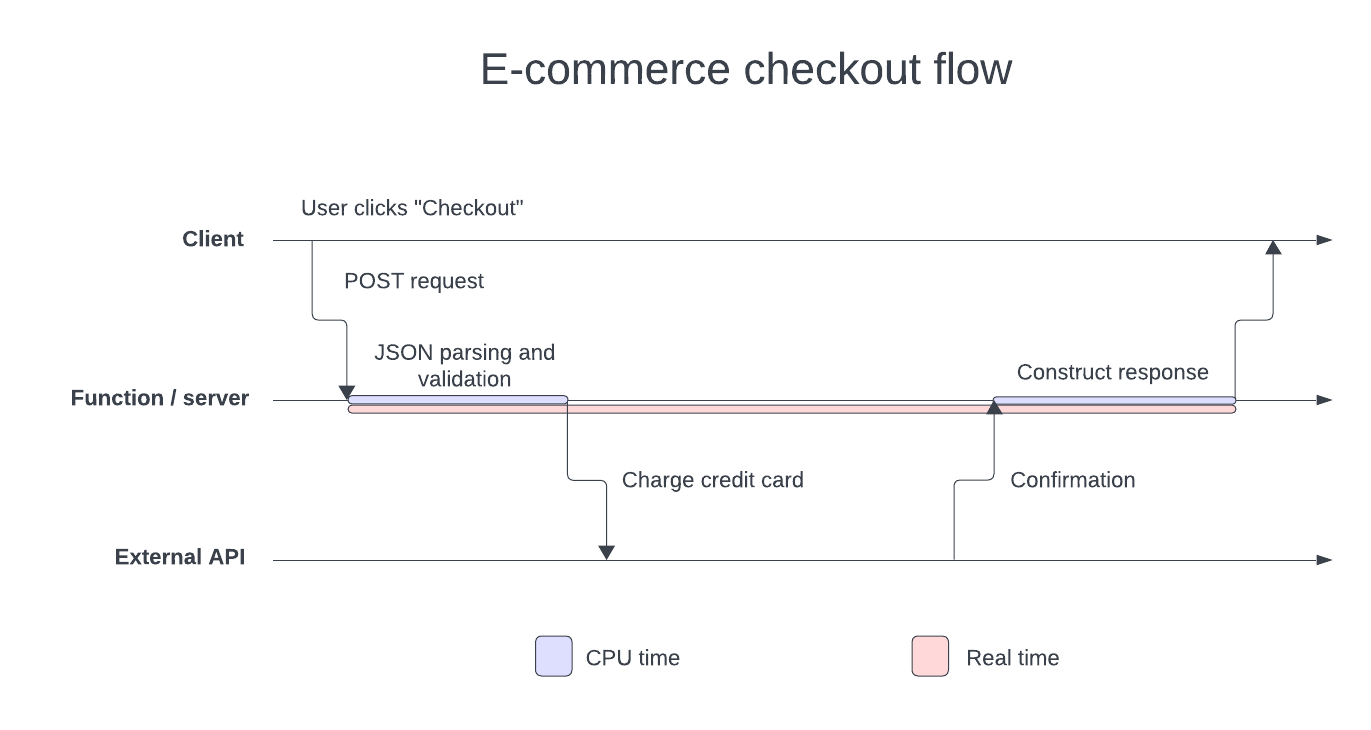
Billing model diagram between compute and real time

In this above flow, “real time” (also called “wall clock time”) billing begins when the application receives the POST request until the application responds to the client. In contrast, “CPU time” only elapses when the function is actually processing, denoted by the blue line. In this sense, CPU time charges based on the work performed and is “more serverless” as in you don’t pay for idle time.

Which solution is right for you?

If you want a more out-of-the-box solution that handles JavaScript and TypeScript with a simpler setup, we encourage you to check out Deno Subhosting. It’s optimized to run untrusted code, so it’s designed with tenant isolation, scaling up and down of deployments, routing traffic, and generating subdomains, so you don’t have to implement these baseline features yourself. Plus, by only supporting JavaScript, it’s optimized for performance with fast deployments and faster cold start times.

However, if you have the time to implement baseline features and want to build a more customized deployment platform that suits your product’s specific needs, or want to support languages like Go, Python, and Java, then AWS Lambda is a great choice.

Got more questions about how Deno Subhosting can unlock growth for your product?

Get in touch with a Deno Subhosting product specialist today.