







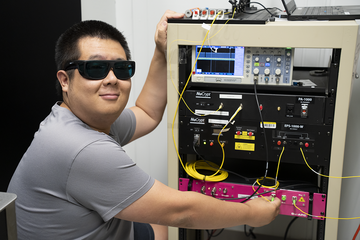
NIST physicist Yicheng Shi displays the equipment used to distribute entangled photons.
Credit: Megan King
In early 2025, special signals wended their way through a fiber-optic highway strung above the streets and sidewalks of the Maryland suburbs. The arrival of those signals at their destination marks a significant step toward a long-held dream of building a “quantum network.” Researchers believe that this emerging technology could someday link quantum devices in ways that supercharge scientific research, enable ultrasecure communications and boost the power of future quantum computers.
National Institute of Standards and Technology (NIST) researchers and collaborators reported this advance in the Journal of Optical Communications and Networking.
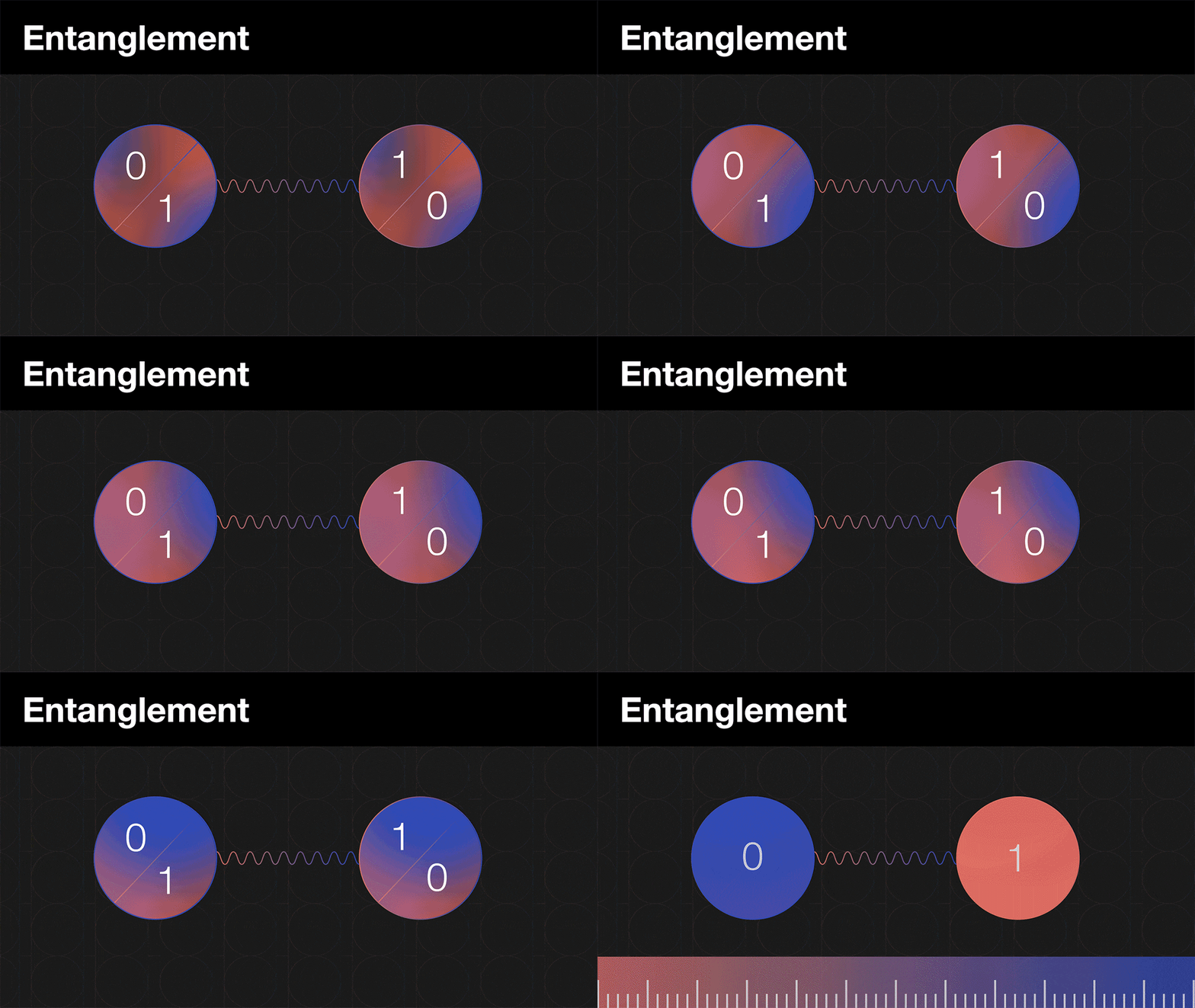
Quantum networks depend on a special phenomenon called entanglement. Often described as “spooky action at a distance” (a translation of a phrase coined by Albert Einstein), entangled objects share a unified quantum state, meaning they cannot be described independently even if they are far apart. When one object from an entangled pair is measured, this action determines the results of a measurement made on the other.
These long-distance links could reshape fields from astronomy to seismology to drug discovery. By sharing entangled photons, telescopes thousands of kilometers apart could someday collect and combine light from the same distant star or planet, yielding a much sharper image than any one telescope could on its own. Entangled sensors spread over an area could “listen” for tiny seismic disturbances and pinpoint a coming earthquake or volcanic eruption.
Networks of entangled quantum computers, meanwhile, might someday crunch algorithms too complex for any single device, helping scientists simulate potential new drugs and materials. Another possible application: ultrasecure communications networks where any attempt at hacking would be easily detected.
To unlock such benefits, however, scientists must first overcome multiple technical challenges. Among the biggest hurdles is finding a way to keep fragile entangled states alive outside the lab.
Quantum networks gain their power by connecting distant users. But building entire fiber networks just for quantum applications would be prohibitively expensive. So a team of researchers from NIST, the Joint Quantum Institute (a partnership between NIST and the University of Maryland) and the New York-based company Qunnect set out to test whether quantum networks can run on the existing fiber-optic infrastructure that powers today’s internet.
Most of the fibers the researchers used in their study dangle from poles. They expand as temperatures rise during the day and contract at night. Wind blows them around, and birds land on them. All these things can distort entangled photons as they propagate through the fibers.
“It’s about as bad a connection as you can possibly have,” said NIST physicist Oliver Slattery, one of the authors of the new study.
A noisy environment doesn’t trouble the so-called classical networks that carry your phone calls, video streams, emails and so on. In classical communication, information is typically encoded by modulating the power of the transmitted light, which is not sensitive to mechanical disturbances or temperature changes.
By contrast, noisy fibers can be a showstopper for quantum networking. That’s because entangled states are usually encoded in what is known as photons’ polarization — the direction along which their electric field vibrates.
As they expand, contract and sway in the wind, fibers can twist and distort the polarizations of photons traveling through them — potentially disrupting the delicate entangled states as well.
Credit: N. Hanacek/NIST
In their study, NIST researchers used a commercial device to produce entangled pairs of photons. The photons in each pair shared a single quantum state in which the polarization of one photon was linked to that of the other. For example, the two polarizations could be parallel or at right angles to each other.
One photon from each pair was directed to an analyzer in the NIST lab, which measured the photon’s polarization. The other traveled through 62 kilometers (about 38.5 miles) of fiber to a second lab at the University of Maryland in College Park.
The researchers knew that if they didn’t protect the flying photons’ quantum states, the fiber would twist and distort them, ruining the entanglement. So the scientists deployed a pair of devices to stabilize the photons’ polarizations in real time. These devices, developed by Qunnect, sent beams of “reference” light through the fiber and, at the other end, measured how their polarization states had been transformed. The exact inverse of these transformations were then applied to the experimental photons, keeping them entangled.
The scientists managed to transmit 1,500 entangled photons per second, a respectable rate though one that would need to improve for quantum networks to become practical. Over a 24-hour period, the researchers were able to distribute entangled photons 92.8% of the time, needing only 7.2% of the time for correcting polarizations. A statistical test confirmed that the photons detected at each end of the fiber had indeed remained entangled.
The experiment did not break a record for long-distance entanglement; a European group in 2022 distributed entangled photons over 248 kilometers of underground fiber. But the new study stands out for how much fiber was above ground and exposed to influences that real-world quantum networks will have to contend with.
“I would call this a stress test of quantum networking systems,” says Yicheng Shi, a physicist at NIST and the study’s lead author. “We put this to an extreme test in an environment that’s really noisy. Amazingly, it turned out it still worked. It’s a demonstration that quantum networking protocols can work in real-world environments.”
Paper: Yicheng Shi, Jing Su, Anouar Rahmouni, Pranish Shrestha, Mheni Merzouki, Gabriel Bello Portmann, Anne Lazenby, Mael Flament, Mehdi Namazi, Abdella Battou, Oliver Slattery and Thomas Gerrits. Entanglement Distribution Over a Polarization-Stabilized Aerial Fiber. Journal of Optical Communications and Networking. Published online July 15, 2026. DOI: 10.1364/JOCN.592521
此内容由惯性聚合(RSS阅读器)自动聚合整理,仅供阅读参考。 原文来自 — 版权归原作者所有。