


惯性聚合 高效追踪和阅读你感兴趣的博客、新闻、科技资讯
阅读原文 在惯性聚合中打开

推荐订阅源

MyScale Blog
MyScale Blog
博客园 - 三生石上(FineUI控件)
人人都是产品经理
人人都是产品经理
Exploit-DB.com RSS Feed
L
LINUX DO - 热门话题
N
Netflix TechBlog - Medium
S
Schneier on Security
T
The Exploit Database - CXSecurity.com
Vercel News
Vercel News
P
Palo Alto Networks Blog
C
CERT Recently Published Vulnerability Notes
Simon Willison's Weblog
I
Intezer
L
Lohrmann on Cybersecurity
CTFtime.org: upcoming CTF events
D
Darknet – Hacking Tools, Hacker News & Cyber Security
P
Proofpoint News Feed
The Register - Security
T
Threat Research - Cisco Blogs
P
Privacy & Cybersecurity Law Blog
A
Arctic Wolf
F
Fortinet All Blogs
V
Vulnerabilities – Threatpost
The Hacker News
The Hacker News
V
Visual Studio Blog
Know Your Adversary
Know Your Adversary
博客园 - Franky
C
Check Point Blog
P
Privacy International News Feed
NISL@THU
NISL@THU
T
Tenable Blog
云风的 BLOG
云风的 BLOG
T
Tailwind CSS Blog
C
Cyber Attacks, Cyber Crime and Cyber Security
B
Blog RSS Feed
A
About on SuperTechFans
L
LangChain Blog
Cyberwarzone
Cyberwarzone
Security Latest
Security Latest
C
CXSECURITY Database RSS Feed - CXSecurity.com
G
Google Developers Blog
WordPress大学
WordPress大学
T
Threatpost
Y
Y Combinator Blog
Last Week in AI
Last Week in AI
The GitHub Blog
The GitHub Blog
爱范儿
爱范儿
T
Tor Project blog
cs.CL updates on arXiv.org
Spread Privacy
Spread Privacy

NETSCOUT

Why Customer Lifetime Value Begins on the Network | NETSCOUT Service Providers Rethink Fraud Detection in the 5G Era | NETSCOUT Resilience Is the Foundation of Modern Security Strategy | NETSCOUT How Machines Are Taking Over Network Traffic | NETSCOUT Why AI Moves Faster Than the Controls Built to Manage It | NETSCOUT NETSCOUT Named a SPARK Matrix™ Leader in Network Observability for the Third Consecutive Year | NETSCOUT Why CDNs Alone Are Not Sufficient for Modern DDoS Protection | NETSCOUT All That Glitters Isn’t Gold: Why AI Needs Better Data | NETSCOUT From Horseback to Real-Time Observability | NETSCOUT Why Digital Twins Are Now Mission-Critical for Scaling 5G with Confidence | NETSCOUT NETSCOUT Earns Six Leader Badges in the G2 Summer 2026 Grid Reports | NETSCOUT When Too Much Data Becomes Too Big an AI Problem | NETSCOUT Game-Changing AI in the RAN Plays by Its Own Rules | NETSCOUT 75,000 DDoS-for-Hire Actors Targeted by Law Enforcement | NETSCOUT What Is NETSCOUT Smart Data and Why Is It So Important? | NETSCOUT Understanding Network Traffic for Threat Hunting | NETSCOUT Black Box Versus Glass Box DDoS Protection Intellyx Names NETSCOUT to Prestigious 2026 Digital Innovator Award List How to Operationalize Threat Hunting with NETSCOUT, SIEM, XDR, EDR, and SOAR Solving Network Blind Spots Created by Massive Data Silos The Self-Healing Network: Why Your AI Strategy Needs a Neutral Lens Does It Feel Like a Stormy Season in Your Cloud? Four AI Trends Transforming Network Operations The 1 A.M. Cloud Migration Meltdown Communication Service Provider Supports Banking Application Success Across International Borders Defending Against DDoS Attacks at Scale AI-Driven Workflow Automation Is the New North Star for Communication Service Providers Key Takeaways from the EMA Network Management Megatrends 2026 The Digital Foundation of Public Trust Is More Than Skin Deep Unlocking the Full Value of 5G with Network Slicing NETSCOUT to Have a Strong Presence at Cisco Live Why Airlines and Airports Must Embrace Observability Ahead of the Summer Travel Surge Beyond “Best Effort”: Why Carrier Grade 5G Slicing Matters More Than Ever | NETSCOUT The Shrinking Lifespan of SSL/TLS Certificates | NETSCOUT From Packets to Insight: How Curated Network Data Powers AI | NETSCOUT Data Centers Are Feeling the Heat, and That’s OK | NETSCOUT If You Can’t See the Slice, You Can’t Sell the SLA | NETSCOUT Insights from the GigaOm Radar for Network Observability v6 Report | NETSCOUT How Shadow AI Creates Zombie Infrastructure NETSCOUT Earns Eight Leader Badges in the G2 Spring 2026 Grid Reports Your Modern Manufacturing Network Deserves a Modern Observability Strategy How Botnet-Driven DDoS Attacks Evolved in 2H 2025 The Hidden Cost of Poor Network Observability Insurance Systems Look Simple, but the Infrastructure Isn’t How AI is Transforming the RAN With the Right Data When Cloud SaaS DDoS Mitigation Offerings Aren’t Enough Frictionless Banking Experiences Start with Observability Colocation Growth Demands Scalable End-to-End Observability Bringing Shadow AI Into the Light AIOps Outcomes Depend on Data Quality, Not Algorithms Why AI, Zero Trust, and Modern Security Require Deep Visibility How Service Behavior Changes in Remote Locations The 10-Hour Problem: How Visibility Gaps Are Burning Out the SOC From Insight to Impact: Observability Fuels AI-Driven Innovation How Orphaned Applications Are Quietly Fueling Your Shadow IT Problem Why Today’s Security Tools Can’t See the Network Anymore How NETSCOUT Addresses Modern Network Observability Challenges Helping IT Organizations Prevent Disruptions Before They Impact Business How Hidden Blind Spots Quietly Became Cybersecurity’s Biggest Vulnerability The Blame Game! Is it the Network or Gaps in Observability? Six Winter 2026 G2 Leader Badges Prove This DDoS Protection Stands Out The Value of Combining Modern Observability Solutions for Actionable Insights AI Failure Is the Norm Because Most Initiatives Are Flying Blind NETSCOUT Distinguished by Frost & Sullivan with the 2025 Company of the Year Recognition 5 Emerging AI Data Trends Enterprise IT Teams Cannot Ignore NETSCOUT’s Omnis Cyber Intelligence Earns Security Today’s 2025 CyberSecured Award Turning a Flood of 5G Data into Rocket Fuel for AIOps NETSCOUT Recognized by Comparably as a Top Workplace for Q4 2025 How to deliver consistent ultra-low latency, high-throughput, and total reliability across complex networks Smart Data: The Super Fuel Driving Next-Gen Observability NETSCOUT Recognized for Leadership in Network Detection and Response Integrating Deep Packet Inspection in 5G Networks Removing Barriers to Digital Transformation Gain Real-time Visibility to Future Proof Your Network for Autonomous Operations Why Is Cloud Performance Still Foggy? Smarter DDoS Security at Scale How DPI Is Transforming Observability and Operational Resilience 10 Key Challenges to Optimizing Radio Access Networks in the 5G Era Why Arbor Edge Defense and CDN-Based DDoS Protection Are Better Together NETSCOUT’s Holiday Playlist for IT Teams and Leaders More Data Does Not Always Equate to Better Business Visibility Seeing Clearly with Deep Packet Inspection at Scale How to Ensure High Availability for FWA Services System Integrators and the Future of Enterprise IT The Transformative Power of ‘Thinking’ AI and the Implications for Business How Fast Can Your Organization Identify and Resolve IT Outages? Observability for the “Always On” Power Industry
What is Network Slicing
Sherrie.Taylor · 2026-01-06 · via NETSCOUT
Woman sitting a workstation looking at 3 monitors

This blog describes the characteristics of 5G network slicing. Network slicing is the killer app of 5G and is expected to present revenue opportunities for communications service providers (CSPs), while allowing enterprises to optimize services for customers via multiple isolated virtual networks.

What Is Network Slicing?

Network slicing is a virtual networking technique that creates multiple logical networks on the same physical network infrastructure, providing flexibility in the allocation and use of network resources. Network slicing involves creating slices in a network according to the various needs of different consumers and industries to meet their requirements for service latency, reliability, and capacity.

How Does Network Slicing Work?

5G network slicing architecture allows for independent and virtualized logical networks on the same physical infrastructure.

Each slice acts as an isolated end-to-end network and is configured and designed for custom results based on application requirements for configuration and performance.  A network operator can deploy:

  • A single slice that is associated with multiple verticals
  • Multiple slices of diverse types that are associated with a business bundle

Figure 1 shows an example 5G mobile network slice architecture and configuration for Internet of Things (IoT) and gaming to help provide ultra-low latency and throughput capabilities for each service across the radio access network (RAN), core, and data networks (formerly known as access point networks [APNs]) to support the end-through-end subscriber experience.
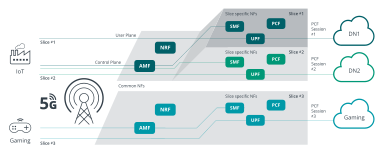
Figure 1: 5G mobile network slicing design example

Figure 1: 5G mobile network slicing design example

The following characteristics must be considered for each slice configuration:

  • Slice isolation: Because network slicing requires the implementation of many diverse types of services, and some services share resources with other virtual slices, the isolation of a slice helps to ensure the quality of service.
  • Diversification: Network slices can share network resources (for example, compute, storage, or bandwidth) with other network services; configuration to do so must be applied from the onset.
  • Deployment: Advanced resource management of network resources is available for network slicing configurations to ensure rapid assignment of shared functions.
  • Advanced management: Slice capabilities must allow subscribers to use diverse network functionalities while negotiating for quality of service.

The network characteristics listed above detail the basics that support “building blocks” for creating network slices. Slices can be implemented to ensure behavioral or functional performance.

Figure 2 illustrates another example of network slicing, where a vehicle may need to have functions for a high-bandwidth slice for infotainment as well as an ultra-reliable slice to automatically collect and transmit sensor data about the driving experience.
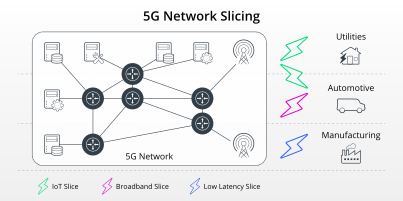
Figure 2: Multiple slices for automotive services

Figure 2: Multiple slices for automotive services

Benefits of Network Slicing

Network slicing is important in emerging telecommunications networks such as 5G because, unlike previous technologies, 5G architecture and specifications have the capabilities to implement and deploy independent virtual network slices supporting enterprise and consumer requirements for a variety of 5G use cases:

  • Enhanced mobile broadband (eMBB): A slice for general mobile internet use with high-speed data
  • Massive machine-type communication (mMTC): A slice for many IoT devices (such as sensors) that connect simultaneously but do not require high speed
  • Ultra-reliable low-latency communication (URLLC): A slice for critical applications, such as self-driving cars or remote surgery, that need extremely low latency and extremely high reliability

The full implementation of network slicing in 5G will benefit the industry by generating new revenue streams, reducing costs, and improving the quality of service and experience for customers.

NETSCOUT Solutions for 5G Network Slicing

NETSCOUT 5G solutions provide proven insights for network slices in support of service-level-agreement (SLA) management, automation, proactive analysis and monitoring, and scalability. Contact us to learn more about how NETSCOUT can help improve network slicing initiatives.