



惯性聚合 高效追踪和阅读你感兴趣的博客、新闻、科技资讯
阅读原文 在惯性聚合中打开

推荐订阅源

IT之家
IT之家
NISL@THU
NISL@THU
The Hacker News
The Hacker News
C
CXSECURITY Database RSS Feed - CXSecurity.com
T
Tenable Blog
Forbes - Security
Forbes - Security
V2EX - 技术
V2EX - 技术
Webroot Blog
Webroot Blog
Schneier on Security
T
The Exploit Database - CXSecurity.com
T
Tor Project blog
C
Cisco Blogs
TaoSecurity Blog
TaoSecurity Blog
The Last Watchdog
The Last Watchdog
PCI Perspectives
PCI Perspectives
O
OpenAI News
C
Cyber Attacks, Cyber Crime and Cyber Security
K
KPMG report finds enterprise disconnect between AI and its ROI | CIO
cs.CL updates on arXiv.org
Google Online Security Blog
宝玉的分享
宝玉的分享
freeCodeCamp Programming Tutorials: Python, JavaScript, Git & More
量子位
D
Docker
AI
AI
Blog — PlanetScale
Blog — PlanetScale
S
Security @ Cisco Blogs
S
Schneier on Security
The GitHub Blog
The GitHub Blog
W
WeLiveSecurity
云风的 BLOG
云风的 BLOG
M
MIT News - Artificial intelligence
P
Privacy International News Feed
Cyber Security Advisories - MS-ISAC
H
Hackread – Cybersecurity News, Data Breaches, AI and More
B
Blog
C
Check Point Blog
A
About on SuperTechFans
D
Darknet – Hacking Tools, Hacker News & Cyber Security
cs.AI updates on arXiv.org
Application and Cybersecurity Blog
Engineering at Meta
Engineering at Meta
I
InfoQ
T
Threat Research - Cisco Blogs
Project Zero
Project Zero
Cloudbric
Cloudbric
MongoDB | Blog
MongoDB | Blog
Cisco Talos Blog
Cisco Talos Blog
L
Lohrmann on Cybersecurity
S
Securelist

NETSCOUT

Resilience Is the Foundation of Modern Security Strategy | NETSCOUT How Machines Are Taking Over Network Traffic | NETSCOUT Why AI Moves Faster Than the Controls Built to Manage It | NETSCOUT NETSCOUT Named a SPARK Matrix™ Leader in Network Observability for the Third Consecutive Year | NETSCOUT Why CDNs Alone Are Not Sufficient for Modern DDoS Protection | NETSCOUT All That Glitters Isn’t Gold: Why AI Needs Better Data | NETSCOUT From Horseback to Real-Time Observability | NETSCOUT NETSCOUT Earns Six Leader Badges in the G2 Summer 2026 Grid Reports | NETSCOUT When Too Much Data Becomes Too Big an AI Problem | NETSCOUT Game-Changing AI in the RAN Plays by Its Own Rules | NETSCOUT 75,000 DDoS-for-Hire Actors Targeted by Law Enforcement | NETSCOUT What Is NETSCOUT Smart Data and Why Is It So Important? | NETSCOUT Understanding Network Traffic for Threat Hunting | NETSCOUT Black Box Versus Glass Box DDoS Protection Intellyx Names NETSCOUT to Prestigious 2026 Digital Innovator Award List How to Operationalize Threat Hunting with NETSCOUT, SIEM, XDR, EDR, and SOAR Solving Network Blind Spots Created by Massive Data Silos The Self-Healing Network: Why Your AI Strategy Needs a Neutral Lens Does It Feel Like a Stormy Season in Your Cloud? Four AI Trends Transforming Network Operations The 1 A.M. Cloud Migration Meltdown Communication Service Provider Supports Banking Application Success Across International Borders Defending Against DDoS Attacks at Scale AI-Driven Workflow Automation Is the New North Star for Communication Service Providers Key Takeaways from the EMA Network Management Megatrends 2026 The Digital Foundation of Public Trust Is More Than Skin Deep Unlocking the Full Value of 5G with Network Slicing NETSCOUT to Have a Strong Presence at Cisco Live Why Airlines and Airports Must Embrace Observability Ahead of the Summer Travel Surge Beyond “Best Effort”: Why Carrier Grade 5G Slicing Matters More Than Ever | NETSCOUT The Shrinking Lifespan of SSL/TLS Certificates | NETSCOUT From Packets to Insight: How Curated Network Data Powers AI | NETSCOUT Data Centers Are Feeling the Heat, and That’s OK | NETSCOUT If You Can’t See the Slice, You Can’t Sell the SLA | NETSCOUT Insights from the GigaOm Radar for Network Observability v6 Report | NETSCOUT How Shadow AI Creates Zombie Infrastructure NETSCOUT Earns Eight Leader Badges in the G2 Spring 2026 Grid Reports Your Modern Manufacturing Network Deserves a Modern Observability Strategy How Botnet-Driven DDoS Attacks Evolved in 2H 2025 The Hidden Cost of Poor Network Observability Insurance Systems Look Simple, but the Infrastructure Isn’t How AI is Transforming the RAN With the Right Data When Cloud SaaS DDoS Mitigation Offerings Aren’t Enough Frictionless Banking Experiences Start with Observability Colocation Growth Demands Scalable End-to-End Observability Bringing Shadow AI Into the Light AIOps Outcomes Depend on Data Quality, Not Algorithms Why AI, Zero Trust, and Modern Security Require Deep Visibility How Service Behavior Changes in Remote Locations The 10-Hour Problem: How Visibility Gaps Are Burning Out the SOC From Insight to Impact: Observability Fuels AI-Driven Innovation How Orphaned Applications Are Quietly Fueling Your Shadow IT Problem Why Today’s Security Tools Can’t See the Network Anymore How NETSCOUT Addresses Modern Network Observability Challenges Helping IT Organizations Prevent Disruptions Before They Impact Business How Hidden Blind Spots Quietly Became Cybersecurity’s Biggest Vulnerability The Blame Game! Is it the Network or Gaps in Observability? Six Winter 2026 G2 Leader Badges Prove This DDoS Protection Stands Out The Value of Combining Modern Observability Solutions for Actionable Insights AI Failure Is the Norm Because Most Initiatives Are Flying Blind NETSCOUT Distinguished by Frost & Sullivan with the 2025 Company of the Year Recognition 5 Emerging AI Data Trends Enterprise IT Teams Cannot Ignore What is Network Slicing NETSCOUT’s Omnis Cyber Intelligence Earns Security Today’s 2025 CyberSecured Award Turning a Flood of 5G Data into Rocket Fuel for AIOps NETSCOUT Recognized by Comparably as a Top Workplace for Q4 2025 How to deliver consistent ultra-low latency, high-throughput, and total reliability across complex networks Smart Data: The Super Fuel Driving Next-Gen Observability NETSCOUT Recognized for Leadership in Network Detection and Response Integrating Deep Packet Inspection in 5G Networks Removing Barriers to Digital Transformation Gain Real-time Visibility to Future Proof Your Network for Autonomous Operations Why Is Cloud Performance Still Foggy? Smarter DDoS Security at Scale How DPI Is Transforming Observability and Operational Resilience 10 Key Challenges to Optimizing Radio Access Networks in the 5G Era Why Arbor Edge Defense and CDN-Based DDoS Protection Are Better Together NETSCOUT’s Holiday Playlist for IT Teams and Leaders More Data Does Not Always Equate to Better Business Visibility Seeing Clearly with Deep Packet Inspection at Scale How to Ensure High Availability for FWA Services System Integrators and the Future of Enterprise IT The Transformative Power of ‘Thinking’ AI and the Implications for Business How Fast Can Your Organization Identify and Resolve IT Outages? Observability for the “Always On” Power Industry
Why Digital Twins Are Now Mission-Critical for Scaling 5G with Confidence | NETSCOUT
Agnes.Mends-Crentsil · 2026-07-01 · via NETSCOUT

Communications service provider (CSP) networks have evolved from static infrastructure into dynamic, multidomain ecosystems spanning radio-access network (RAN), transport, core, and cloud. While modern observability provides visibility into real-time events, it falls short of answering the more critical questions predicting what will happen next—and how the network should respond.

This gap becomes most pronounced in high-stakes scenarios such as 5G and dynamic network slicing rollout, where decisions must be proactive, predictive, and policy-driven—not reactive. To run 5G at scale, CSPs must move beyond observability alone and embrace a new operational paradigm: digital twin networks (DTNs) powered by AIOps.

Why Digital Twins Are Foundational to AI-Driven Network Operations

Digital twins transform networks from systems you watch into systems you can predict, simulate, and optimize in real time. DTNs function as a living, virtual replica of the network, enabling CSPs to:

  • Simulate changes before deployment (simulation-first operations)
  • Predict performance and failure scenarios before impact
  • Improve resources dynamically based on real-time conditions
  • Enable AI-assisted orchestration at scale

As networks become more autonomous, digital twins will serve as the foundation for closed-loop automation, intent-based networking, and AI-native operations. In short, DTNs shift network operating models from reactive troubleshooting to predictive optimization and autonomous execution.
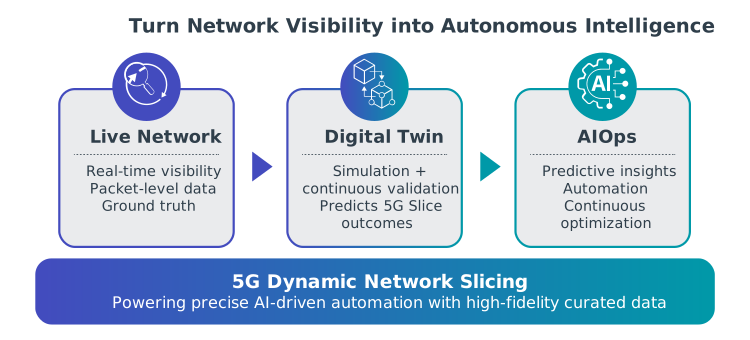
Chart on 5G Dynamic Network Slicing

Critical Dependency: High-Fidelity, Curated Data

However, digital twins are only as effective as the data that powers them. To function accurately, DTNs need continuous, high-fidelity, correlated data across:

  • Topology
  • Traffic (packet-level visibility)
  • Performance
  • Configuration

Without data quality, CSPs face three major barriers:

  • Data fidelity and real-time synchronization: If the twin does not align with the live network in real time, simulations drift, and decisions degrade.
  • Integration complexity: Multivendor environments and legacy infrastructure create data silos, interoperability gaps, and slower deployment cycles.
  • Scalability and performance: Without scalable data pipelines, digital twins become latent instead of real-time, reactive instead of predictive, and operationally irrelevant at 5G scale.

Digital Twins and 5G Dynamic Network Slicing: Where It All Converges

In open, programmable, autonomous 5G networks, dynamic network slicing introduces real-time service provisioning, application-aware performance guarantees, and rapid continuous integration/continuous delivery (CI/CD)-driven updates. Digital twins are essential to making it all work together in harmony.

DTNs will allow CSPs to confirm slice configurations before rollout, test performance under real-world conditions, ensure service-level agreements (SLAs) for enterprise and mission-critical services, and continuously improve slice performance post-deployment. In this operating model, network slices becomes self-optimizing, policy-driven resources that adapt to demands in real time for performance and business intent. But this can work only if CSPs have access to high-fidelity data that aligns with true end-through-end visibility across both the live network and the digital twin environment.

Unified Visibility for DTN Matters

Without unified visibility across both the live and digital twin networks, CSPs risk misaligned digital twins, faulty simulations, ineffective automation, and broken service- level guarantees.

NETSCOUT data-source and monitoring solutions offer CSPs a single source of truth across both the live network and its digital twin—enabling confident simulation, faster decision-making, and autonomous optimization. The journey to autonomous, AI-driven networks requires more than observability. It requires:

  • Digital twins for prediction and simulation
  • AIOps for intelligence and automation
  • End-through-end visibility for accuracy and trust

NETSCOUT OFFERINGS

NETSCOUT high-fidelity, packet-based curated data and end-through-end visibility solutions ensure digital twins are:

  • Accurate (mirroring real conditions)
  • Timely (real-time or near-real-time updates)
  • Actionable (feeding AIOps and automation systems)

CSPs can rely on NETSCOUT solutions for data integrity to ensure emerging network transformations, knowing that the data fueling both live operations and digital twins is complete, precise, and actionable.

NETSCOUT solutions enable CSPs to capture ground-truth network data across RAN, core, cloud, and to the network edge; deliver consistent telemetry across multivendor environments; correlate data across live network and digital twin models; fuel AIOps with precise trusted inputs; confirm network slicing performance; and policy execution end-through-end.

With our solutions, CSPs can turn visibility into intelligence—and intelligence into action—in
real time. Learn how NETSCOUT enables CSPs to evolve their emerging networks with
end-through-end visibility, AIOps, and 5G network slicing.

Learn more about 5G service assurance, carrier-grade AI operations, and 5G network slicing.