
惯性聚合 高效追踪和阅读你感兴趣的博客、新闻、科技资讯
阅读原文 在惯性聚合中打开

推荐订阅源

A
Arctic Wolf
F
Fortinet All Blogs
酷 壳 – CoolShell
酷 壳 – CoolShell
奇客Solidot–传递最新科技情报
奇客Solidot–传递最新科技情报
C
Check Point Blog
P
Proofpoint News Feed
aimingoo的专栏
aimingoo的专栏
Blog — PlanetScale
Blog — PlanetScale
cs.AI updates on arXiv.org
Recent Announcements
L
LangChain Blog
B
Blog RSS Feed
Application and Cybersecurity Blog
O
OpenAI News
V
Vulnerabilities – Threatpost
G
Google Developers Blog
博客园 - 三生石上(FineUI控件)
T
Troy Hunt's Blog
P
Proofpoint News Feed
D
Darknet – Hacking Tools, Hacker News & Cyber Security
V
V2EX
H
Help Net Security
MongoDB | Blog
MongoDB | Blog
N
Netflix TechBlog - Medium
Know Your Adversary
Know Your Adversary
P
Privacy & Cybersecurity Law Blog
博客园 - Franky
Microsoft Azure Blog
TaoSecurity Blog
TaoSecurity Blog
I
Intezer
W
WeLiveSecurity
Cisco Talos Blog
Cisco Talos Blog
WordPress大学
WordPress大学
L
Lohrmann on Cybersecurity
Spread Privacy
Spread Privacy
Google Online Security Blog
Schneier on Security
Cloudbric
Cloudbric
U
Unit 42
S
Security Affairs
大猫的无限游戏
大猫的无限游戏
F
Full Disclosure
T
Threatpost
Hacker News - Newest:
Hacker News - Newest: "LLM"
Exploit-DB.com RSS Feed
Engineering at Meta
Engineering at Meta
Hacker News: Ask HN
Hacker News: Ask HN
Stack Overflow Blog
Stack Overflow Blog
T
Tor Project blog
Microsoft Security Blog

NETSCOUT

Why Customer Lifetime Value Begins on the Network | NETSCOUT Service Providers Rethink Fraud Detection in the 5G Era | NETSCOUT Resilience Is the Foundation of Modern Security Strategy | NETSCOUT How Machines Are Taking Over Network Traffic | NETSCOUT Why AI Moves Faster Than the Controls Built to Manage It | NETSCOUT NETSCOUT Named a SPARK Matrix™ Leader in Network Observability for the Third Consecutive Year | NETSCOUT Why CDNs Alone Are Not Sufficient for Modern DDoS Protection | NETSCOUT All That Glitters Isn’t Gold: Why AI Needs Better Data | NETSCOUT From Horseback to Real-Time Observability | NETSCOUT Why Digital Twins Are Now Mission-Critical for Scaling 5G with Confidence | NETSCOUT NETSCOUT Earns Six Leader Badges in the G2 Summer 2026 Grid Reports | NETSCOUT When Too Much Data Becomes Too Big an AI Problem | NETSCOUT Game-Changing AI in the RAN Plays by Its Own Rules | NETSCOUT 75,000 DDoS-for-Hire Actors Targeted by Law Enforcement | NETSCOUT What Is NETSCOUT Smart Data and Why Is It So Important? | NETSCOUT Understanding Network Traffic for Threat Hunting | NETSCOUT Intellyx Names NETSCOUT to Prestigious 2026 Digital Innovator Award List How to Operationalize Threat Hunting with NETSCOUT, SIEM, XDR, EDR, and SOAR Solving Network Blind Spots Created by Massive Data Silos The Self-Healing Network: Why Your AI Strategy Needs a Neutral Lens Does It Feel Like a Stormy Season in Your Cloud? Four AI Trends Transforming Network Operations The 1 A.M. Cloud Migration Meltdown Communication Service Provider Supports Banking Application Success Across International Borders Defending Against DDoS Attacks at Scale AI-Driven Workflow Automation Is the New North Star for Communication Service Providers Key Takeaways from the EMA Network Management Megatrends 2026 The Digital Foundation of Public Trust Is More Than Skin Deep Unlocking the Full Value of 5G with Network Slicing NETSCOUT to Have a Strong Presence at Cisco Live Why Airlines and Airports Must Embrace Observability Ahead of the Summer Travel Surge Beyond “Best Effort”: Why Carrier Grade 5G Slicing Matters More Than Ever | NETSCOUT The Shrinking Lifespan of SSL/TLS Certificates | NETSCOUT From Packets to Insight: How Curated Network Data Powers AI | NETSCOUT Data Centers Are Feeling the Heat, and That’s OK | NETSCOUT If You Can’t See the Slice, You Can’t Sell the SLA | NETSCOUT Insights from the GigaOm Radar for Network Observability v6 Report | NETSCOUT How Shadow AI Creates Zombie Infrastructure NETSCOUT Earns Eight Leader Badges in the G2 Spring 2026 Grid Reports Your Modern Manufacturing Network Deserves a Modern Observability Strategy How Botnet-Driven DDoS Attacks Evolved in 2H 2025 The Hidden Cost of Poor Network Observability Insurance Systems Look Simple, but the Infrastructure Isn’t How AI is Transforming the RAN With the Right Data When Cloud SaaS DDoS Mitigation Offerings Aren’t Enough Frictionless Banking Experiences Start with Observability Colocation Growth Demands Scalable End-to-End Observability Bringing Shadow AI Into the Light AIOps Outcomes Depend on Data Quality, Not Algorithms Why AI, Zero Trust, and Modern Security Require Deep Visibility How Service Behavior Changes in Remote Locations The 10-Hour Problem: How Visibility Gaps Are Burning Out the SOC From Insight to Impact: Observability Fuels AI-Driven Innovation How Orphaned Applications Are Quietly Fueling Your Shadow IT Problem Why Today’s Security Tools Can’t See the Network Anymore How NETSCOUT Addresses Modern Network Observability Challenges Helping IT Organizations Prevent Disruptions Before They Impact Business How Hidden Blind Spots Quietly Became Cybersecurity’s Biggest Vulnerability The Blame Game! Is it the Network or Gaps in Observability? Six Winter 2026 G2 Leader Badges Prove This DDoS Protection Stands Out The Value of Combining Modern Observability Solutions for Actionable Insights AI Failure Is the Norm Because Most Initiatives Are Flying Blind NETSCOUT Distinguished by Frost & Sullivan with the 2025 Company of the Year Recognition 5 Emerging AI Data Trends Enterprise IT Teams Cannot Ignore What is Network Slicing NETSCOUT’s Omnis Cyber Intelligence Earns Security Today’s 2025 CyberSecured Award Turning a Flood of 5G Data into Rocket Fuel for AIOps NETSCOUT Recognized by Comparably as a Top Workplace for Q4 2025 How to deliver consistent ultra-low latency, high-throughput, and total reliability across complex networks Smart Data: The Super Fuel Driving Next-Gen Observability NETSCOUT Recognized for Leadership in Network Detection and Response Integrating Deep Packet Inspection in 5G Networks Removing Barriers to Digital Transformation Gain Real-time Visibility to Future Proof Your Network for Autonomous Operations Why Is Cloud Performance Still Foggy? Smarter DDoS Security at Scale How DPI Is Transforming Observability and Operational Resilience 10 Key Challenges to Optimizing Radio Access Networks in the 5G Era Why Arbor Edge Defense and CDN-Based DDoS Protection Are Better Together NETSCOUT’s Holiday Playlist for IT Teams and Leaders More Data Does Not Always Equate to Better Business Visibility Seeing Clearly with Deep Packet Inspection at Scale How to Ensure High Availability for FWA Services System Integrators and the Future of Enterprise IT The Transformative Power of ‘Thinking’ AI and the Implications for Business How Fast Can Your Organization Identify and Resolve IT Outages? Observability for the “Always On” Power Industry
Black Box Versus Glass Box DDoS Protection
mike.wetherbee · 2026-06-11 · via NETSCOUT

Distributed denial-of-service (DDoS) attacks continue to grow in scale, frequency, and sophistication, forcing organizations to rethink not just how they defend against attacks, but how much visibility and control they have over those defenses. At the center of this shift is a fundamental architectural choice: black box versus glass box DDoS protection.

While both approaches aim to stop attacks and keep services available, the difference between them comes down to transparency, trust, and operational control. Understanding these differences is critical for organizations that treat availability, customer experience, and resilience as strategic priorities rather than technical checkboxes.

The Appeal and Limits of Black Box Protection

“Black box” DDoS protection is often accepted as “good enough” for maintaining uptime, but in reality it frequently fails in critical ways. These systems tend to over block legitimate traffic, disrupting services, while also under blocking actual attacks, allowing damage to continue. When failures happen, operators lack visibility and control; they can’t see what was blocked, understand why, or fix issues quickly. This makes it difficult to prove problems, validate decisions, or restore service.

As attacks become more sophisticated, these weaknesses worsen. Instead of simplifying operations, black box solutions increase risk, turning protection into a potential source of outages. While they may be appealing for quick deployment or limited resources, they ultimately undermine reliability, customer trust, and long-term stability, making them an inadequate security approach.
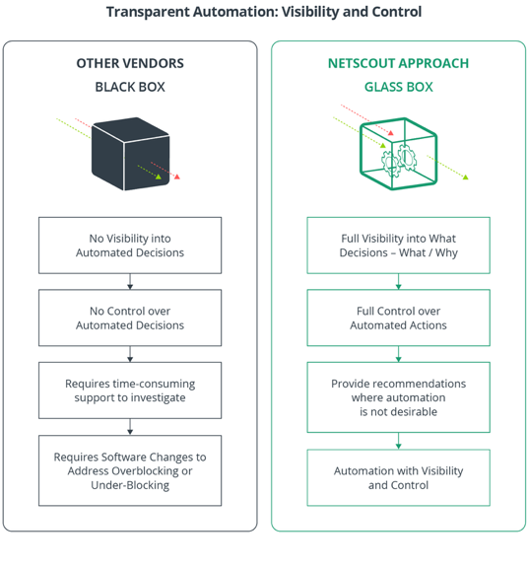
Illustration of Transparent Automation Visibility and Control for Black Box and Glass Box

Why Glass Box Transparency Changes the Equation

A “glass box” DDoS protection approach focuses on full, real-time visibility into network activity and mitigation decisions. NETSCOUT’s Arbor Adaptive DDoS Protection uses continuous analysis of traffic, threat intelligence, and attacker behavior to adapt defenses dynamically. Instead of static, one-time responses, it runs as a closed-loop process that updates mitigation as attacks evolve. This gives security teams the ability to understand, audit, and refine defenses at every stage, while still maintaining the efficiency of automated protection.

This level of transparency allows security teams to validate decisions, tune policies to their environment, and reduce false positives that can disrupt legitimate users. Importantly, glass box protection doesn’t replace automation, it enhances it by combining machine speed with human insight. The result is more predictable, explainable, and defensible DDoS mitigation.

Why This Matters for Modern Enterprises and Service Providers

Modern DDoS attacks are becoming faster, more dynamic, and harder to detect, which makes traditional black box defenses less effective. These older approaches lack visibility and struggle to adapt when attacks change tactics midstream.

Glass box DDoS protection addresses this by offering transparency and control. It helps organizations clearly see how attacks behave, align defenses accordingly, and explain actions to stakeholders.

In short, the shift is from opaque, one-size-fits-all protection to defenses that are visible, adaptable, and provably effective which is essential for organizations that rely on always-on digital services.

The Bottom Line

DDoS protection is no longer just about blocking bad traffic. It’s about confidence, accountability, and operational insight. As organizations mature their security posture, the shift from black box to glass box thinking reflects a broader industry truth: defenses are strongest when they’re not only effective, but understandable.

The shift from black box to glass box DDoS protection reflects a broader truth in security: Defenses are strongest when teams can see, trust, and refine how they work.

For more about black box versus glass box protection, read this case study.