


惯性聚合 高效追踪和阅读你感兴趣的博客、新闻、科技资讯
阅读原文 在惯性聚合中打开

推荐订阅源

钛媒体:引领未来商业与生活新知
钛媒体:引领未来商业与生活新知
Security Latest
Security Latest
Jina AI
Jina AI
爱范儿
爱范儿
Attack and Defense Labs
Recent Commits to openclaw:main
GbyAI
GbyAI
N
News | PayPal Newsroom
Last Week in AI
Last Week in AI
V
Visual Studio Blog
SecWiki News
SecWiki News
H
Heimdal Security Blog
D
Darknet – Hacking Tools, Hacker News & Cyber Security
腾讯CDC
L
LINUX DO - 热门话题
I
InfoQ
罗磊的独立博客
博客园_首页
Know Your Adversary
Know Your Adversary
T
The Exploit Database - CXSecurity.com
博客园 - 【当耐特】
阮一峰的网络日志
阮一峰的网络日志
Hacker News - Newest:
Hacker News - Newest: "LLM"
T
Threat Research - Cisco Blogs
美团技术团队
IT之家
IT之家
AWS News Blog
AWS News Blog
OSCHINA 社区最新新闻
OSCHINA 社区最新新闻
N
Netflix TechBlog - Medium
Help Net Security
Help Net Security
S
Secure Thoughts
Microsoft Security Blog
Schneier on Security
Spread Privacy
Spread Privacy
B
Blog RSS Feed
N
News and Events Feed by Topic
L
Lohrmann on Cybersecurity
Google Online Security Blog
Microsoft Azure Blog
N
News and Events Feed by Topic
I
Intezer
Blog — PlanetScale
Blog — PlanetScale
云风的 BLOG
云风的 BLOG
A
Arctic Wolf
C
Cyber Attacks, Cyber Crime and Cyber Security
G
Google Developers Blog
The Register - Security
The GitHub Blog
The GitHub Blog
MyScale Blog
MyScale Blog
F
Full Disclosure

NETSCOUT

Service Providers Rethink Fraud Detection in the 5G Era | NETSCOUT Resilience Is the Foundation of Modern Security Strategy | NETSCOUT How Machines Are Taking Over Network Traffic | NETSCOUT Why AI Moves Faster Than the Controls Built to Manage It | NETSCOUT NETSCOUT Named a SPARK Matrix™ Leader in Network Observability for the Third Consecutive Year | NETSCOUT Why CDNs Alone Are Not Sufficient for Modern DDoS Protection | NETSCOUT All That Glitters Isn’t Gold: Why AI Needs Better Data | NETSCOUT From Horseback to Real-Time Observability | NETSCOUT Why Digital Twins Are Now Mission-Critical for Scaling 5G with Confidence | NETSCOUT NETSCOUT Earns Six Leader Badges in the G2 Summer 2026 Grid Reports | NETSCOUT When Too Much Data Becomes Too Big an AI Problem | NETSCOUT Game-Changing AI in the RAN Plays by Its Own Rules | NETSCOUT 75,000 DDoS-for-Hire Actors Targeted by Law Enforcement | NETSCOUT What Is NETSCOUT Smart Data and Why Is It So Important? | NETSCOUT Understanding Network Traffic for Threat Hunting | NETSCOUT Black Box Versus Glass Box DDoS Protection Intellyx Names NETSCOUT to Prestigious 2026 Digital Innovator Award List How to Operationalize Threat Hunting with NETSCOUT, SIEM, XDR, EDR, and SOAR Solving Network Blind Spots Created by Massive Data Silos The Self-Healing Network: Why Your AI Strategy Needs a Neutral Lens Does It Feel Like a Stormy Season in Your Cloud? Four AI Trends Transforming Network Operations The 1 A.M. Cloud Migration Meltdown Communication Service Provider Supports Banking Application Success Across International Borders Defending Against DDoS Attacks at Scale AI-Driven Workflow Automation Is the New North Star for Communication Service Providers Key Takeaways from the EMA Network Management Megatrends 2026 The Digital Foundation of Public Trust Is More Than Skin Deep Unlocking the Full Value of 5G with Network Slicing NETSCOUT to Have a Strong Presence at Cisco Live Why Airlines and Airports Must Embrace Observability Ahead of the Summer Travel Surge Beyond “Best Effort”: Why Carrier Grade 5G Slicing Matters More Than Ever | NETSCOUT The Shrinking Lifespan of SSL/TLS Certificates | NETSCOUT Data Centers Are Feeling the Heat, and That’s OK | NETSCOUT If You Can’t See the Slice, You Can’t Sell the SLA | NETSCOUT Insights from the GigaOm Radar for Network Observability v6 Report | NETSCOUT How Shadow AI Creates Zombie Infrastructure NETSCOUT Earns Eight Leader Badges in the G2 Spring 2026 Grid Reports Your Modern Manufacturing Network Deserves a Modern Observability Strategy How Botnet-Driven DDoS Attacks Evolved in 2H 2025 The Hidden Cost of Poor Network Observability Insurance Systems Look Simple, but the Infrastructure Isn’t How AI is Transforming the RAN With the Right Data When Cloud SaaS DDoS Mitigation Offerings Aren’t Enough Frictionless Banking Experiences Start with Observability Colocation Growth Demands Scalable End-to-End Observability Bringing Shadow AI Into the Light AIOps Outcomes Depend on Data Quality, Not Algorithms Why AI, Zero Trust, and Modern Security Require Deep Visibility How Service Behavior Changes in Remote Locations The 10-Hour Problem: How Visibility Gaps Are Burning Out the SOC From Insight to Impact: Observability Fuels AI-Driven Innovation How Orphaned Applications Are Quietly Fueling Your Shadow IT Problem Why Today’s Security Tools Can’t See the Network Anymore How NETSCOUT Addresses Modern Network Observability Challenges Helping IT Organizations Prevent Disruptions Before They Impact Business How Hidden Blind Spots Quietly Became Cybersecurity’s Biggest Vulnerability The Blame Game! Is it the Network or Gaps in Observability? Six Winter 2026 G2 Leader Badges Prove This DDoS Protection Stands Out The Value of Combining Modern Observability Solutions for Actionable Insights AI Failure Is the Norm Because Most Initiatives Are Flying Blind NETSCOUT Distinguished by Frost & Sullivan with the 2025 Company of the Year Recognition 5 Emerging AI Data Trends Enterprise IT Teams Cannot Ignore What is Network Slicing NETSCOUT’s Omnis Cyber Intelligence Earns Security Today’s 2025 CyberSecured Award Turning a Flood of 5G Data into Rocket Fuel for AIOps NETSCOUT Recognized by Comparably as a Top Workplace for Q4 2025 How to deliver consistent ultra-low latency, high-throughput, and total reliability across complex networks Smart Data: The Super Fuel Driving Next-Gen Observability NETSCOUT Recognized for Leadership in Network Detection and Response Integrating Deep Packet Inspection in 5G Networks Removing Barriers to Digital Transformation Gain Real-time Visibility to Future Proof Your Network for Autonomous Operations Why Is Cloud Performance Still Foggy? Smarter DDoS Security at Scale How DPI Is Transforming Observability and Operational Resilience 10 Key Challenges to Optimizing Radio Access Networks in the 5G Era Why Arbor Edge Defense and CDN-Based DDoS Protection Are Better Together NETSCOUT’s Holiday Playlist for IT Teams and Leaders More Data Does Not Always Equate to Better Business Visibility Seeing Clearly with Deep Packet Inspection at Scale How to Ensure High Availability for FWA Services System Integrators and the Future of Enterprise IT The Transformative Power of ‘Thinking’ AI and the Implications for Business How Fast Can Your Organization Identify and Resolve IT Outages? Observability for the “Always On” Power Industry
From Packets to Insight: How Curated Network Data Powers AI | NETSCOUT
Jennifer.Steele · 2026-04-21 · via NETSCOUT

In modern telecommunications networks, especially those built on 3rd Generation Partnership Project (3GPP) standards, operators face the challenge of managing immense volumes of data generated by radio-access and core infrastructure. Some networks are already producing as many as 1 million transactions per second, creating a data environment far too large, unstructured, and hurried for direct ingestion by generative artificial intelligence (GenAI) systems.

As NETSCOUT’s Rick Fulwiler explained in an interview with Fierce Network TV (FNTV) during MWC 2026, the industry must abandon the assumption that “more data equals more intelligence.” Instead, meaningful AI outcomes depend not on raw packet capture but on carefully curated network data enriched with context, structure, and relationships.

Raw Packets Overwhelm GenAI

Raw packet streams pose several fundamental problems for AI models:

  • Ultra-high volume: Telco-scale packet data is massive, continuous, and often too fast to be realistically processed—even by advanced AI systems. Without distillation, the data becomes computationally impossible to handle.
  • Lack of structure: Raw packets are inherently low-context. They contain technical information, but not the higher-level insights an AI agent needs to understand events, user journeys, system behaviors, or anomalies.
  • Expensive tokenization: Feeding these packets directly into a GenAI model can drastically inflate token counts. For communications service providers (CSPs), the associated costs make such an approach economically unrealistic.
  • Hallucination vulnerability: Without proper context or relationship mapping, AI models may infer patterns that don’t exist, leading to inaccurate diagnoses, misleading recommendations, or incorrect security conclusions.

Given these limitations, simply feeding packet streams to an AI model and hoping for operational insight is both ineffective and cost prohibitive.

A Curated Network Data Approach

Curated network data is not just a filtered subset of packet captures. Instead, it represents a transformed and enriched layer of intelligence and packet-derived insights infused with contextual information.

With a curation process in place, service providers can harvest data that is more suitable for AI reasoning.

True curation enables the end-to-end stitching of information for context so AI can understand a subscriber’s full journey rather than viewing packets in isolation. By linking events into coherent sequences, the AI can interpret where a user is, what activities are underway, how those events relate, and where issues begin to surface.

Curation also enriches the data with meaningful metrics, key performance indicators (KPIs), and attributes that define entities such as subscribers, cells, and network nodes, as well as events such as handovers, session setups, or flooding, along with the relationships connecting them. This added intelligence gives AI the domain awareness it needs to reason accurately about operational or security conditions.

Finally, domain localization is applied to identify whether an issue originates in the RAN, the core, or the transport network, enabling AI to isolate impact, determine causality, and provide more-reliable recommendations for next steps.
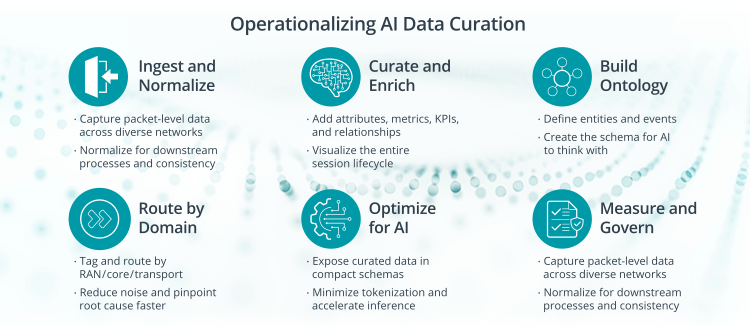
Chart showing steps to operationalize AI Data Curation

Curated Data Powers Assurance and Security

Once packet-level information is transformed, AI models can support high-value operational and security outcomes.

In service assurance, curated data makes it possible to understand a subscriber’s real-time location within the network; rapidly diagnose service degradation and failures; quickly determine whether issues stem from the RAN, core, or transport layers; and ultimately accelerate triage while improving the overall customer experience.

This level of session-aware visibility significantly reduces the time operators spend isolating root causes.

In network security, curation empowers AI to detect and analyze threats with far greater accuracy by identifying rogue or spoofed base stations, recognizing packet floods or distributed denial-of-service (DDoS)-like events from malicious actors, detecting SIM swap scenarios, and performing precision location analysis to uncover anomalies.

Because curated data embeds relationships and context, AI systems can distinguish between benign network irregularities and true security threats.

Economic and Risk-Reduction Benefits

Beyond performance, curated network data dramatically improves the cost profile of AI adoption for telecom operators. Raw packets generate enormous token loads when processed via GenAI models, making direct ingestion financially untenable. Curation reduces data volume while increasing informational density, meaning:

  • Fewer tokens need to be processed
  • Models have less “noise” to sift through
  • The risk of hallucination is reduced
  • AI recommendations become more consistent and reliable

As Fulwiler emphasizes, carriers simply cannot afford to tokenize raw packet data at scale. Curation is therefore not just a technical necessity—it is an economic imperative.

Conclusion

In modern telecom networks, actionable AI cannot spring from raw packet streams. Effective AI for assurance and security requires curated, contextual, and enriched network data—the transformation of low-level packet information into high-value, structured intelligence. With data volume scaling rapidly across global networks, curated sources are essential to achieving accurate AI reasoning, manageable costs, and dependable operations at carrier scale.

For more information about how NETSCOUT is helping service providers operationalize AI data curation, watch the complete interview.