








At 03:00 next Sunday, someone will be on shift, responsible for your network. It is worth asking who that actually is, and whether they can read a BGP table or only acknowledge an alarm. For a growing number of UK fibre operators, the honest answer is the second one, and for 128 of the 168 hours in a week there may be no answer at all.
That question used to be survivable, because the market rewarded building, but that era is closing. Ofcom puts full fibre at more than three-quarters of UK premises, and AlixPartners estimates nearly half of UK fibre operators must refinance by the end of 2026, at rates far above what they borrowed at. Lenders no longer fund premises passed. They fund take-up, revenue and cost discipline. The sorting criterion has moved from how much network you built to how well you run it.
The gap every operations lead already knows about
Most operations leaders at altnets know exactly where their gaps are, overnight coverage is thin, the inventory has drifted, the change process depends on one person being awake. What they lack is the headcount economics to fix it.
Covering one 24/7 seat sounds like simple arithmetic, 168 hours against 40-hour weeks suggests five engineers. Anyone who has built a rota knows that people need rest after nights, and someone is always on leave, off sick or working on their notice. A sustainable team takes six engineers, or five plus a lead, and it cannot be six juniors because a seat that can resolve incidents at 03:00, not just acknowledge them, needs a mix of first-line and senior engineers, which in the UK means salaries from around £33,000 to £50,000 and beyond, per public salary data. That puts the team behind that one seat at roughly £250,000 a year in base pay, and £350,000 or more with employer costs, shift premiums, recruitment, training and tooling. All of it buys one person watching at any given moment. In a consolidating market, closing this gap by hiring is the most expensive answer, competing for the same scarce engineers everyone else is chasing.
What we find inside real networks
ITcare runs managed NOC and network engineering for ISPs, data centre operators and hosting providers across North America and Europe. When we take over or extend an operator’s network operations, the pattern is consistent, the inventory is wrong in ways nobody has quantified, monitoring has either no visibility or produces a ton of alarms nobody has triaged in months, and the topology lives in one senior engineer’s head. None of this reflects badly on the teams involved. It reflects an operations function built during the build era, now carrying an operate era load it was never staffed for.
The specialist model exists for exactly this, a dedicated team of service provider engineers takes the 24/7 load, the change discipline and the escalations, working as a standalone team or an extension of the operator’s own team, and usually for less than what staffing a single 24/7 seat in-house would cost. The in-house engineers stop firefighting and go back to the work that grows the business.
The AI claim, stated honestly
Every stand at Connected Britain will say AI this year, so let me say it precisely. We build and operate HORA, an AI network operations platform, and we ran it inside our own NOC, breaking things in our own lab, before any customer touched it. That made us conservative in a specific way.
AI earns its keep on the read side. HORA brings metrics, logs, flows, BGP state, discovered topology and the source of truth into one place, and an AI engineer correlates across all of it to get a human to root cause in minutes. That is why a lean team can operate more network, and why, after a merger leaves two networks and two half-accurate inventories, automated discovery turns an integration plan into an integration. The write side is different. We keep AI off it by architecture, it proposes, a human approves, and what touches a device is deterministic automation a person wrote and can audit. Any AI pitch that skips this distinction is selling you the demo.
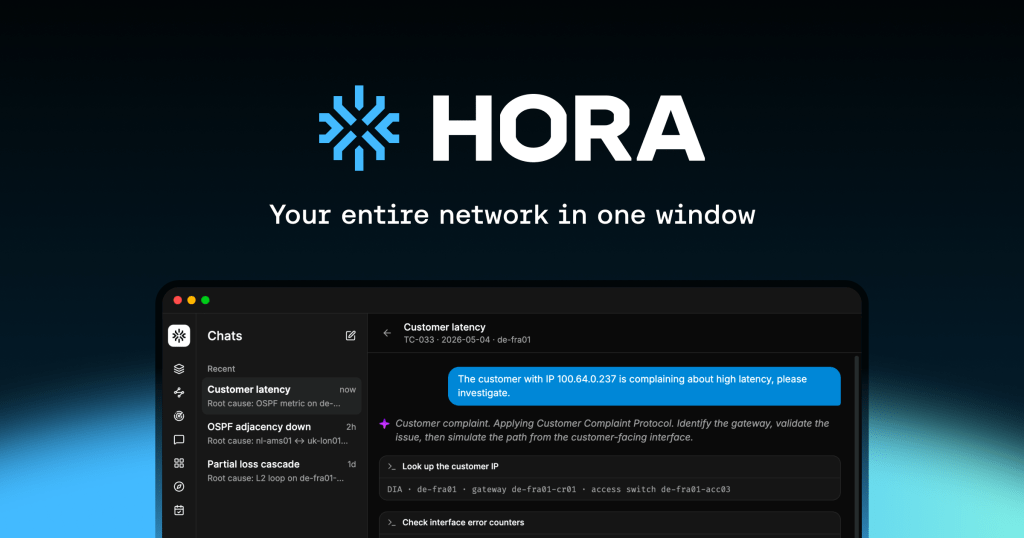
HORA correlating live network state to root cause.
The operate era
The strategic question for every operator heading into the autumn is not how much network you have, but whether the way it is operated would survive due diligence. If the honest answer is no, that is fixable, and it costs less than you think.
We will be at Connected Britain on 9 and 10 September, stand 140. Bring us your hardest operational problem, the inventory nobody trusts, the alarm queue nobody reads, and we will tell you on the spot how we would approach it. To set up a meeting ahead of the event, write to andrian.visnevschi@itcare.net.
Andrian Visnevschi is CEO and CTO of ITcare and holds JNCIE-SP #2975. ITcare runs managed NOC and network engineering for ISPs, data centre operators and hosting providers worldwide, and builds HORA, an AI network operations platform.
此内容由惯性聚合(RSS阅读器)自动聚合整理,仅供阅读参考。 原文来自 — 版权归原作者所有。