







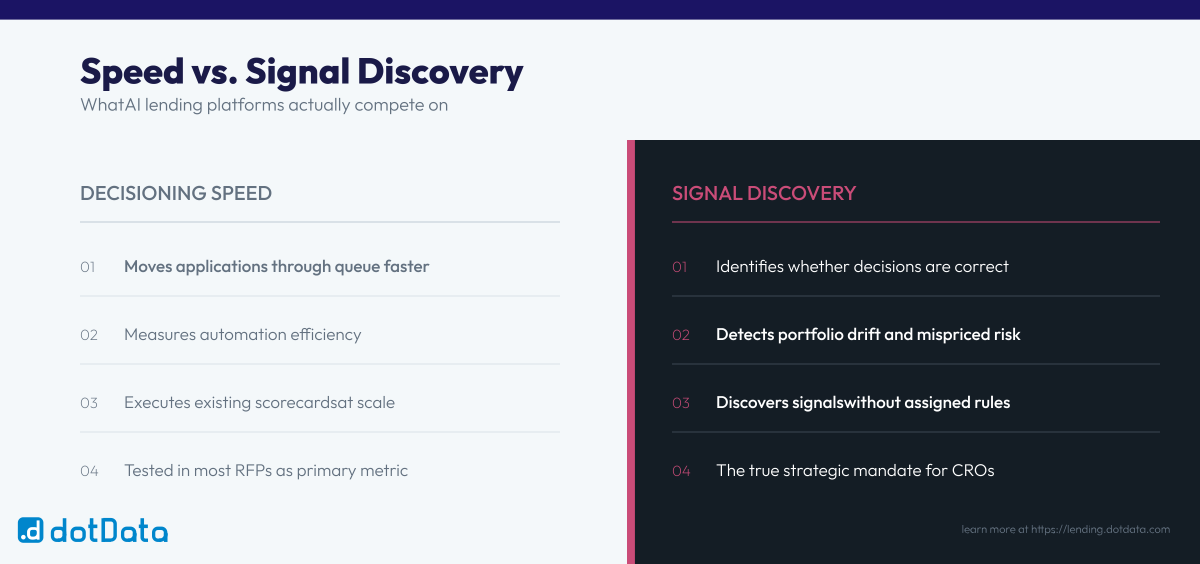
In today’s compressed margin environment, a single mispriced auto vintage can wipe out an entire quarter of portfolio gains. Yet, as financial institutions evaluate “AI based lending models,” most companies and RFPs test for only one metric: decisioning speed.
Accelerating approvals moves loan applications through the queue faster, but executing a two-year-old scorecard at 10x speed only multiplies the underlying portfolio drift. For Chief Risk Officers navigating state-level scrutiny and the CFPB’s updated Regulation B rules, the true strategic mandate isn’t decision velocity—it is Signal Discovery.
That checklist measures one job well. It measures automation — how fast a lender can move an application from submission to decision using AI driven automation to reduce manual effort and eliminate repetitive manual tasks. It says almost nothing about whether the decision itself is correct, or whether the portfolio sitting behind that decision is drifting into risk nobody assigned a rule for. A platform can auto-decision every application that hits its queue and still be systematically wrong about which segments are underpriced.
This post separates the category into what it actually contains, shows why decisioning speed alone doesn’t move loss metrics, and walks through what changed — and what didn’t — in the regulatory environment around AI powered credit decisioning as of mid-2026.
Direct answer: “AI in lending” is a market label that covers three distinct functions — document automation, decisioning automation, and signal discovery — frequently sold under a single name despite solving different problems. Most vendors deliver one or two of the three; almost none deliver all three at production depth to help lenders realize true efficiency benefits.
Document automation reads and validates unstructured inputs, such as pay stubs, bank statements, and title documents. It replaces manual data entry, and it’s genuinely mature technology at this point — error rates on structured documents now run under 1% in production systems at scale.
Decisioning automation takes a defined model or rules engine and executes it faster, at higher volume, with fewer manual handoffs to streamline the loan approval process. Speed is the layer most RFPs are actually testing when they ask a vendor to demo “AI.” It’s valuable for boosting overall operational efficiency. It’s also the layer that inherits whatever blind spots the underlying model already had — automation multiplies throughput, not accuracy.
Signal discovery is different in kind, not degree. It searches raw relational data across the entire credit lifecycle for the specific variable combinations that predict a KPI — not the variables an analyst already thought to test, but the ones nobody thought to include. Most vendor conversations skip this layer entirely because it’s the hardest to build and the easiest to fake with a dashboard.
The lack of clarity incurs actual financial costs. When a lender assesses three “AI lending platforms” simultaneously, without distinguishing their functions, they inadvertently compare a document scanner, a decision engine, and a discovery tool against a single scorecard not tailored to any of them.
| Function | Primary Role | What It Solves | What It Inherits / Leaves Unsolved |
|---|---|---|---|
|
Document Automation |
Unstructured Data Entry |
Processing friction & intake speed |
Validates document data, not credit risk |
|
Decisioning Automation |
Rule & Scorecard Execution |
Queue throughput & handoff speed |
Multiplies throughput of existing model blind spots |
|
Signal Discovery |
Relational Feature Eng. |
Uncovering non-obvious KPI drivers |
Upstream risk discovery & explainable logic |
Direct answer: automated decisioning increases approval velocity and application throughput by executing an existing model more quickly and consistently. It does not identify what that model is currently blind to — so a faster wrong decision is still a wrong decision, made sooner and at higher volume.
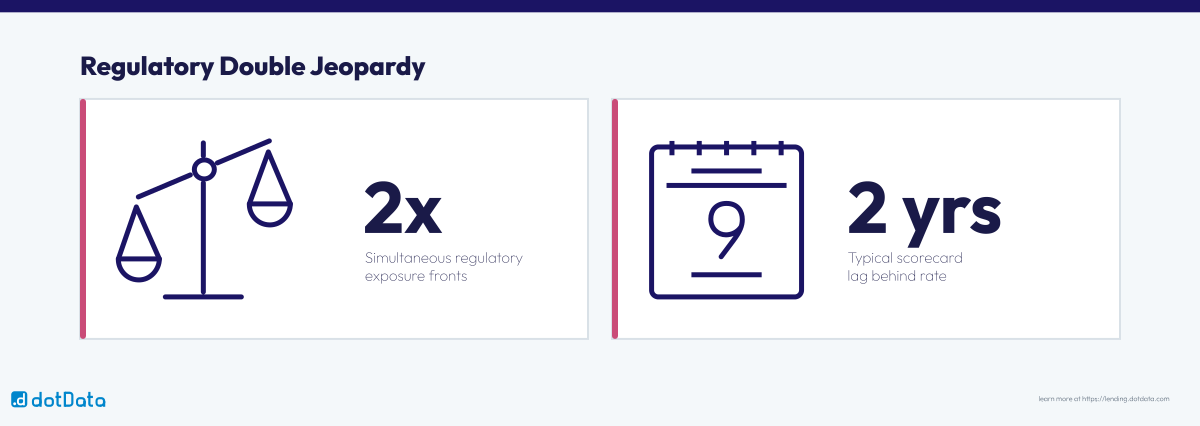
Here’s the part most evaluation criteria miss entirely: a decisioning engine can only act on the variables someone already told it to consider. If the underlying scorecard was built two years ago on a different rate environment, automating it doesn’t correct the drift — it just executes the stale logic with less friction. Speed becomes a multiplier on whatever error rate the model already carries.
Accelerating decisions based on old assumptions isn’t a hypothetical concern. Auto lenders adopting AI tools are now facing what compliance experts describe as regulatory double jeopardy — state regulators intensifying scrutiny of AI driven lending decisions at the same time federal agencies are still finalizing their own guidance on the technology, according to compliance specialists speaking at a recent industry conference covered by Auto Finance News. A lender that can’t explain why its automated model made a specific decision is exposed on two fronts simultaneously, not one.
The practical consequence: a lender who measures success purely by approval-rate lift or time-to-decision can hit every KPI in the automation dashboard. At the same time, the portfolio’s actual loss curve continues to climb. Those two outcomes aren’t contradictory. They’re describing two different systems that happen to share a vendor contract.
Direct answer: signal discovery is the process of surfacing the specific, non-obvious combinations of variables that drive a target KPI — such as the 90-day past-due rate — that a standing scorecard was never built to test for. It operates upstream of decisioning, not as a replacement for it, providing deeper risk analysis and a more comprehensive risk assessment before a loan is ever originated.
Think about what a scorecard actually contains: a fixed list of variables, chosen by a human analyst, at a point in time. Every variable outside that list is invisible to the model no matter how predictive it is. Signal discovery inverts the starting point — instead of testing a hypothesis an analyst already had using standard credit reports or a shallow review of credit history, it evaluates millions of relational combinations across both internal data and external data sources directly against the KPI. It surfaces the ones that actually move it, turning vast amounts of complex data into actionable insights.
Signal Discovery is the layer where dotData Core operates. Rather than requiring a data science team to manually hypothesize and test each candidate variable from vast pools of borrower data — a process that can take weeks per hypothesis — the platform evaluates relational data directly. It generates Driver Signals: specific, named patterns tied to measurable lift. One example already in production use: a vehicle-attribute Driver Signal showing that Consumers who use credit builders match 13% of historical records and lift default risk by 11.5 percentage points above the portfolio average. That’s not a demo statistic. It’s the kind of variable a manual review process would need months, not minutes, to isolate.
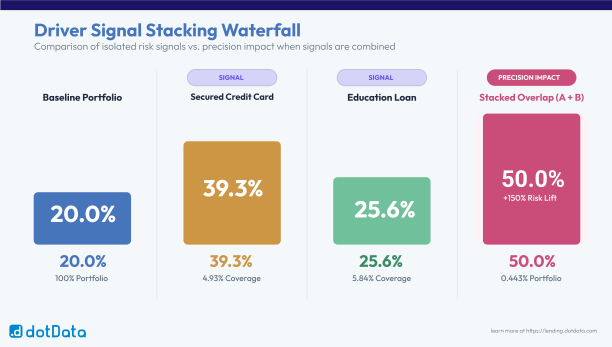
The stacking mechanics matter more than the individual signals do. A secured credit card Driver Signal, covering 4.93% of records, lifts the target default rate from a 20% baseline to 39.3%. An education-loan Driver Signal covering 5.84% of records independently lifts it to 25.6%. Stacked together into a single Precision Impact Segment, the overlapping 0.443% of the portfolio carries a 50.0% default rate — a 30-percentage-point surge over baseline, invisible to either signal on its own.
A 0.443%-of-portfolio segment running at 2.5 times the baseline default rate is not a model-retrain problem. It’s a pricing or knockout-rule decision that can be implemented this week, not next quarter’s redevelopment cycle.
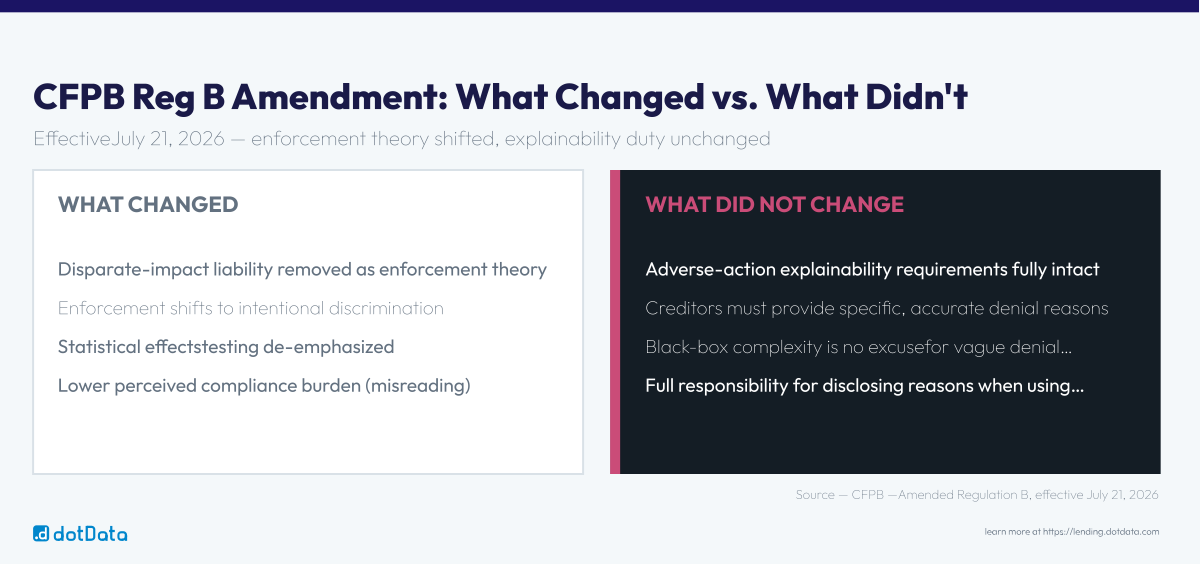
Direct answer: on April 22, 2026, the CFPB finalized an amendment to Regulation B that removes disparate-impact liability as a theory of enforcement under the Equal Credit Opportunity Act. The change does not affect adverse-action explainability requirements — creditors must still provide specific, accurate reasons for every denial, regardless of the technology used to reach that loan decision.
Lenders who interpret the “disparate impact eliminated” statement as implying a lower compliance burden are interpreting the rule too narrowly. The CFPB changed the enforcement theory it uses in pursuing discrimination claims. The Bureau’s amended Regulation B, effective July 21, 2026, shifts enforcement toward intentional discrimination and away from statistical effects testing. What did not change is the underlying statutory duty. ECOA and Regulation B still require creditors to give specific, accurate reasons for every adverse action, and that obligation is unaffected by the CFPB’s 2025 withdrawal of its earlier AI-specific circulars. Black-box complexity is not an excuse for a vague denial reason — the model a lender cannot explain is still the lender’s legal problem.
That distinction is exactly where explainable signal infrastructure earns its keep. dotData’s approach to this problem — covered in depth in Why ‘Glass Box’ Models Win — is to make every discovered signal exportable as transparent, auditable SQL logic rather than an opaque model score. An underwriter or examiner can trace the exact variables behind a denial. That doesn’t just satisfy the letter of Regulation B; it removes the ambiguity that turns a routine audit into a prolonged one.
An examiner finding, a remediation plan, and months of heightened scrutiny on subsequent model decisions can all be triggered by a single non-compliant adverse action notice. The upfront development of explainable signal infrastructure is consistently proven to be the more cost-effective approach for managing risk and working to reduce risk across diverse credit products.
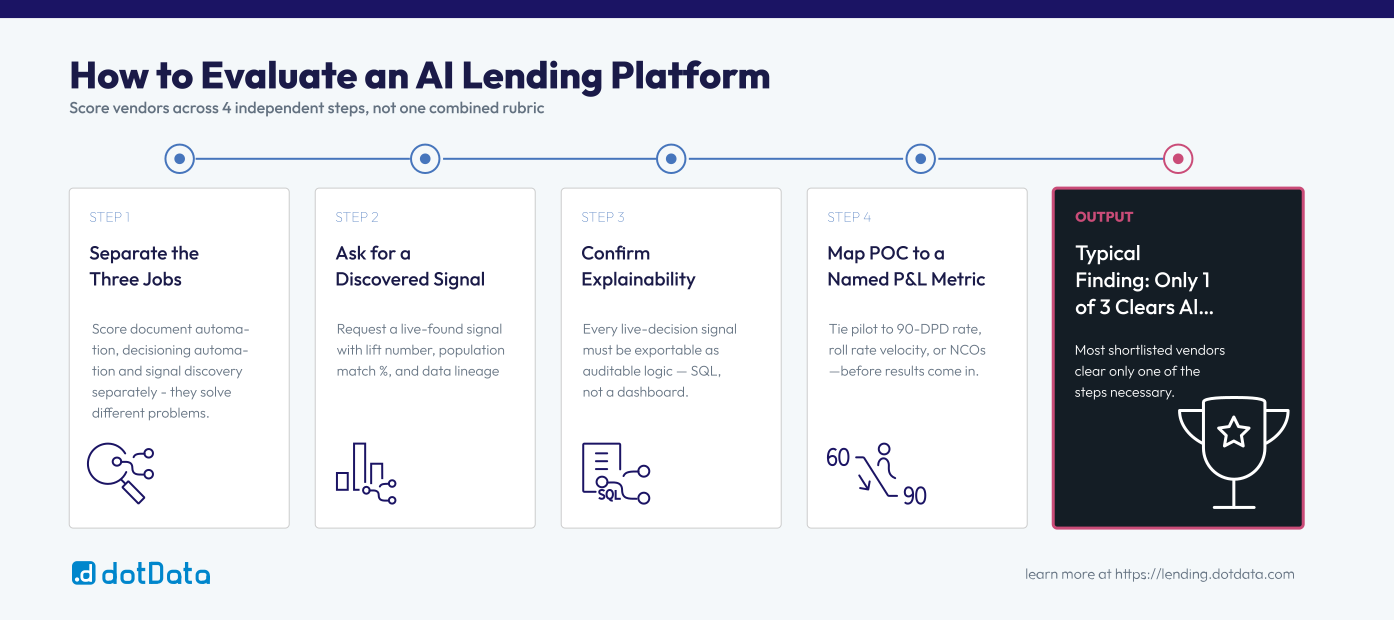
Direct answer: score any platform against three separate questions rather than a single combined scorecard:
A vendor that only answers the first question is selling a document scanner or a decision engine, not a discovery tool, regardless of what the pitch deck calls it. When you’re ready to run this against a real shortlist, the best AI-powered lending platforms guide applies these three questions to the vendors most lenders actually evaluate — and covers the regulatory vetting gap the NCUA and the banking agencies haven’t closed.
The quickest method to determine the actual category of a vendor is to request a live example of a signal that their system has identified, rather than one that their team has pre-constructed and uploaded into a demonstration environment.
A discovered signal includes a lift number, a population match percentage, and a data lineage that an analyst can follow. Conversely, a pre-built signal is merely represented on a slide.
A regional credit union running this evaluation framework against three shortlisted vendors typically finds that only one clears all four steps. The other two clear step one and stop there — which is a useful finding in itself, just not the one their sales teams lead with.
“AI in lending” was never one product. It’s at least three, sold under a single search term because the market hasn’t forced vendors to be precise about which job they actually do. Lenders who buy against the label instead of the function end up with faster processing of the same blind spots they had before, and a compliance posture that assumes speed and explainability are the same thing. Modernizing internal lending processes shouldn’t come at the expense of loan quality or a seamless customer experience.
The lenders who separate the three jobs — automation, decisioning, and discovery — before signing anything are the ones who show up for their next examiner review with answers rather than dashboards. That’s not a technology advantage. It’s a due diligence one, and it’s available to any lender willing to ask the sharper questions before the demo starts.
“AI in lending” is a broad market category covering document automation, decisioning automation, and signal discovery. Automated loan decisioning is specifically the second of those three — a system executing a defined model or rules engine faster and at higher volume. It does not, on its own, discover new predictive patterns; it just runs the existing ones faster.
A lender can use a complex or opaque model, but doing so does not remove the legal obligation to provide specific, accurate reasons for any adverse action under ECOA and Regulation B. That duty sits in the statute, not in agency guidance the Bureau can withdraw — a creditor that cannot explain its own model’s output is exposed regardless of how accurate that model may be.
See where your existing models and scorecards have blind spots. Talk to dotData about signal discovery for your portfolio.
此内容由惯性聚合(RSS阅读器)自动聚合整理,仅供阅读参考。 原文来自 — 版权归原作者所有。