




惯性聚合 高效追踪和阅读你感兴趣的博客、新闻、科技资讯
阅读原文 在惯性聚合中打开

推荐订阅源

WordPress大学
WordPress大学
Spread Privacy
Spread Privacy
T
The Exploit Database - CXSecurity.com
Simon Willison's Weblog
P
Privacy & Cybersecurity Law Blog
L
LINUX DO - 热门话题
T
Threat Research - Cisco Blogs
T
Tenable Blog
TaoSecurity Blog
TaoSecurity Blog
Security Archives - TechRepublic
AI
AI
P
Proofpoint News Feed
A
About on SuperTechFans
P
Privacy International News Feed
月光博客
月光博客
雷峰网
雷峰网
S
Secure Thoughts
博客园 - 叶小钗
博客园 - 聂微东
cs.CL updates on arXiv.org
Project Zero
Project Zero
The Cloudflare Blog
SecWiki News
SecWiki News
The Hacker News
The Hacker News
V
Vulnerabilities – Threatpost
罗磊的独立博客
A
Arctic Wolf
阮一峰的网络日志
阮一峰的网络日志
Know Your Adversary
Know Your Adversary
酷 壳 – CoolShell
酷 壳 – CoolShell
OSCHINA 社区最新新闻
OSCHINA 社区最新新闻
T
Troy Hunt's Blog
The Last Watchdog
The Last Watchdog
Schneier on Security
小众软件
小众软件
有赞技术团队
有赞技术团队
博客园 - 司徒正美
T
Tailwind CSS Blog
量子位
C
Cybersecurity and Infrastructure Security Agency CISA
让小产品的独立变现更简单 - ezindie.com
Hugging Face - Blog
Hugging Face - Blog
人人都是产品经理
人人都是产品经理
奇客Solidot–传递最新科技情报
奇客Solidot–传递最新科技情报
S
Security @ Cisco Blogs
大猫的无限游戏
大猫的无限游戏
S
SegmentFault 最新的问题
Apple Machine Learning Research
宝玉的分享
宝玉的分享
L
Lohrmann on Cybersecurity

博客园 - Stanley.Luo

CentOS 7+nginx+PHP+php-fpm Linux 的系统目录介绍 Loom工具类:Unity3D巧妙处理多线程 3Dmax 创建物体 3DMax 物体选择方法 3DMax 常用快捷键 HTC Vive 与Leap Motion 出现位置错误的问题 Groovy与Gradle在Android中的应用 VR的UI、UX设计原则 为什么带网格(mesh)的模型添加了刚体Rigidbody和MeshCollider,还是会从地板穿过去? Mecanim动画模型规范 Mecanim动画系统 制作流程 HTC Vive 体验的折腾经历 OpenGLES 2.0 可编程渲染管线 【VR视频播放】解决Unity模型贴图反转的问题 Lua语言的特别之处 Unity3D 的摄像机 iptables 的使用 CentOS安装Nginx
C++与Java,C#的异同(一):值,地址,引用
Stanley.Luo · 2017-01-22 · via 博客园 - Stanley.Luo

Java,C#已经比较熟悉,最近在从0开始自学C++。学习过程中必然会与Java,C#进行对比,有吐槽,也有点赞。

先来讲讲最基本也是最重要的部分:参数传递的方式。

对于类型, Java分基本类型、复合类型,从另外一个角度分是值类型,引用类型。在展开对比前, 我们先来看看三个关键方式:

    • 创建新的副本,与原来的没有关系
  • 地址(指针)

    • 把对象所在内存的地址传递过去
  • 引用

    • 可以理解为变量的别名

举个例子:

 1 void testMethodA(int input) {
 2     input = 999;
 3 }
 4 
 5 void testMethodB(int* input) {
 6     //int newValue = 888;
 7     *input = 888;
 8 }
 9 
10 void testMethodC(int& input) {
11     input = 777;
12 }
13 
14 int main() {
15 
16     int input = 111;
17     cout << "Original: " << input << endl;
18     testMethodA(input);
19     cout << "After testMethodA: " << input << endl;
20     cout << input;
21     testMethodB(&input);
22     cout << "After testMethodB: " << input << endl;
23     cout << input;
24     testMethodC(input);
25     cout << "After testMethodC: " << input << endl;
26 
27     std::cin.get();
28 
29     // What is the value of input?
30 
31 }

运行后的结果:

Original: 111
After testMethodA: 111
111After testMethodB: 888
888After testMethodC: 777

 解释一下:

函数 testMethodA 的参数是值传递的,调用函数后,创建了一个input的副本,副本的值改变了, 但是input值没有被改变。

函数 testMethodB 的参数是地址(指针)传递的,函数内修改了input指向的那块内存区域,所以input的值也被改变了。

函数 testMethodC的行为看起来是和函数 testMethodB是一样的, input值也被改变了,他们有什么区别呢?

区别在于:

传递地址,函数内改变的是变量指向的那块内存区域的内容。

传递引用,函数内改变的是变量的指向,换句话说,input指向的内存地址都变了。

 如下图:
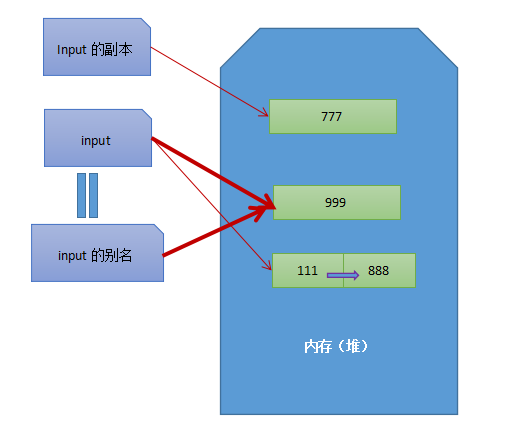
在C++里面,所有的类型,不管是基础数据类型,结构体,还是类,默认都是“值”传递的;显式声明为指针,才是传地址;显式声明为引用,可以认为就是给变量起了一个别名。

在Java里面,只有基础数据类型(int, double, float等),是值传递的,所有的类对象,都是传地址(注意,不是传引用), 实际上,java里面没有引用传递的概念。

在C#里面, 基础数据类型,结构体, 默认都是值传递;所有的对象, 默认都是传地址;如果想传引用,在参数前面加ref关键字,例如:

1  void testMethodC(ref int input) {
2      input = 777;
3  }