

惯性聚合 高效追踪和阅读你感兴趣的博客、新闻、科技资讯
阅读原文 在惯性聚合中打开

推荐订阅源

cs.AI updates on arXiv.org
WordPress大学
WordPress大学
宝玉的分享
宝玉的分享
人人都是产品经理
人人都是产品经理
博客园 - 聂微东
IT之家
IT之家
V
V2EX
Jina AI
Jina AI
V
Visual Studio Blog
有赞技术团队
有赞技术团队
博客园 - 司徒正美
博客园 - 叶小钗
The Cloudflare Blog
cs.CV updates on arXiv.org
小众软件
小众软件
奇客Solidot–传递最新科技情报
奇客Solidot–传递最新科技情报
博客园 - 三生石上(FineUI控件)
OSCHINA 社区最新新闻
OSCHINA 社区最新新闻
Google DeepMind News
钛媒体:引领未来商业与生活新知
钛媒体:引领未来商业与生活新知
腾讯CDC
Google Online Security Blog
博客园 - 【当耐特】
Apple Machine Learning Research
K
KPMG report finds enterprise disconnect between AI and its ROI | CIO
N
News and Events Feed by Topic
N
News and Events Feed by Topic
The Last Watchdog
The Last Watchdog
W
WeLiveSecurity
月光博客
月光博客
Security Archives - TechRepublic
Webroot Blog
Webroot Blog
SecWiki News
SecWiki News
博客园_首页
罗磊的独立博客
量子位
Latest news
Latest news
I
Intezer
V
Vulnerabilities – Threatpost
A
Arctic Wolf
Last Week in AI
Last Week in AI
Recent Commits to openclaw:main
S
SegmentFault 最新的问题
S
Security Affairs
阮一峰的网络日志
阮一峰的网络日志
让小产品的独立变现更简单 - ezindie.com
酷 壳 – CoolShell
酷 壳 – CoolShell
P
Palo Alto Networks Blog
C
CXSECURITY Database RSS Feed - CXSecurity.com
N
News | PayPal Newsroom

Threat Intelligence Blog | Flashpoint

Understanding Illicit Ecosystems: How Dark Web Forums Structure Cybercrime AI, Trust, and the Future of Threat Intelligence Remus Stealer: A New, Not-So-New Infostealer America250 Fourth of July Threat Assessment Unmasking the Digital Trail: Essential Techniques for Vetting AI-Generated Content The Shift to Threat-Informed Prioritization: Operationalizing CISA BOD 26-04 Identity Is the New Attack Surface: How Infostealers Are Reshaping Enterprise Risk Understanding Illicit Ecosystems: Weaponizing Mainstream Apps and Social Infrastructure Connecting Vulnerability Intelligence to Real-World Exposure With Flashpoint EASM Understanding Illicit Ecosystems: XSS and the Current State of the Russian-Speaking Underground How to Align and Measure Threat Intelligence Operations: Flashpoint Priority Intelligence Requirements The Mini Shai-Hulud Worm and the New Era of CI/CD Exploitation Understanding Illicit Ecosystems: The Hybrid Threat of “The Com” AI Threat Report: How Artificial Intelligence Is Used Across Illicit Communities How Mergers and Acquisitions Expand Your Attack Surface Overnight The Evolution of the Geotag: How AI is Bridging the Gap in Location-Based OSINT Navigating the Threat Landscape of the 2026 FIFA World Cup Flashpoint MCP Server: Operationalizing Cyber Threat Data for Agentic AI Security Workflows 2026 Gartner® Magic Quadrant™ for Cyber Threat Intelligence: Key Takeaways for Security Leaders Escalation in the Middle East: Tracking “Operation Epic Fury” Across Military and Cyber Domains How to Build and Operationalize Priority Intelligence Requirements National Vulnerability Database (NVD) Shifts to Selective Enrichment as CVE Volume Surges Flashpoint Surpasses Cataloging 7,000 Known Exploited Vulnerabilities as Disclosure Volume Accelerates Why Intelligence Requirements Fall Flat and How to Fix Them with a Practical Priority Intelligence Requirements Framework The Phishing-as-a-Service Pipeline: How a Scalable Fraud Ecosystem Is Driving Global Attacks Tax Refund Fraud in 2026: How Threat Actors Exploit Identity, Verification, and Cash-Out Channels The Language of Emojis in Threat Intelligence: How Adversaries Signal, Obfuscate, and Coordinate Online What the NVD ‘Slowdown’ Means For You: How to Stay Ahead in Vulnerability Management Forrester Threat Intelligence Landscape: Key Takeaways for Security Leaders Connecting Threat Intelligence to Decision-Making: How Flashpoint Is Operationalizing Intelligence in 2026 Iran-Aligned Militias Signal Expanded Regional Risk Amid US–Israel–Iran Conflict Destructive Activity Targeting Stryker Highlights Emerging Supply Chain Risks Navigating 2026’s Converged Threats: Insights from Flashpoint’s Global Threat Intelligence Report What to Know About the Notepad++ Supply-Chain Attack Cyber Threat Intelligence Index: Q3 2023 Edition Beyond Hamas: Militant and Terrorist Groups Involved in the October 7 Attack on Israel The First 72 Hours of the Israel-Hamas War: Hamas and PIJ Activity on Telegram About Us Qakbot Takedown: A Brief Victory in the Fight Against Resilient Malware Unmasking the Attacker and Decoding Threat Actor Patterns The Flashpoint Firehose: 5 Questions With Michael Raypold, VP of Engineering The Seven Phases of a Ransomware Attack: A Step-by-Step Breakdown of the Attack Lifecycle Lost in Transition: A Timeline of Failed Successors to Breach and Raid Forums Days of Chaos: How OSINT Helps Us Understand the Putin-Prigozhin Schism Lessons From Clop: Combating Ransomware and Cyber Extortion Events How to Combat Check Fraud: Leveraging Intelligence to Prevent Financial Loss Beyond Gates and Alarms: The Scope and Impact of Physical Security Intelligence Why We Built Flashpoint Ignite: Unity, Power, and Performance The Risk-Reducing Power of Flashpoint Video Search Card Shop Threat Landscape: BidenCash Dumps 2.1M Stolen Credit Cards Flashpoint in 2023: A Note From Our CEO 5 Reasons Taiwan Is a Growing Source of US-China Tension Why We Acquired Echosec Systems: The OSINT Revolution Open Source Intelligence
Inside the 2026 Cyber Threat Landscape: Data-Driven Security Priorities
Flashpoint · 2026-05-09 · via Threat Intelligence Blog | Flashpoint

In 2026, the threat landscape operates as a single, connected system. Identity, malware, and infrastructure are now part of the same attack chain, executed at a speed that compresses the time between access and impact.

What once required multiple stages and specialized tooling is now streamlined and automated.

Flashpoint recently hosted an on-demand webinar, “Inside the 2026 Cyber Threat Landscape: Data-Driven Security Priorities,” where our intelligence team broke down the trends driving this shift. Drawing from primary source intelligence across forums, marketplaces, and closed communities, the session examined how modern attack chains are forming and evolving, as well as where defenders still have opportunities to intervene.

Here are the key takeaways you need to know to prioritize threats and protect your organization.

AI Is Being Operationalized Across the Attack Lifecycle

Artificial intelligence is now embedded across multiple stages of attacker workflows.

Flashpoint tracked more than 1.5 billion mentions of AI in illicit communities in 2025, with activity accelerating sharply toward the end of the year. These discussions center on how AI can be applied to real operations, including phishing, malware development, and fraud.
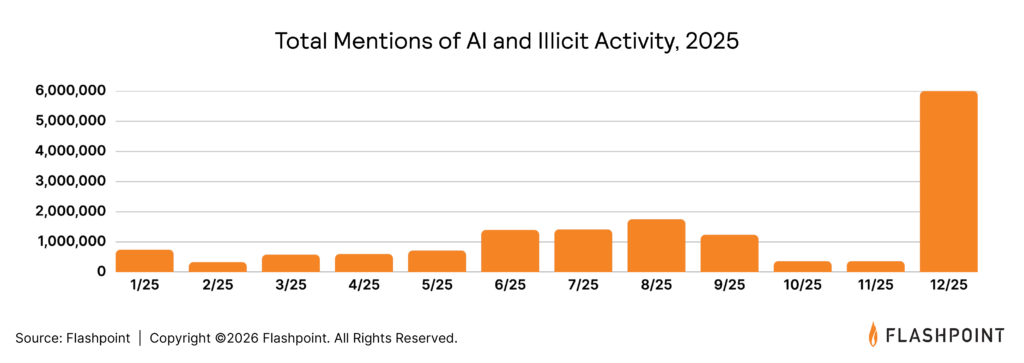
As Ian Gray, Vice President of Intelligence at Flashpoint, noted during the session, “Adversaries are extremely adept, and they’re constantly looking at how they can use the newest state-of-the-art tools—whether that’s commercial models or their own implementations—and how they can jailbreak them or adapt them to their workflows.”

One of the most notable developments is the use of agentic AI systems to automate tasks that were previously manual. These systems are being used to:

  • Test stolen credentials across VPNs, SaaS platforms, and cloud environments
  • Rotate infrastructure during active operations
  • Generate and refine attack inputs based on previous outcomes

Alongside this, threat actors are actively exploring ways to bypass safeguards in commercial AI tools, including:

  • Jailbreaking model restrictions
  • Embedding hidden instructions through prompt injection
  • Manipulating AI-powered features within enterprise applications

This activity reflects a sustained effort to integrate AI directly into attack execution rather than treating it as a standalone capability.

Identity Is Driving Initial Access

The fundamental mechanics of cybercrime have shifted from breaking in to logging in, as attackers leverage stolen session cookies to behave like legitimate users.

As Gray explained, “Threat actors are finding a variety of ways to get into enterprise networks, and typically it’s through the human element. While humans can be trained or educated, it’s not something that can be patched in the traditional sense.”

This dynamic is already visible at scale.

Flashpoint observed 11.1 million infected devices and 3.3 billion stolen credentials in 2025. These credentials are extracted through infostealers and circulated across marketplaces, enabling direct access into enterprise environments.

In many cases, attackers are using:

  • Session cookies and tokens to bypass authentication flows
  • Browser fingerprints and system metadata to replicate legitimate user behavior
  • Valid credentials to access SaaS platforms, VPNs, and internal systems

Once access is established, activity often blends into normal user behavior, making detection more difficult. Compromised identities are also reused across multiple services, expanding the scope of potential exposure.

This pattern continues to appear in intrusion activity tied to SaaS platforms and third-party integrations, where access to one system can provide visibility into multiple environments.

Infostealers Are Enabling Scalable Access

Infostealers remain a primary driver of credential exposure.

Logs containing credentials, cookies, and system data are continuously harvested and made available through criminal marketplaces and subscription-based services. These logs are used directly or integrated into automated workflows that test and validate access at scale.

Gray pointed to how this plays out in practice: “Infostealers have really commoditized access. They harvest credentials, identify which ones are useful, and then test them at scale across VPNs, SaaS platforms, and cloud environments.”

The ecosystem continues to shift as law enforcement activity disrupts established players and new variants gain traction. Families such as Vidar, Lumma, and others maintain a strong presence due to accessibility and ongoing development.
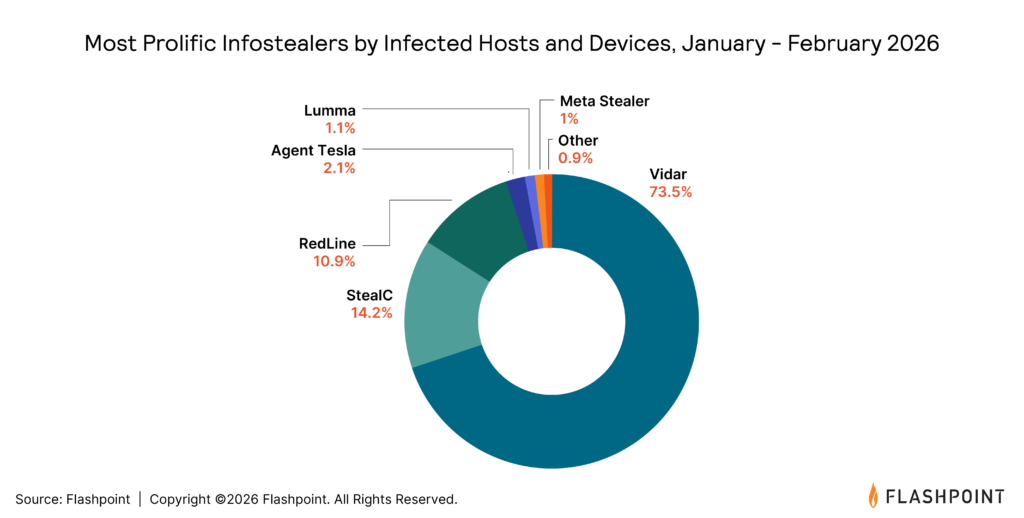
In parallel, credential harvesting is feeding downstream activity, including:

  • Account takeover
  • Fraud operations
  • Data exfiltration and extortion

This linkage between initial access and follow-on activity is consistent across multiple reporting streams.

Vulnerability Exploitation Is Moving Faster

Vulnerability volume continues to increase alongside exploitation speed.

Flashpoint recorded more than 44,000 disclosed vulnerabilities in 2025, with over 14,000 tied to publicly available exploits. In several cases, exploitation activity followed disclosure within a day.

As Gray put it, “With vulnerabilities, it can feel like you’re trying to boil the ocean. There’s such a high volume of disclosures, but in reality, there’s a smaller set—those that are remotely exploitable, have proof-of-concept code, and are being actively used—that you need to focus on.”

Attacker focus is concentrated in areas that provide broad access or downstream impact, including:

  • Software supply chains and CI/CD environments
  • Open-source dependencies
  • Widely used enterprise platforms

Given the volume of disclosures, prioritization remains critical. Vulnerabilities that are remotely exploitable and paired with public exploit code present immediate risk, particularly when active discussion or exploitation is observed.

Ransomware Activity Continues to Shift

Ransomware activity increased by 53%, with continued changes in how operations are carried out.

Gray framed the shift this way: “Why even bother to develop ransomware? That takes time, resources, and overhead—when you can gain access through a compromised account or third-party platform and immediately move to extortion.”

In addition to traditional ransomware deployment, there is sustained activity centered on:

  • Data exfiltration followed by extortion
  • Use of compromised credentials for direct access
  • Targeting of third-party providers and SaaS platforms

Intrusions tied to help desks, identity workflows, and federated applications continue to appear in reporting, often involving social engineering or unauthorized access provisioning.

There is also ongoing activity related to insider recruitment, with threat actors seeking individuals who can provide direct access or privileged information.

Industries with higher operational dependencies, including manufacturing, technology, and healthcare, continue to be targeted due to the potential impact of disruption.

Translating Intelligence Into Action

The trends shaping 2026 are grounded in how attackers are currently operating across multiple domains.

As Gray emphasized, “You have to take into account vulnerabilities, exposures, infostealers, and identity compromise all at the same time. These aren’t separate problems anymore—they’re all part of the same attack chain.”

Security teams should focus on:

  • Identifying exposures with a high likelihood of exploitation
  • Monitoring for compromised credentials tied to organizational domains
  • Reviewing identity access and third-party integrations
  • Prioritizing vulnerabilities with active exploit availability
  • Tracking attacker activity across forums, marketplaces, and communication channels

These actions align with observed attacker behavior and provide a clearer path to prioritization.

Watch the Full Webinar and Explore the Data

The trends shaping 2026 are grounded in how attackers are already operating.

Flashpoint’s full webinar provides a deeper look at the data, along with practical guidance on how to translate intelligence into action.

Watch the on-demand session to see the full breakdown of these trends, or download the 2026 Global Threat Intelligence Report to explore the underlying data and analysis in more detail.