
惯性聚合 高效追踪和阅读你感兴趣的博客、新闻、科技资讯
阅读原文 在惯性聚合中打开

推荐订阅源

Threat Intelligence Blog | Flashpoint
T
Troy Hunt's Blog
Scott Helme
Scott Helme
T
Threat Research - Cisco Blogs
T
Tenable Blog
L
LINUX DO - 热门话题
V
Visual Studio Blog
I
Intezer
Blog — PlanetScale
Blog — PlanetScale
Cisco Talos Blog
Cisco Talos Blog
A
Arctic Wolf
C
Cyber Attacks, Cyber Crime and Cyber Security
F
Fortinet All Blogs
aimingoo的专栏
aimingoo的专栏
Know Your Adversary
Know Your Adversary
CTFtime.org: upcoming CTF events
N
Netflix TechBlog - Medium
SecWiki News
SecWiki News
I
InfoQ
Microsoft Security Blog
Project Zero
Project Zero
W
WeLiveSecurity
Microsoft Azure Blog
A
About on SuperTechFans
Recorded Future
Recorded Future
Cyber Security Advisories - MS-ISAC
Vercel News
Vercel News
S
Securelist
Spread Privacy
Spread Privacy
L
LangChain Blog
云风的 BLOG
云风的 BLOG
G
Google Developers Blog
MongoDB | Blog
MongoDB | Blog
Google DeepMind News
Recent Commits to openclaw:main
D
Darknet – Hacking Tools, Hacker News & Cyber Security
C
CERT Recently Published Vulnerability Notes
罗磊的独立博客
K
KPMG report finds enterprise disconnect between AI and its ROI | CIO
The Last Watchdog
The Last Watchdog
Attack and Defense Labs
博客园 - 司徒正美
Help Net Security
Help Net Security
L
Lohrmann on Cybersecurity
人人都是产品经理
人人都是产品经理
Forbes - Security
Forbes - Security
Hacker News - Newest:
Hacker News - Newest: "LLM"
PCI Perspectives
PCI Perspectives
博客园 - 【当耐特】
T
Tor Project blog

Threat Intelligence Blog | Flashpoint

Understanding Illicit Ecosystems: How Dark Web Forums Structure Cybercrime AI, Trust, and the Future of Threat Intelligence America250 Fourth of July Threat Assessment Unmasking the Digital Trail: Essential Techniques for Vetting AI-Generated Content The Shift to Threat-Informed Prioritization: Operationalizing CISA BOD 26-04 Identity Is the New Attack Surface: How Infostealers Are Reshaping Enterprise Risk Understanding Illicit Ecosystems: Weaponizing Mainstream Apps and Social Infrastructure Connecting Vulnerability Intelligence to Real-World Exposure With Flashpoint EASM Understanding Illicit Ecosystems: XSS and the Current State of the Russian-Speaking Underground How to Align and Measure Threat Intelligence Operations: Flashpoint Priority Intelligence Requirements The Mini Shai-Hulud Worm and the New Era of CI/CD Exploitation Understanding Illicit Ecosystems: The Hybrid Threat of “The Com” AI Threat Report: How Artificial Intelligence Is Used Across Illicit Communities How Mergers and Acquisitions Expand Your Attack Surface Overnight The Evolution of the Geotag: How AI is Bridging the Gap in Location-Based OSINT Navigating the Threat Landscape of the 2026 FIFA World Cup Inside the 2026 Cyber Threat Landscape: Data-Driven Security Priorities Flashpoint MCP Server: Operationalizing Cyber Threat Data for Agentic AI Security Workflows 2026 Gartner® Magic Quadrant™ for Cyber Threat Intelligence: Key Takeaways for Security Leaders Escalation in the Middle East: Tracking “Operation Epic Fury” Across Military and Cyber Domains How to Build and Operationalize Priority Intelligence Requirements National Vulnerability Database (NVD) Shifts to Selective Enrichment as CVE Volume Surges Flashpoint Surpasses Cataloging 7,000 Known Exploited Vulnerabilities as Disclosure Volume Accelerates Why Intelligence Requirements Fall Flat and How to Fix Them with a Practical Priority Intelligence Requirements Framework The Phishing-as-a-Service Pipeline: How a Scalable Fraud Ecosystem Is Driving Global Attacks Tax Refund Fraud in 2026: How Threat Actors Exploit Identity, Verification, and Cash-Out Channels The Language of Emojis in Threat Intelligence: How Adversaries Signal, Obfuscate, and Coordinate Online What the NVD ‘Slowdown’ Means For You: How to Stay Ahead in Vulnerability Management Forrester Threat Intelligence Landscape: Key Takeaways for Security Leaders Connecting Threat Intelligence to Decision-Making: How Flashpoint Is Operationalizing Intelligence in 2026 Iran-Aligned Militias Signal Expanded Regional Risk Amid US–Israel–Iran Conflict Destructive Activity Targeting Stryker Highlights Emerging Supply Chain Risks Navigating 2026’s Converged Threats: Insights from Flashpoint’s Global Threat Intelligence Report What to Know About the Notepad++ Supply-Chain Attack Cyber Threat Intelligence Index: Q3 2023 Edition Beyond Hamas: Militant and Terrorist Groups Involved in the October 7 Attack on Israel The First 72 Hours of the Israel-Hamas War: Hamas and PIJ Activity on Telegram About Us Qakbot Takedown: A Brief Victory in the Fight Against Resilient Malware Unmasking the Attacker and Decoding Threat Actor Patterns The Flashpoint Firehose: 5 Questions With Michael Raypold, VP of Engineering The Seven Phases of a Ransomware Attack: A Step-by-Step Breakdown of the Attack Lifecycle Lost in Transition: A Timeline of Failed Successors to Breach and Raid Forums Days of Chaos: How OSINT Helps Us Understand the Putin-Prigozhin Schism Lessons From Clop: Combating Ransomware and Cyber Extortion Events How to Combat Check Fraud: Leveraging Intelligence to Prevent Financial Loss Beyond Gates and Alarms: The Scope and Impact of Physical Security Intelligence Why We Built Flashpoint Ignite: Unity, Power, and Performance The Risk-Reducing Power of Flashpoint Video Search Card Shop Threat Landscape: BidenCash Dumps 2.1M Stolen Credit Cards Flashpoint in 2023: A Note From Our CEO 5 Reasons Taiwan Is a Growing Source of US-China Tension Why We Acquired Echosec Systems: The OSINT Revolution Open Source Intelligence
Remus Stealer: A New, Not-So-New Infostealer
Flashpoint Intel Team · 2026-07-03 · via Threat Intelligence Blog | Flashpoint

The underground marketplace rarely stays quiet for long. A new information-stealing malware dubbed Remus Stealer has surfaced in the cybercrime underground, exhibiting significant similarities to the notorious Lumma malware family across its administration panel, stolen log files, and core code structure.

Despite parallels in its code and functionality, threat actors are eagerly buying into the platform. In addition to its familiar features, it provides attackers with a distinct, modern command and control (C2) and networking infrastructure designed to slip past current security perimeters.

What We Know About Remus

Flashpoint first observed Remus appearing for sale within illicit communities in March 2026. The malware listing offers similar functionality to other popular Malware-as-a-Service (MaaS) offerings, including Google OAuth cookie restoration and Telegram channel integration for logs.

Much like the Lumma malware family, the Remus subscription service operates on a three-tiered access model:

  • Basic: US$250
  • Pro: US$500
  • Enterprise: US$1,000

At this time, Remus has no additional channels or automated bots associated with its sale or distribution. Despite undeniable similarities to Lumma, its developer claims to not be a rebrand of the Lumma project.

Since March 2026, Remus has continued its operations mostly unhindered by negative associations associated with Lumma—particularly the doxxing of its panel in August 2025.

Similarities to Lumma

Similarities can be observed in the Remus and Lumma panels in both aesthetics and functionality. Both panels use similar assets for tab icons and have embedded advertisements for other illicit services such as packers and log clouds. Harvested logs also share extremely similar directory structures in log files, including unique identifiers.
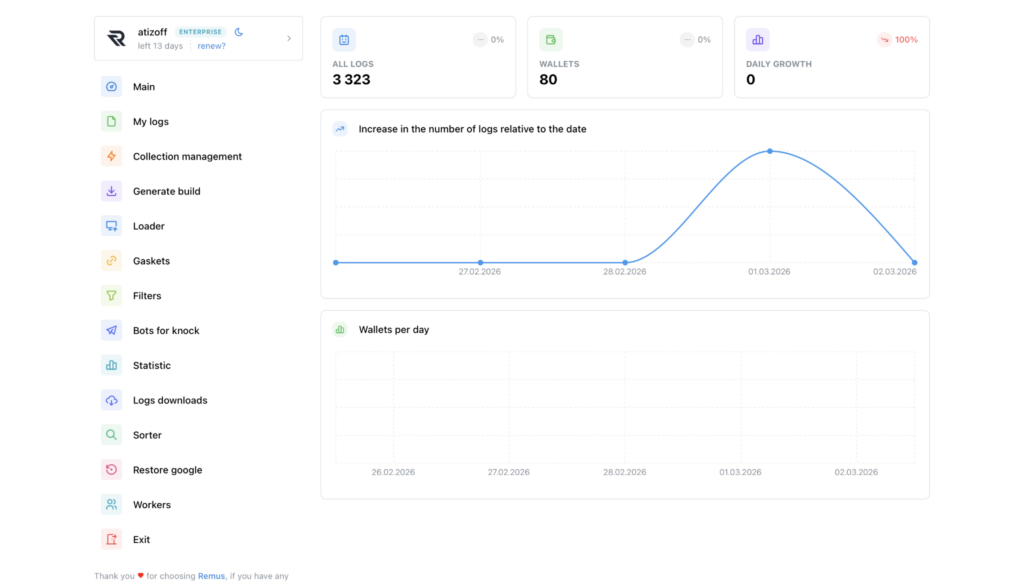
Remus Stealer panel (Source: Flashpoint Collections)

Code-Level Overlaps

Remus is a 64-bit compiled binary, and Lumma was a 32-bit binary. However, major similarities between the code bases of both malware can be observed.

Upon execution of an unpacked sample, both Remus and Lumma will send warning messages to the user that the build is unpacked. This was a unique phenomenon first established by Lumma several years ago. In both Remus and Lumma samples, the pack check and window message are performed before the main functionality of the malware.

In both Remus and Lumma, a function is used first to check if the sample is packed, and a second function is used to send the window error message.

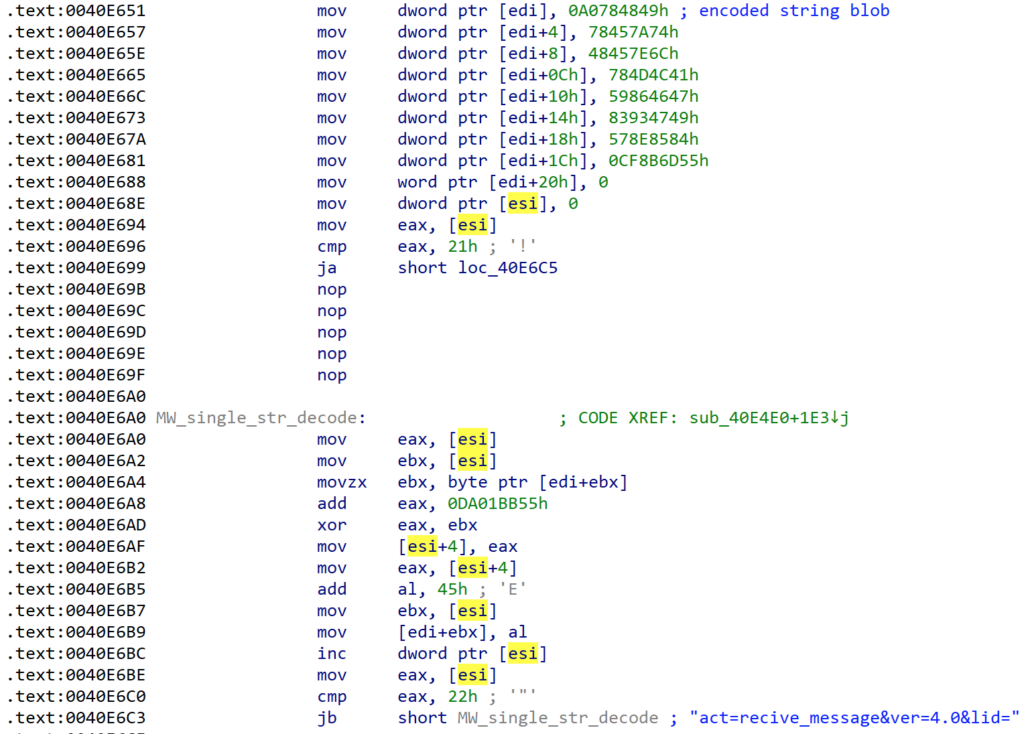
Remus uses similar string obfuscation methods to Lumma, in which each string has been uniquely encoded and then decoded during runtime. Deobfuscation occurs by looping byte by byte through encoded blobs. Each encoded string is obfuscated by a unique pattern. This can be seen in the code samples below:
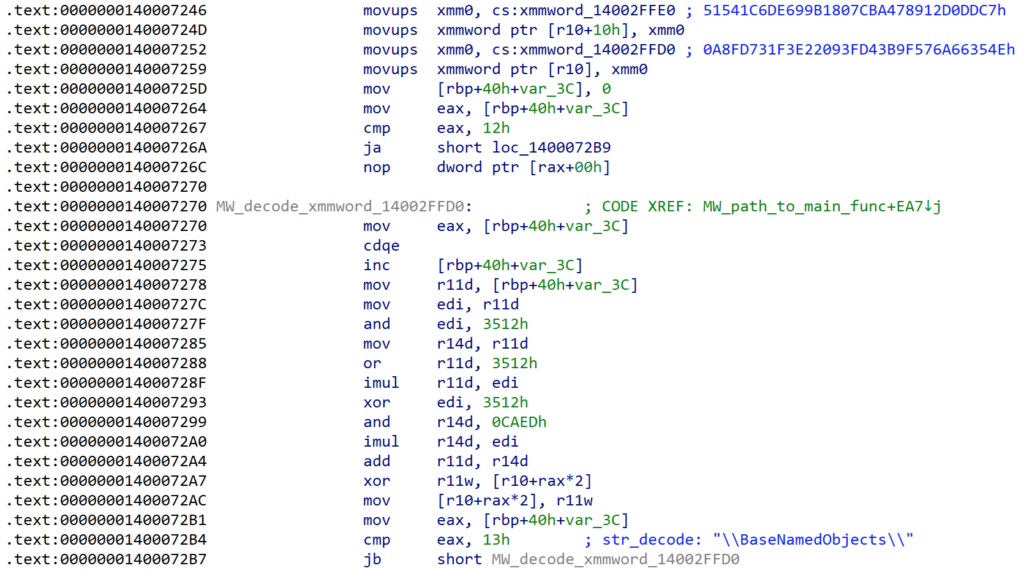
Remus inline string deobfuscation (Source: Flashpoint)
Lumma inline string deobfuscation. (Source: Flashpoint)

Of note, both samples have at least one NOP instruction between the encoded blob being moved onto the stack and the deobfuscation loop.

Another unique feature of Lumma is the presence of a plaintext identifier string used to link customers to specific build generations. In Lumma, this string was referred to as the LID (Lumma ID), and this ID method appears in Remus as well as a “tag.”

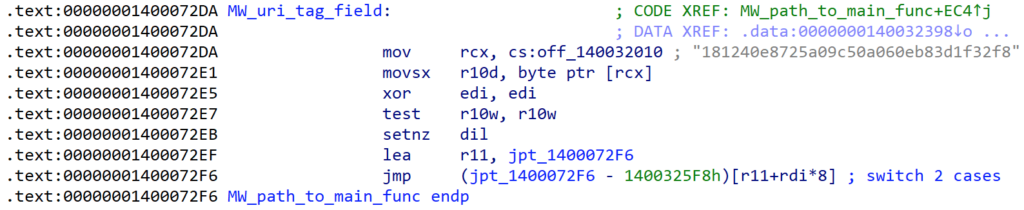
Lumma ID (Source: Flashpoint)
Remus tag (Source: Flashpoint)

Like the Lumma LID string, the Remus tag could be leveraged to attribute variant builds and campaigns to single threat actors or groups.

Additionally, both Remus and Lumma exhibit similar control flow obfuscation by replacing direct jumps with indirect jumps read from offsets that have been moved onto the stack, jumps computed from a jump table, and jumps resolved by a pointer.

Differentiators of Remus

Although Remus bears remarkable similarities to Lumma, its main differences lie in its C2 beaconing.

Before performing main stealer functionality, Remus will beacon out to its C2 infrastructure. It will attempt to resolve several domain:port combinations via POST requests, and attempt a final connection to find the C2 server using EtherHiding. If it is unable to connect, the malware will terminate.

After a connection is established, the stealer sends a POST request to the C2 in order to receive an access token. Once received and decoded, this access token is used to receive encrypted config data used by Remus to target assets on the victim system. Data collected for logs is then exfiltrated as encrypted POST data.
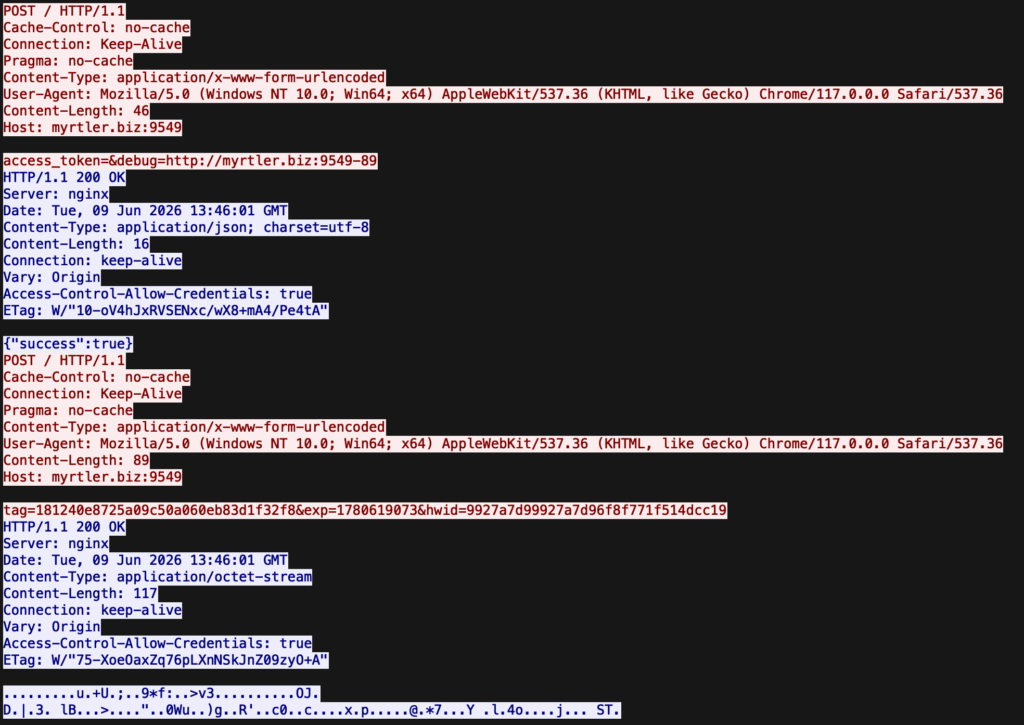
Network traffic from Remus sample (Source: Flashpoint)

Protect Against Infostealers Using Flashpoint

Remus stealer represents a sophisticated continuation of the MaaS infostealer model left behind by Lumma’s collapse. While the developer asserts independence, the overwhelming code overlaps, matching obfuscation techniques, and administrative panels indicate that Remus is either heavily inspired by, or derived from the Lumma codebase. These traits have allowed it to thrive, providing threat actors with a familiar, robust alternative that sidesteps the reputational baggage and law enforcement scrutiny of its predecessors.

Flashpoint continuously tracks the latest developments in illicit communities, hard-to-reach adversary spaces, and malware repositories to identify emerging threats. Request a demo to learn how Flashpoint’s primary source collections and analyst insights empowers your security teams.