


惯性聚合 高效追踪和阅读你感兴趣的博客、新闻、科技资讯
阅读原文 在惯性聚合中打开

推荐订阅源

人人都是产品经理
人人都是产品经理
The Hacker News
The Hacker News
D
Darknet – Hacking Tools, Hacker News & Cyber Security
cs.CL updates on arXiv.org
L
Lohrmann on Cybersecurity
MyScale Blog
MyScale Blog
GbyAI
GbyAI
博客园 - 【当耐特】
J
Java Code Geeks
Jina AI
Jina AI
I
InfoQ
The Register - Security
Cyberwarzone
Cyberwarzone
Scott Helme
Scott Helme
S
Schneier on Security
WordPress大学
WordPress大学
月光博客
月光博客
C
Cybersecurity and Infrastructure Security Agency CISA
AWS News Blog
AWS News Blog
The Cloudflare Blog
Google DeepMind News
P
Privacy & Cybersecurity Law Blog
P
Proofpoint News Feed
T
The Exploit Database - CXSecurity.com
Blog — PlanetScale
Blog — PlanetScale
博客园 - Franky
Simon Willison's Weblog
T
Threatpost
Project Zero
Project Zero
I
Intezer
Know Your Adversary
Know Your Adversary
A
About on SuperTechFans
S
Security Affairs
让小产品的独立变现更简单 - ezindie.com
博客园 - 聂微东
P
Proofpoint News Feed
Cloudbric
Cloudbric
V2EX - 技术
V2EX - 技术
OSCHINA 社区最新新闻
OSCHINA 社区最新新闻
Exploit-DB.com RSS Feed
S
Secure Thoughts
IT之家
IT之家
Forbes - Security
Forbes - Security
freeCodeCamp Programming Tutorials: Python, JavaScript, Git & More
CTFtime.org: upcoming CTF events
The Last Watchdog
The Last Watchdog
H
Heimdal Security Blog
Schneier on Security
Webroot Blog
Webroot Blog
Apple Machine Learning Research

Threat Intelligence Blog | Flashpoint

The Flashpoint Method: Prioritizing Vulnerabilities in an Era of AI-Accelerated Discovery Understanding Illicit Ecosystems: Inside Rehub’s Rise as a Primary Ransomware Marketplace Inside Qilin Ransomware: Custom Rust Loader and Kernel-Level EDR Killer Understanding Illicit Ecosystems: How Dark Web Forums Structure Cybercrime AI, Trust, and the Future of Threat Intelligence Remus Stealer: A New, Not-So-New Infostealer America250 Fourth of July Threat Assessment Unmasking the Digital Trail: Essential Techniques for Vetting AI-Generated Content The Shift to Threat-Informed Prioritization: Operationalizing CISA BOD 26-04 Identity Is the New Attack Surface: How Infostealers Are Reshaping Enterprise Risk Understanding Illicit Ecosystems: Weaponizing Mainstream Apps and Social Infrastructure Connecting Vulnerability Intelligence to Real-World Exposure With Flashpoint EASM Understanding Illicit Ecosystems: XSS and the Current State of the Russian-Speaking Underground How to Align and Measure Threat Intelligence Operations: Flashpoint Priority Intelligence Requirements The Mini Shai-Hulud Worm and the New Era of CI/CD Exploitation Understanding Illicit Ecosystems: The Hybrid Threat of “The Com” AI Threat Report: How Artificial Intelligence Is Used Across Illicit Communities How Mergers and Acquisitions Expand Your Attack Surface Overnight The Evolution of the Geotag: How AI is Bridging the Gap in Location-Based OSINT Navigating the Threat Landscape of the 2026 FIFA World Cup Inside the 2026 Cyber Threat Landscape: Data-Driven Security Priorities Flashpoint MCP Server: Operationalizing Cyber Threat Data for Agentic AI Security Workflows 2026 Gartner® Magic Quadrant™ for Cyber Threat Intelligence: Key Takeaways for Security Leaders Escalation in the Middle East: Tracking “Operation Epic Fury” Across Military and Cyber Domains How to Build and Operationalize Priority Intelligence Requirements National Vulnerability Database (NVD) Shifts to Selective Enrichment as CVE Volume Surges Why Intelligence Requirements Fall Flat and How to Fix Them with a Practical Priority Intelligence Requirements Framework The Phishing-as-a-Service Pipeline: How a Scalable Fraud Ecosystem Is Driving Global Attacks Tax Refund Fraud in 2026: How Threat Actors Exploit Identity, Verification, and Cash-Out Channels The Language of Emojis in Threat Intelligence: How Adversaries Signal, Obfuscate, and Coordinate Online What the NVD ‘Slowdown’ Means For You: How to Stay Ahead in Vulnerability Management Forrester Threat Intelligence Landscape: Key Takeaways for Security Leaders Connecting Threat Intelligence to Decision-Making: How Flashpoint Is Operationalizing Intelligence in 2026 Iran-Aligned Militias Signal Expanded Regional Risk Amid US–Israel–Iran Conflict Destructive Activity Targeting Stryker Highlights Emerging Supply Chain Risks Navigating 2026’s Converged Threats: Insights from Flashpoint’s Global Threat Intelligence Report What to Know About the Notepad++ Supply-Chain Attack Cyber Threat Intelligence Index: Q3 2023 Edition Beyond Hamas: Militant and Terrorist Groups Involved in the October 7 Attack on Israel The First 72 Hours of the Israel-Hamas War: Hamas and PIJ Activity on Telegram About Us Qakbot Takedown: A Brief Victory in the Fight Against Resilient Malware Unmasking the Attacker and Decoding Threat Actor Patterns The Flashpoint Firehose: 5 Questions With Michael Raypold, VP of Engineering The Seven Phases of a Ransomware Attack: A Step-by-Step Breakdown of the Attack Lifecycle Lost in Transition: A Timeline of Failed Successors to Breach and Raid Forums Days of Chaos: How OSINT Helps Us Understand the Putin-Prigozhin Schism Lessons From Clop: Combating Ransomware and Cyber Extortion Events How to Combat Check Fraud: Leveraging Intelligence to Prevent Financial Loss Beyond Gates and Alarms: The Scope and Impact of Physical Security Intelligence Why We Built Flashpoint Ignite: Unity, Power, and Performance The Risk-Reducing Power of Flashpoint Video Search Card Shop Threat Landscape: BidenCash Dumps 2.1M Stolen Credit Cards Flashpoint in 2023: A Note From Our CEO 5 Reasons Taiwan Is a Growing Source of US-China Tension Why We Acquired Echosec Systems: The OSINT Revolution Open Source Intelligence
Flashpoint Surpasses Cataloging 7,000 Known Exploited Vulnerabilities as Disclosure Volume Accelerates
Flashpoint · 2026-04-16 · via Threat Intelligence Blog | Flashpoint

Flashpoint Vulnerability Intelligence has surpassed cataloging 7,000 known exploited vulnerabilities, surpassing another major milestone as vulnerability disclosures accelerate across the global attack surface.

In 2025, Flashpoint tracked 44,509 disclosed vulnerabilities, a pace that continues to accelerate into 2026. Of those, 14,593 had publicly available exploits (1,944 more with proof-of-concepts), giving threat actors immediate pathways to weaponization.
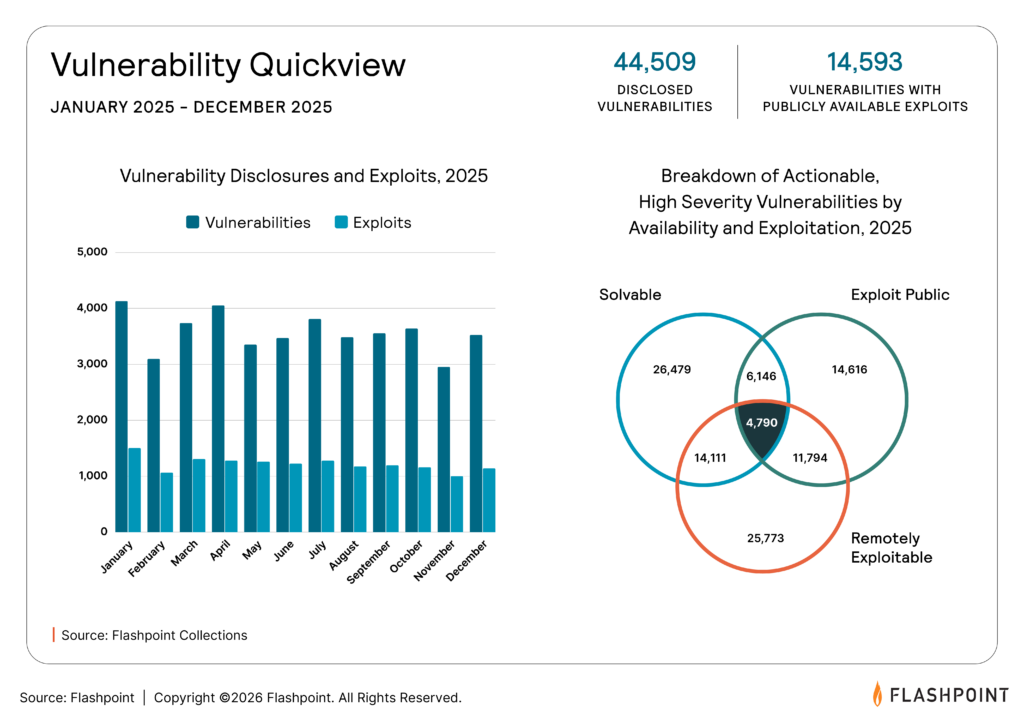
This pace is shaping how exploitation unfolds, with high-impact vulnerabilities being operationalized within hours or days, particularly when they affect widely deployed technologies or core infrastructure.

Security teams are operating within this compressed environment every day. They are reviewing more findings across open-source software, commercial applications, cloud environments, and third-party dependencies, while working within tighter timelines to assess impact and take action.

Flashpoint’s latest milestone of surpassing 7,000 known exploited vulnerabilities (KEVs) cataloged reflects that reality. It highlights how vulnerability management programs are evolving toward prioritization as a core capability, with a focus on vulnerabilities tied to active exploitation and real-world risk.

What The 7,000+ KEV Milestone Means for You

Security teams are operating in a high-volume environment. Vulnerabilities are disclosed continuously across open-source software, commercial applications, cloud environments, and third-party dependencies. At the same time, advancements in automation and code analysis are increasing the rate at which new findings are surfaced.

Each of these findings enters an already crowded workflow. Teams are expected to determine relevance, urgency, and impact quickly, often with limited context. This is where risk-based decision making becomes essential.

Flashpoint tracks hundreds of thousands of vulnerabilities across thousands of sources. Within that dataset, a much smaller percentage shows confirmed exploitation activity. That concentration of risk informs how effective programs allocate time and resources.

Crossing the 7,000+ KEV milestone goes beyond scale to provide greater precision, deeper context, and stronger confidence in how teams prioritize and act on the most critical vulnerabilities.

  • Validated threats: Each KEV entry reflects observed exploitation in the wild by threat actors, including APT groups, cybercriminal operations, ransomware presence, and automated botnets.
  • Exploit-aware prioritization: In reality, only a small percentage of tracked vulnerabilities drive real-world incidents. FP KEV provides visibility into that subset so teams can focus remediation efforts where they have immediate impact.
  • Human-curated intelligence: Every entry is reviewed, validated, and enriched by analysts, with context on exploit maturity, adversary usage, and remediation pathways when available.

This level of clarity allows teams to move faster without sacrificing accuracy. It supports vulnerability management programs that are built around real-world attacker behavior and aligned to current risk.

How Public Vulnerability Data Fits Into the Picture

Public vulnerability catalogs remain useful reference points for tracking disclosures and confirmed exploitation. The CISA Known Exploited Vulnerabilities catalog, for example, gives security teams a curated view into a limited set of vulnerabilities that have been exploited in the wild that impact U.S. government stakeholders.

For many organizations, though, that level of visibility is not enough.

Public catalogs capture only part of the picture. They tend to reflect a narrower slice of exploitation activity, with less detail on how vulnerabilities are being used, which actors are leveraging them, and what defenders should do next. They also rely heavily on CVE-based tracking, leaving gaps around non-CVE exposures and other vulnerabilities that still carry operational risk.

Flashpoint’s FP KEV and Vulnerability Intelligence provide a broader and more actionable view. The advantage is visible in both scale and depth. Of the 7,000 known exploited vulnerabilities in FP KEV, over 800 are missing from CVE. That expanded coverage is paired with the context security teams need to prioritize effectively, including exploit maturity, adversary mapping, affected product detail, and remediation guidance.

DimensionPublic KEV CatalogsFlashpoint FP KEV
ScopeVaries by provider, with coverage dependent on available sources and methodologyGlobal, cross-industry coverage
CoverageCVE-based trackingCVE and non-CVE vulnerabilities
ContextLimited enrichmentExploit maturity, adversary mapping, remediation
Update ModelPeriodic updatesContinuously updated with analyst input

This is what separates a reference list from an operational dataset. Teams need vulnerability intelligence that supports triage, remediation, reporting, and broader risk reduction efforts. Wider visibility and deeper context make that possible.

The Critical Role of Human-Curated Intelligence

Vulnerability data originates from a wide range of sources with varying levels of completeness and accuracy.

Flashpoint’s intelligence model includes analyst validation to ensure consistency and depth across the dataset.

This process includes:

  • Reviewing disclosures across public and private sources
  • Validating exploit availability and usage
  • Enriching entries with technical and operational context

Analyst input supports:

  • Accurate classification of vulnerabilities
  • Clear understanding of exploitation pathways
  • Timely updates as activity evolves

Supporting Decision-Making Across Teams

Vulnerability intelligence feeds multiple functions across an organization. Teams use this data to align technical actions with current threat activity.

Common use cases include:

  • Vulnerability management: Align patching priorities with active exploitation trends.
  • Threat intelligence: Map vulnerabilities to threat actor campaigns and observed behaviors.
  • Security operations: Tune detection based on known exploit techniques.
  • Executive reporting: Communicate risk posture using data tied to real-world activity.

Each of these functions relies on consistent, enriched intelligence to maintain alignment.

Proactively Address Vulnerability Risk

Vulnerability discovery continues to expand across software ecosystems, infrastructure, and identity layers.

Security teams require a clear understanding of which issues are relevant to their environment at any given time.

Flashpoint provides primary source intelligence that supports this need through:

  • Continuous monitoring of vulnerability disclosures and exploitation
  • Analyst-driven validation and enrichment
  • Integration-ready data for operational workflows

This approach enables teams to maintain focus, allocate resources effectively, and respond to risk based on current threat activity. Request a demo and learn more today.