


惯性聚合 高效追踪和阅读你感兴趣的博客、新闻、科技资讯
阅读原文 在惯性聚合中打开

推荐订阅源

S
Schneier on Security
The Register - Security
月光博客
月光博客
freeCodeCamp Programming Tutorials: Python, JavaScript, Git & More
OSCHINA 社区最新新闻
OSCHINA 社区最新新闻
The GitHub Blog
The GitHub Blog
博客园 - 司徒正美
罗磊的独立博客
U
Unit 42
S
SegmentFault 最新的问题
Y
Y Combinator Blog
博客园_首页
Hugging Face - Blog
Hugging Face - Blog
J
Java Code Geeks
Schneier on Security
Know Your Adversary
Know Your Adversary
C
Check Point Blog
Cyber Security Advisories - MS-ISAC
Simon Willison's Weblog
V
Vulnerabilities – Threatpost
让小产品的独立变现更简单 - ezindie.com
阮一峰的网络日志
阮一峰的网络日志
The Hacker News
The Hacker News
博客园 - 叶小钗
C
Cybersecurity and Infrastructure Security Agency CISA
Spread Privacy
Spread Privacy
L
LINUX DO - 热门话题
T
The Exploit Database - CXSecurity.com
P
Palo Alto Networks Blog
cs.CL updates on arXiv.org
Latest news
Latest news
L
Lohrmann on Cybersecurity
A
About on SuperTechFans
L
LangChain Blog
Stack Overflow Blog
Stack Overflow Blog
S
Securelist
A
Arctic Wolf
D
Darknet – Hacking Tools, Hacker News & Cyber Security
T
Threatpost
Scott Helme
Scott Helme
博客园 - 聂微东
博客园 - 【当耐特】
T
Tenable Blog
I
Intezer
D
DataBreaches.Net
B
Blog RSS Feed
Security Latest
Security Latest
C
Cisco Blogs
T
Tor Project blog
N
Netflix TechBlog - Medium

Microsoft Security Blog

Least privilege for AI agents: Identity, access, and tool binding | Microsoft Security Blog Unpacking the AsyncAPI npm supply chain compromise and import-time payload delivery | Microsoft Security Blog Turning threat intelligence into decisive action with Defender Experts | Microsoft Security Blog Defending SaaS-based applications against ShinyHunters OAuth abuse | Microsoft Security Blog Microsoft Entra ID security updates: Passkeys are the default authentication method in Entra ID | Microsoft Security Blog Securing our future: July 2026 progress report on Microsoft's Secure Future Initiative | Microsoft Security Blog GigaWiper: Anatomy of a destructive backdoor assembled from multiple malware | Microsoft Security Blog Protecting Microsoft at AI speed: How SFI proactively hardens our cloud   | Microsoft Security Blog 5 insights from Frost & Sullivan’s 2025 Frost Radar™ for Cloud Security Posture Management | Microsoft Security Blog Improving security posture across the Microsoft partner ecosystem | Microsoft Security Blog Microsoft named a leader in the Frost Radar for cloud and application runtime security | Microsoft Security Blog Accelerating the quantum-safe timeline | Microsoft Security Blog ​​What’s new in Microsoft Security: June 2026 | Microsoft Security Blog Securing AI agents: When AI tools move from reading to acting | Microsoft Security Blog Chromium extension uses AI‑related branding to redirect browser search | Microsoft Security Blog Photo ZIP campaign targeting hospitality industry delivers Node.js implant for persistent access | Microsoft Security Blog Microsoft a Leader in The Forrester Wave™ for Endpoint Management Platforms | Microsoft Security Blog CNAPP evolution: How Microsoft aligns with leading cloud risk management platforms | Microsoft Security Blog StealC and Amadey: Breaking down infostealers and the cybercrime services that deliver them | Microsoft Security Blog Guarding AI memory | Microsoft Security Blog One intrusion, two cyberattackers: Uncovering parallel threat activity | Microsoft Security Blog AutoJack: How a single page can RCE the host running your AI agent  | Microsoft Security Blog New Forrester study shows customers who unified with Microsoft Security benefited from 124% ROI | Microsoft Security Blog From package to postinstall payload: Inside the Mastra npm supply chain compromise | Microsoft Security Blog Crypto Clipper uses Tor and worm-like propagation for persistence and control | Microsoft Security Blog Beyond the benchmark: Advancing security at AI speed  | Microsoft Security Blog ​​Forrester names Microsoft a Leader in the 2026 Extended Detection and Response Platforms Wave™ report | Microsoft Security Blog AI is accelerating cyberattacks—here’s how to stay ahead Microsoft Defender email security benchmarking: Key insights from one year of data | Microsoft Security Blog Reconstructing AI activity in investigations AI brands as bait: How threat actors are using the AI hype in social engineering Securing CI/CD in an agentic world: Claude Code Github action case Updating the taxonomy of failure modes in agentic AI systems: What a year of red teaming taught us Preinstall to persistence: Inside the Red Hat npm Miasma credential-stealing campaign Turn specs into evals for any agent with ASSERT Microsoft Build 2026: Securing code, agents, and models across the development lifecycle Malicious npm packages abuse dependency confusion to profile developer environments Microsoft is named a Leader in the 2026 Gartner® Magic Quadrant™ for Endpoint Protection Typosquatted npm packages used to steal cloud and CI/CD secrets The Gentlemen ransomware: Dissecting a self-propagating Go encryptor From poisoned search results to GPU mining: A cryptojacking campaign abusing ScreenConnect and Microsoft .NET utilities Microsoft recognized as a Leader in The Forrester Wave™ for Workforce Identity Security Platforms From edge appliance to enterprise compromise: Multi-stage Linux intrusion via F5 and Confluence Microsoft Security success stories: How St. Luke’s and ManpowerGroup are securing AI foundations What’s new in Microsoft Security: May 2026 Mini Shai Hulud: Compromised @antv npm packages enable CI/CD credential theft Securing the gaming culture of cultures Introducing RAMPART and Clarity: Open source tools to bring safety into Agent development workflow Exposing Fox Tempest: A malware-signing service operation How Storm-2949 turned a compromised identity into a cloud-wide breach How to better protect your growing business in an AI-powered world When configuration becomes a vulnerability: Exploitable misconfigurations in AI apps Accelerating detection engineering using AI-assisted synthetic attack logs generation Defending consumer web properties against modern DDoS attacks Undermining the trust boundary: Investigating a stealthy intrusion through third-party compromise Active attack: Dirty Frag Linux vulnerability expands post-compromise risk When prompts become shells: RCE vulnerabilities in AI agent frameworks World Passkey Day: Advancing passwordless authentication ​​Microsoft named an overall leader in KuppingerCole Analyst’s 2026 Emerging AI Security Operations Center (SOC) report ​​ ClickFix campaign uses fake macOS utilities lures to deliver infostealers Breaking the code: Multi-stage ‘code of conduct’ phishing campaign leads to AiTM token compromise CVE-2026-31431: Copy Fail vulnerability enables Linux root privilege escalation across cloud environments Microsoft Agent 365, now generally available, expands capabilities and integrations What’s new, updated, or recently released in Microsoft Security Email threat landscape: Q1 2026 trends and insights 8 best practices for CISOs conducting risk reviews Simplifying AWS defense with Microsoft Sentinel UEBA AI-powered defense for an AI-accelerated threat landscape Detection strategies across cloud and identities against infiltrating IT workers Making opportunistic cyberattacks harder by design Cross‑tenant helpdesk impersonation to data exfiltration: A human-operated intrusion playbook Containing a domain compromise: How predictive shielding shut down lateral movement Building your cryptographic inventory: A customer strategy for cryptographic posture management Dissecting Sapphire Sleet’s macOS intrusion from lure to compromise Incident response for AI: Same fire, different fuel The agentic SOC—Rethinking SecOps for the next decade Investigating Storm-2755: “Payroll pirate” attacks targeting Canadian employees Intent redirection vulnerability in third-party SDK exposed millions of Android wallets to potential risk Inside an AI‑enabled device code phishing campaign Storm-1175 focuses gaze on vulnerable web-facing assets in high-tempo Medusa ransomware operations Threat actor abuse of AI accelerates from tool to cyberattack surface Cookie-controlled PHP webshells: A stealthy tradecraft in Linux hosting environments Mitigating the Axios npm supply chain compromise Critical Infrastructure at Risk | Security Insider
Defense in depth for autonomous AI agents
Alyssa Ofste · 2026-05-15 · via Microsoft Security Blog

Designing Secure Autonomous AI Agents with Defense in Depth

AI agents are moving beyond assistance and into action. Instead of generating content, they invoke tools, modify data, trigger workflows, and operate across systems with increasing autonomy. This shift changes the security problem fundamentally. When an agent can act autonomously, mistakes propagate faster, blast radius increases, and rollback becomes harder.

Security for agentic AI relies on defense in depth. What changes with autonomous agentic AI is where security decisions matter most. As autonomy increases, the center of gravity moves away from the model alone and toward how agents are assembled, constrained, and governed inside real applications. To build agentic AI applications that can be operated safely at scale, you need to deliberately design how agents are assembled, constrained, and governed within real applications. In return, you increase the likelihood of predictable behavior, controlled blast radius, and the confidence to deploy autonomy in production.

Defense in depth for agentic AI systems

Agentic AI systems are vulnerable to the existing security risks of software systems, and introduce new threat classes: agent hijacking, intent breaking, sensitive data leakage, supply chain compromise, and inappropriate reliance. Any weakness in permissions, data protection, or access control that exists today is amplified when an agent is added to the system.

A useful way to reason about agent security is through the following mitigation layers:

  • Model layer: Influences how the agent reasons through training data, fine-tuning, and refusal behaviors.
  • Safety system layer: Provides runtime protections such as content filtering, guardrails, logging, and observability.
  • Application layer: Defines what the agent can do and how it does it through application architecture, permissions, workflows, and escalation paths.
  • Positioning layer: Shapes how the system is presented to users through transparency documentation and UX disclosure.

Each layer reinforces the others, and no single layer is sufficient on its own. The model layer is probabilistic by nature. The safety system layer observes and intervenes at runtime. The positioning layer shapes perception. But for organizations building agentic AI applications, the application layer is the decisive one because it is the only layer builders fully control.  The application layer translates probabilistic model behavior into deterministic system outcomes. This is also where customers turn generic components into differentiated systems: two organizations can start with the same model and tools and end up with very different security outcomes depending on how they constrain agent behavior at this layer.

Why the application layer matters most when building agentic AI applications

Most organizations build agentic AI applications by combining off-the-shelf models, tools, and business data into systems that perform specific tasks. The application layer is where they decide which actions an agent is allowed to take, which tools and data it can access, how permissions are scoped and enforced, how failures are handled, and when humans must be involved.

Getting these decisions right requires thinking through several specific design patterns. Each one addresses a distinct failure mode. Together, they form the practical expression of defense in depth at the application layer.

Here are some recommended design patterns for building a more resilient application layer for your agents.
Pattern 1: Design agents like microservices

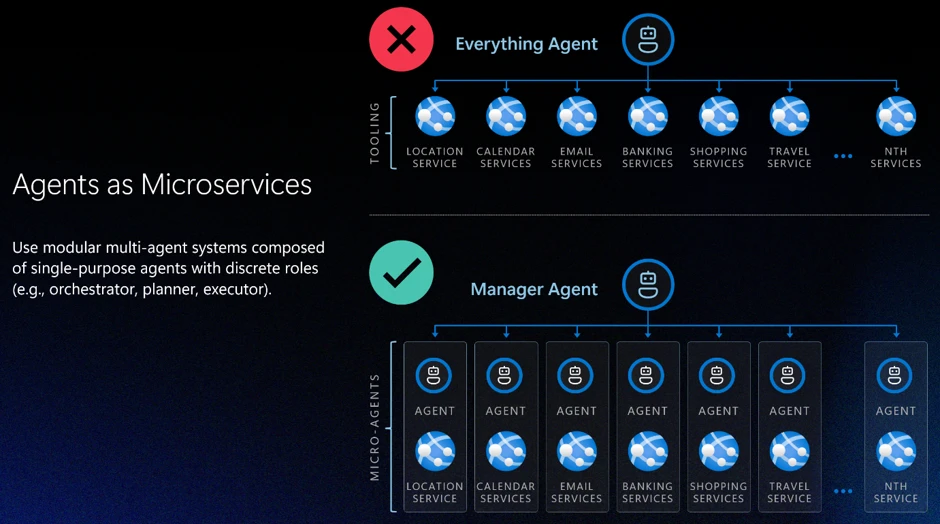
The most consequential application layer decision is action scope: how broadly you define an agent’s responsibilities. A common and dangerous failure mode is the “everything agent,” a single agent with broad permissions, many tools, and loosely defined responsibilities. Every additional tool expands the attack surface. Every ambiguous instruction increases the risk of error or task drift. As autonomy and tools increase, these risks compound quickly.

A more resilient approach is to design agents the way distributed systems have been designed for decades: as carefully scoped components with bounded capabilities. Agents should have isolated permissions, clear interfaces, and narrow responsibilities. More complex behaviors emerge from orchestration rather than from granting a single agent broad authority. Building agents like microservices, with constrained responsibilities and scoped permissions by design, is one of the most effective structural controls available at the application layer.

Pattern 2: Least permissions

Bounded scope defines what an agent is responsible for. Progressive permissioning governs what actions are permitted within that scope. As a rule, permissions should always start at zero (“zero trust”).

For safe design, no actions should be permitted by default. Actions are enabled explicitly, based on role and system needs. Least-privilege and zero-access principles apply to agents just as they do to human users.

Permissions granted loosely at design time become exploitable surfaces at runtime.

In practice, this means every tool call, data access, and external integration an agent can invoke should be the result of a deliberate authorization decision, not an implicit one. The question is not “should we restrict this?” but “have we explicitly permitted this?”

The general rule is to scope capabilities to the duration of a specific task. If task-based limits aren’t feasible, implement time-based limits. Task-focused permissions are preferred because they naturally “expire” when the task completes; temporal permissions help limit blast radius.

Pattern 3: Deterministic human-in-the-loop design

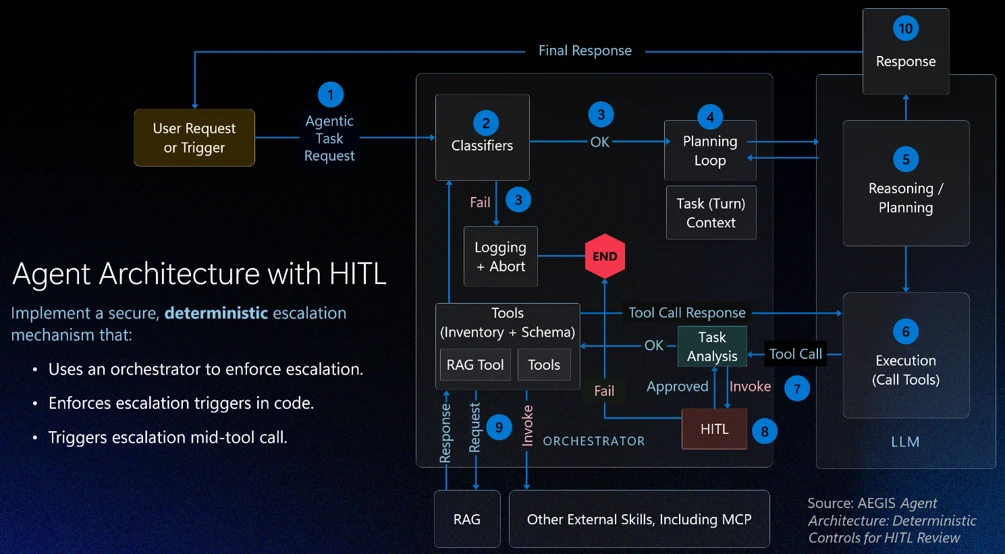
Even well-scoped, well-permissioned agents need a governance backstop for high-stakes decisions. Human-in-the-loop (HITL) review is often discussed as a trust mechanism: a way to keep humans informed. In agentic systems, it is better understood as a governance mechanism: a structural control that prevents agents from self-authorizing consequential actions.

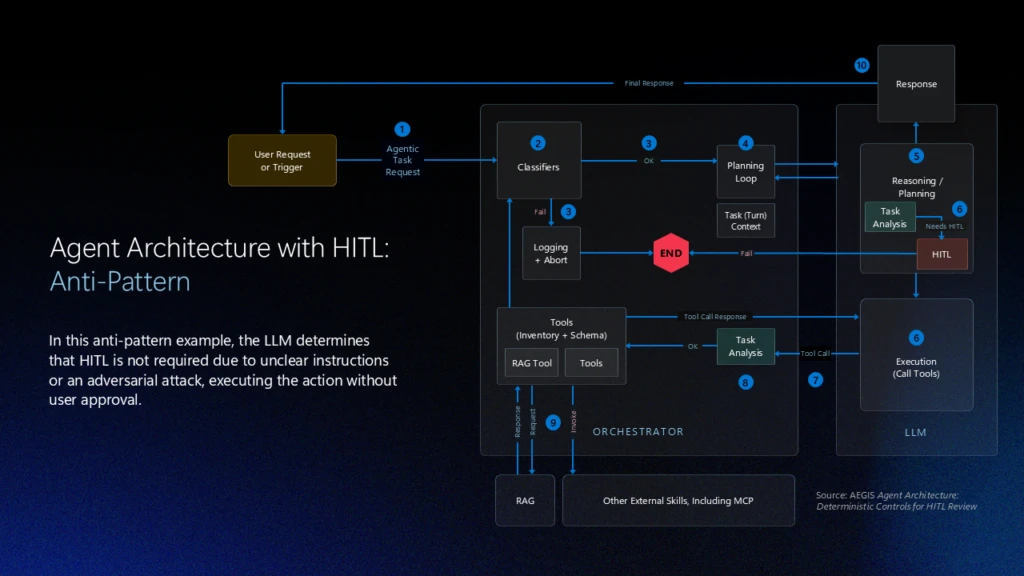
The critical design mistake here is letting the model decide when human review is required. If escalation is left to probabilistic reasoning, an adversarial prompt or an ambiguous instruction can bypass review entirely. A model that reasons its way out of escalating is exhibiting exactly the behavior the escalation mechanism was supposed to catch.

In secure agentic systems:

  • HITL review ideally is enforced deterministically by the application layer, or orchestrator, not delegated to the model.
  • Escalation triggers are defined in code.
  • An orchestrator enforces HITL review triggers.
  • Intervention can occur mid-execution — including during tool calls — rather than only before or after an action completes.

This design removes ambiguity about when review is required, supports auditability for oversight and compliance, and ensures that as agents move toward greater autonomy, the separation between reasoning and enforcement remains intact.
Pattern 4: Agent identity as a security primitive

It is an unfortunate reality that human users are routinely over-permissioned (“give them access to everything”). To implement Pattern 1: Agents as Microservices and Pattern 2: Least permissions, agents must never have the same identity as the user. This sounds obvious, but it requires deliberate design: When an action is taken, you need to know if it was executed by the user, the agent was acting on its own behalf, or the agent acting on the user’s behalf. Each agent must be assigned a unique, verifiable identity which allows assignment of explicit and narrowly scoped permissions, lifecycle controls, and accountability.

Agent identity enables least-privilege enforcement, because you cannot scope permissions to a specific agent if you cannot distinguish that agent from other agents or a human user. It also enables lifecycle governance, because revocation actions won’t be invoked when many agents are affected. Finally, separate agent identity enables meaningful observability, because actions can be traced back to a specific agent rather than being attributed vaguely to “the system.”

 As enterprises manage agent sprawl (with more agents, more deployments, and even more integrations), identity clarity becomes operationally critical. Identity is not a feature you add later. It is a prerequisite for operating autonomous agents responsibly at scale, and it ties together every other application layer pattern: permissioning, escalation, and logging all depend on knowing which agent is acting.

How the Other Layers Reinforce ApplicationLayer Design

Focusing on the application layer does not diminish the importance of the other layers. Instead, it clarifies their roles.

  • The model layer – the model chosen to enable the application – shapes how an agent reasons, but remains probabilistic. It can be tuned toward safer behavior, but it cannot guarantee it.
  • The safety system layer – platform tools like content filters and groundedness detection – compensates for what models alone cannot prevent: it detects anomalies, filters harmful outputs, and fulfills the observability teams’ need to respond when something goes wrong.
  • The positioning layer – how the UI and UX explains that AI is in use, what it can do, and what it can’t do

Each layer addresses failure modes the others cannot fully cover. A strong safety system cannot compensate for an agent with unlimited scope. A well-tuned model cannot substitute for deterministic escalation triggers. The application layer is where the load-bearing decisions are made. The other layers make those decisions more resilient.

Designing for Secure Autonomy

The four patterns described here — agents as microservices, least permissions, deterministic human-in-the-loop design, and agent identity — are mutually reinforcing. Scope containment limits blast radius. Permissioning limits what a contained agent can do. Deterministic escalation ensures that neither scope nor permissions can be circumvented by adversarial input. Identity makes all of it auditable.

The application layer is where customers have the most power to shape how their agent behaves. It is where off‑the‑shelf models become real agentic AI applications. It is where security decisions shape both business value and risk. Defense in depth remains the right strategy. As agents take on more responsibility, the application layer becomes the place where that strategy succeeds or fails.

As organizations deploy more agentic AI systems, the question is not whether agents will make mistakes. They already have and will continue to. The question is whether those mistakes are minimized, identified, and contained. Secure autonomous agentic AI systems are achieved by designing systems where autonomy is bounded by architecture, permissions, identity, and deterministic oversight from the start.

To learn more about Microsoft Security solutions, visit our website. Bookmark the Security blog to keep up with our expert coverage on security matters. Also, follow us on LinkedIn (Microsoft Security) and X (@MSFTSecurity) for the latest news and updates on cybersecurity.