
惯性聚合 高效追踪和阅读你感兴趣的博客、新闻、科技资讯
阅读原文 在惯性聚合中打开

推荐订阅源

小众软件
小众软件
MyScale Blog
MyScale Blog
N
News and Events Feed by Topic
IT之家
IT之家
OSCHINA 社区最新新闻
OSCHINA 社区最新新闻
有赞技术团队
有赞技术团队
T
The Blog of Author Tim Ferriss
The Cloudflare Blog
博客园 - 聂微东
Apple Machine Learning Research
Cyber Security Advisories - MS-ISAC
美团技术团队
V
Visual Studio Blog
M
MIT News - Artificial intelligence
V
V2EX
博客园_首页
freeCodeCamp Programming Tutorials: Python, JavaScript, Git & More
Blog — PlanetScale
Blog — PlanetScale
F
Full Disclosure
H
Help Net Security
MongoDB | Blog
MongoDB | Blog
博客园 - 叶小钗
S
SegmentFault 最新的问题
博客园 - 三生石上(FineUI控件)
D
Docker
Engineering at Meta
Engineering at Meta
博客园 - Franky
aimingoo的专栏
aimingoo的专栏
Jina AI
Jina AI
N
Netflix TechBlog - Medium
宝玉的分享
宝玉的分享
大猫的无限游戏
大猫的无限游戏
人人都是产品经理
人人都是产品经理
云风的 BLOG
云风的 BLOG
博客园 - 司徒正美
I
InfoQ
G
Google Developers Blog
L
LangChain Blog
F
Fortinet All Blogs
博客园 - 【当耐特】
Hugging Face - Blog
Hugging Face - Blog
H
Hackread – Cybersecurity News, Data Breaches, AI and More
WordPress大学
WordPress大学
A
Arctic Wolf
Martin Fowler
Martin Fowler
G
GRAHAM CLULEY
L
LINUX DO - 热门话题
C
Cisco Blogs
Y
Y Combinator Blog
罗磊的独立博客

Microsoft Security Blog

Real world incident response: Microsoft and AXA XL strengthen cyber resilience | Microsoft Security Blog Microsoft at Black Hat USA 2026: Defending trust in the age of AI and supply chain attacks | Microsoft Security Blog ACR Stealer: Two observed intrusion chains amid increased threat activity | Microsoft Security Blog Least privilege for AI agents: Identity, access, and tool binding | Microsoft Security Blog Unpacking the AsyncAPI npm supply chain compromise and import-time payload delivery | Microsoft Security Blog Turning threat intelligence into decisive action with Defender Experts | Microsoft Security Blog Defending SaaS-based applications against ShinyHunters OAuth abuse | Microsoft Security Blog Microsoft Entra ID security updates: Passkeys are the default authentication method in Entra ID | Microsoft Security Blog Securing our future: July 2026 progress report on Microsoft's Secure Future Initiative | Microsoft Security Blog GigaWiper: Anatomy of a destructive backdoor assembled from multiple malware | Microsoft Security Blog Protecting Microsoft at AI speed: How SFI proactively hardens our cloud   | Microsoft Security Blog 5 insights from Frost & Sullivan’s 2025 Frost Radar™ for Cloud Security Posture Management | Microsoft Security Blog Improving security posture across the Microsoft partner ecosystem | Microsoft Security Blog Microsoft named a leader in the Frost Radar for cloud and application runtime security | Microsoft Security Blog Accelerating the quantum-safe timeline | Microsoft Security Blog ​​What’s new in Microsoft Security: June 2026 | Microsoft Security Blog Securing AI agents: When AI tools move from reading to acting | Microsoft Security Blog Chromium extension uses AI‑related branding to redirect browser search | Microsoft Security Blog Photo ZIP campaign targeting hospitality industry delivers Node.js implant for persistent access | Microsoft Security Blog Microsoft a Leader in The Forrester Wave™ for Endpoint Management Platforms | Microsoft Security Blog CNAPP evolution: How Microsoft aligns with leading cloud risk management platforms | Microsoft Security Blog StealC and Amadey: Breaking down infostealers and the cybercrime services that deliver them | Microsoft Security Blog Guarding AI memory | Microsoft Security Blog One intrusion, two cyberattackers: Uncovering parallel threat activity | Microsoft Security Blog AutoJack: How a single page can RCE the host running your AI agent  | Microsoft Security Blog New Forrester study shows customers who unified with Microsoft Security benefited from 124% ROI | Microsoft Security Blog From package to postinstall payload: Inside the Mastra npm supply chain compromise | Microsoft Security Blog Crypto Clipper uses Tor and worm-like propagation for persistence and control | Microsoft Security Blog Beyond the benchmark: Advancing security at AI speed  | Microsoft Security Blog ​​Forrester names Microsoft a Leader in the 2026 Extended Detection and Response Platforms Wave™ report | Microsoft Security Blog AI is accelerating cyberattacks—here’s how to stay ahead Reconstructing AI activity in investigations AI brands as bait: How threat actors are using the AI hype in social engineering Securing CI/CD in an agentic world: Claude Code Github action case Updating the taxonomy of failure modes in agentic AI systems: What a year of red teaming taught us Preinstall to persistence: Inside the Red Hat npm Miasma credential-stealing campaign Turn specs into evals for any agent with ASSERT Microsoft Build 2026: Securing code, agents, and models across the development lifecycle Malicious npm packages abuse dependency confusion to profile developer environments Microsoft is named a Leader in the 2026 Gartner® Magic Quadrant™ for Endpoint Protection Typosquatted npm packages used to steal cloud and CI/CD secrets The Gentlemen ransomware: Dissecting a self-propagating Go encryptor From poisoned search results to GPU mining: A cryptojacking campaign abusing ScreenConnect and Microsoft .NET utilities Microsoft recognized as a Leader in The Forrester Wave™ for Workforce Identity Security Platforms From edge appliance to enterprise compromise: Multi-stage Linux intrusion via F5 and Confluence Microsoft Security success stories: How St. Luke’s and ManpowerGroup are securing AI foundations What’s new in Microsoft Security: May 2026 Mini Shai Hulud: Compromised @antv npm packages enable CI/CD credential theft Securing the gaming culture of cultures Introducing RAMPART and Clarity: Open source tools to bring safety into Agent development workflow Exposing Fox Tempest: A malware-signing service operation How Storm-2949 turned a compromised identity into a cloud-wide breach How to better protect your growing business in an AI-powered world Defense in depth for autonomous AI agents When configuration becomes a vulnerability: Exploitable misconfigurations in AI apps Accelerating detection engineering using AI-assisted synthetic attack logs generation Defending consumer web properties against modern DDoS attacks Undermining the trust boundary: Investigating a stealthy intrusion through third-party compromise Active attack: Dirty Frag Linux vulnerability expands post-compromise risk When prompts become shells: RCE vulnerabilities in AI agent frameworks World Passkey Day: Advancing passwordless authentication ​​Microsoft named an overall leader in KuppingerCole Analyst’s 2026 Emerging AI Security Operations Center (SOC) report ​​ ClickFix campaign uses fake macOS utilities lures to deliver infostealers Breaking the code: Multi-stage ‘code of conduct’ phishing campaign leads to AiTM token compromise CVE-2026-31431: Copy Fail vulnerability enables Linux root privilege escalation across cloud environments Microsoft Agent 365, now generally available, expands capabilities and integrations What’s new, updated, or recently released in Microsoft Security Email threat landscape: Q1 2026 trends and insights 8 best practices for CISOs conducting risk reviews Simplifying AWS defense with Microsoft Sentinel UEBA AI-powered defense for an AI-accelerated threat landscape Detection strategies across cloud and identities against infiltrating IT workers Making opportunistic cyberattacks harder by design Cross‑tenant helpdesk impersonation to data exfiltration: A human-operated intrusion playbook Containing a domain compromise: How predictive shielding shut down lateral movement Building your cryptographic inventory: A customer strategy for cryptographic posture management Dissecting Sapphire Sleet’s macOS intrusion from lure to compromise Incident response for AI: Same fire, different fuel The agentic SOC—Rethinking SecOps for the next decade Investigating Storm-2755: “Payroll pirate” attacks targeting Canadian employees Intent redirection vulnerability in third-party SDK exposed millions of Android wallets to potential risk Inside an AI‑enabled device code phishing campaign Storm-1175 focuses gaze on vulnerable web-facing assets in high-tempo Medusa ransomware operations Threat actor abuse of AI accelerates from tool to cyberattack surface Cookie-controlled PHP webshells: A stealthy tradecraft in Linux hosting environments Mitigating the Axios npm supply chain compromise Critical Infrastructure at Risk | Security Insider
Microsoft Defender email security benchmarking: Key insights from one year of data | Microsoft Security Blog
Jeff Pinkston · 2026-06-16 · via Microsoft Security Blog

Microsoft publishes quarterly email security benchmarking data comparing Microsoft Defender against secure email gateway (SEG) and integrated cloud email security (ICES) vendors using real-world threat telemetry.

A year ago, we set out to change how email security effectiveness is measured. With our first benchmarking report in July 2025, we committed to publishing real-world performance data, not synthetic tests, so security teams could make decisions grounded in evidence. With each quarterly update, we refined our methodology, expanded our analysis, and listened to customer and partner feedback.

Alongside it, we established the Microsoft Defender ICES vendor ecosystem, designed to enable seamless integration with trusted third-party vendors and streamline security operations center (SOC) workflows for organizations who have chosen a multi-vendor email security strategy.

Key insights from a year of email benchmarking

With four consecutive quarters, several findings have proven to be durable insights, highlighting the sustained realities of how layered email security performs in production:

1. Defender consistently leads in pre-delivery detection. Across every benchmarking period since July 2025, Defender has missed fewer high-severity cyberthreats than every SEG vendor evaluated, while the next closest SEG vendor had 2.5 times more misses.

2. ICES vendors add the most value in promotional and bulk email filtering. Promotional filtering uplift has been the clearest area of ICES value with an average uplift of 15% over the four quarters of evaluation. Meanwhile ICES vendor uplift for malicious catch and spam has consistently remained relatively nominal, averaging at 0.29% and 0.68%, respectively. In addition, over the last three quarters we’ve seen a consistent downward trend in these numbers, as we have continued to drive innovation in post-delivery mail detection.

3. Defender’s share of post-delivery remediation has grown significantly. In our second report, we introduced insights on the contribution of Defender to post-delivery malicious catch. Initially, Defender contributed 45% of post-delivery malicious catch, which has since risen to an average of 96%. This trajectory underscores that Microsoft’s post-delivery catch is an increasingly critical backstop, operating even when ICES solutions are in place, and that Defender is delivering the majority of post-delivery remediation.

Bar chart comparing average uplift from ICES vendors over the past 12 months, showing much higher gains for promotional and bulk email filtering than for malicious email and spam detection.
Figure 1: Malicious catch and spam catch uplift from ICES vendors of the past 12 months.

SEG vendor benchmarking results

For SEG vendors, a threat is classified as “missed” if it was not detected prior to delivery. Using this definition, Microsoft Defender once again missed fewer high-severity email threats than all other solutions evaluated, consistent with every prior benchmarking period.

Column chart of high-severity email threats missed per 1,000 users from February to April 2026, showing Microsoft Defender with the fewest misses compared with evaluated SEG vendors.
Figure 2: High-severity email threats missed by SEG vendors (February 2026-April 2026), measured as threats missed per 1,000 users protected.

This quarter, Defender missed 59% fewer high-severity threats than the next-closest SEG vendor, a gap that has remained consistent across all four benchmarking periods.

ICES vendor benchmarking results

ICES solutions operating on top of Microsoft Defender continue to provide benefit, particularly in reducing promotional and bulk email, with an average improvement of 16.85% over the last quarter. This helps minimize inbox clutter and improves user productivity in environments where promotional noise is a concern. For malicious messages and spam, the average improvement across vendors was 0.13% for malicious and 0.28% for spam catch, compared to 0.24% and 0.29% in the prior report.
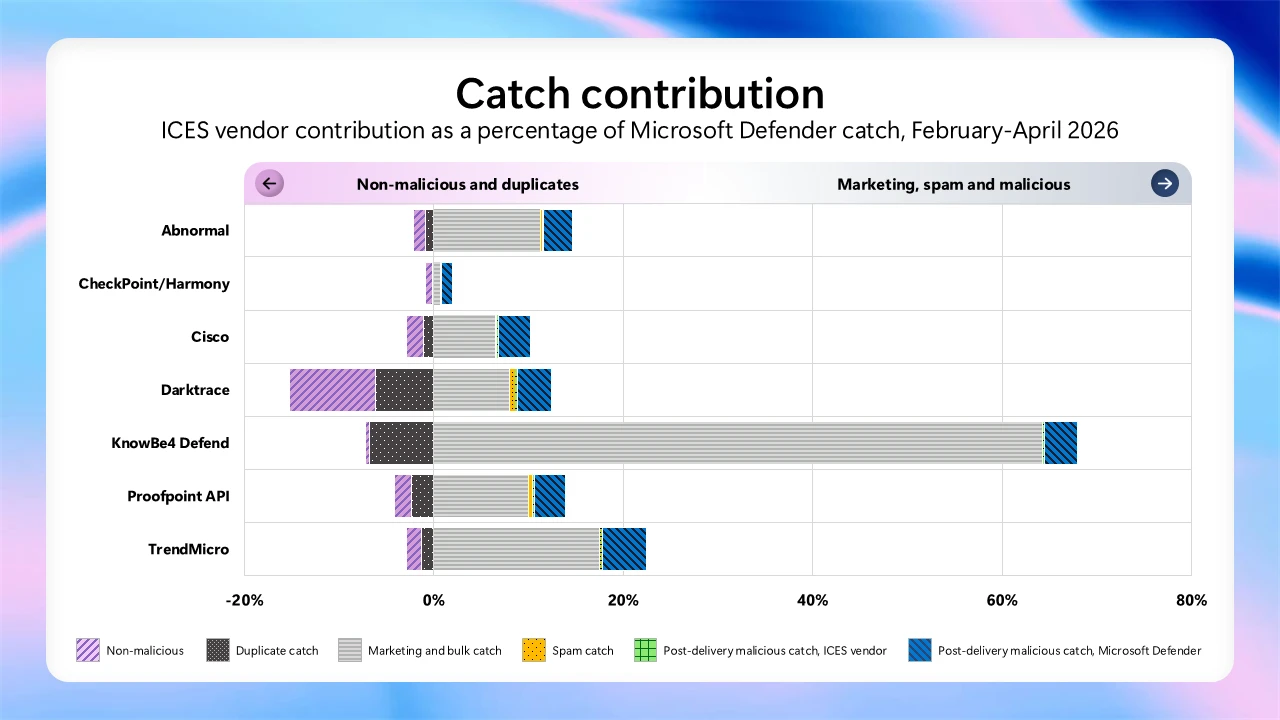
Chart comparing catch contribution from February to April 2026 across ICES vendors.
Figure 3: ICES vendor catch contribution (February 2026-April 2026).

Focusing only on malicious messages that reached the inbox, the latest quarter shows Microsoft Defender’s post-delivery catch continues to improve, catching the majority of post‑delivery remediation. It removes an average of 96.03%, up from 70.8% in the previous quarter, highlighting the effectiveness of our continuous investments in this area. Post‑delivery remediation remains a critical backstop when cyberthreats evade initial filtering.
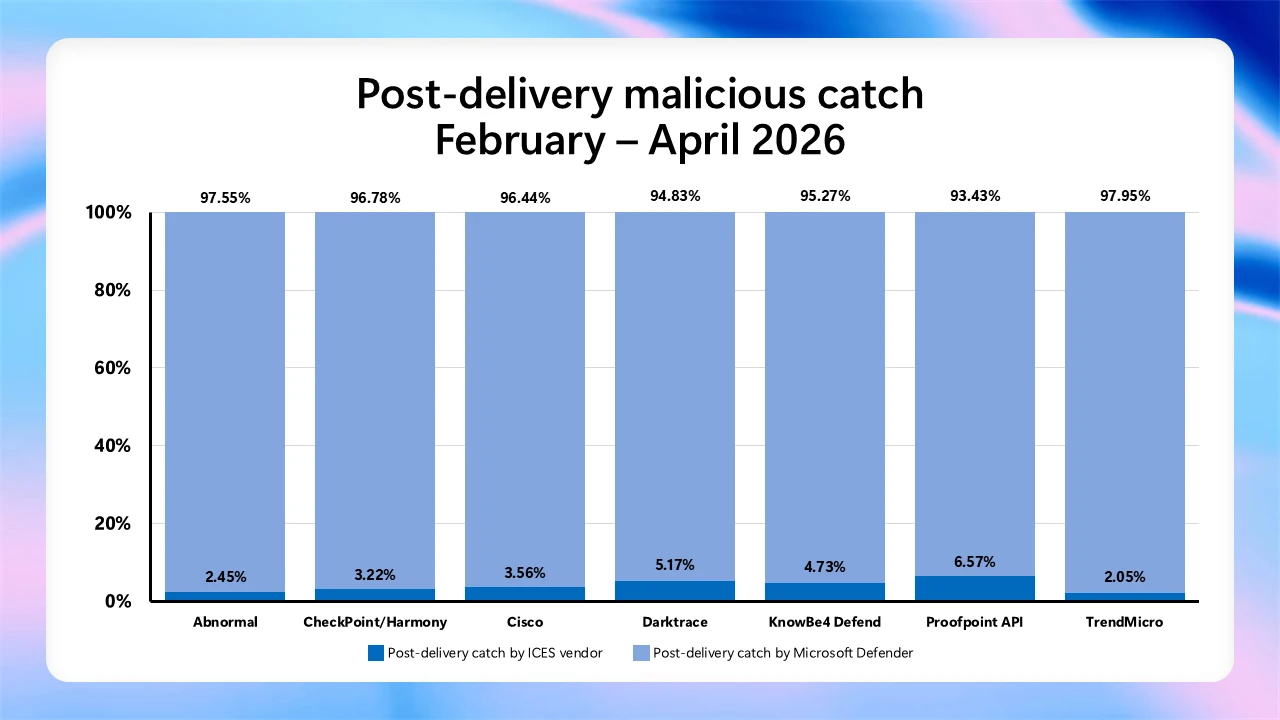
Chart comparing post-delivery malicious catch contribution from February to April 2026 across ICES vendors, showing Microsoft Defender providing the large majority of remediation at roughly 96% on average.
Figure 4: Post‑delivery malicious catch by Microsoft Defender (February 2026-April 2026), shown across vendors and overall average.

Innovation shaped by benchmarking insights

Benchmarking doesn’t just help customers make better decisions. It shapes what we build. Over the past year we’ve used the insights from our benchmarking reports, as well as insights from the growing ICES vendor ecosystem, to directly shape our innovation and product outcomes. Below are some of the most recent highlights, that we directly attribute to the continued improvements in Microsoft Defender performance.

Native promotion and bulk mail filtering in Outlook: A dedicated Promotions folder, natively provisioned in Outlook, now keeps legitimate bulk mail out of the primary inbox. Promotional content is separated from priority emails without being sent to Junk, which means users can still access and browse newsletters and updates at their own pace. The folder appears at the top level of the mailbox for easy discovery and is visible across all Outlook experiences. Once generally available it will be on by default, improving the native promotional filtering. Learn more.

System-level AI advancements: Among other AI enhancements, in November 2025 we introduced an agentic grading system that reduces the reliance on manual review in the submission and analysis pipeline. It helps deliver lower wait times, faster responses, and higher-quality results when emails are submitted to Microsoft for review. That means security teams can investigate reported messages more efficiently, respond more promptly, and act with greater confidence against phishing threats. Learn more.

Accelerating investigation with AI: The growing role of post-delivery remediation in our benchmarking data highlights a related challenge: when threats reach users and get reported, SOC teams need to triage those submissions quickly and accurately. The Microsoft Security Copilot Alert Triage Agent uses language model-powered reasoning to classify user-reported phishing emails, resolve false positives, and escalate confirmed threats for analyst review. Results show analysts identify 6.5 times more malicious alerts, improve verdict accuracy by 77%, and spend 53% more time investigating real cyberthreats. Security Copilot’s Email Summary further speeds investigations by turning email detection data into clear, actionable insights in the Email entity page. Learn more.

A year into this effort, our commitment to transparent benchmarking remains unchanged. We’ll continue using these insights to shape product innovation, share real-world performance data with customers, and invest in a strong ecosystem that meets organizations where they are—supporting the layered email security strategies that work best for their environments.

Learn more

Learn more about Microsoft Defender.

To learn more about Microsoft Security solutions, visit our website. Bookmark the Security blog to keep up with our expert coverage on security matters. Also, follow us on LinkedIn (Microsoft Security) and X (@MSFTSecurity) for the latest news and updates on cybersecurity.