


惯性聚合 高效追踪和阅读你感兴趣的博客、新闻、科技资讯
阅读原文 在惯性聚合中打开

推荐订阅源

MongoDB | Blog
MongoDB | Blog
博客园 - 聂微东
Attack and Defense Labs
WordPress大学
WordPress大学
D
Darknet – Hacking Tools, Hacker News & Cyber Security
Spread Privacy
Spread Privacy
AI
AI
宝玉的分享
宝玉的分享
K
KPMG report finds enterprise disconnect between AI and its ROI | CIO
C
Cyber Attacks, Cyber Crime and Cyber Security
爱范儿
爱范儿
Help Net Security
Help Net Security
V
Visual Studio Blog
大猫的无限游戏
大猫的无限游戏
Forbes - Security
Forbes - Security
P
Privacy & Cybersecurity Law Blog
Project Zero
Project Zero
IT之家
IT之家
Hugging Face - Blog
Hugging Face - Blog
博客园 - 三生石上(FineUI控件)
S
SegmentFault 最新的问题
有赞技术团队
有赞技术团队
T
Troy Hunt's Blog
美团技术团队
T
Threatpost
K
Kaspersky official blog
V
V2EX
Scott Helme
Scott Helme
Vercel News
Vercel News
T
The Blog of Author Tim Ferriss
T
Tailwind CSS Blog
V
Vulnerabilities – Threatpost
Last Week in AI
Last Week in AI
PCI Perspectives
PCI Perspectives
Google Online Security Blog
Apple Machine Learning Research
Engineering at Meta
Engineering at Meta
Exploit-DB.com RSS Feed
I
InfoQ
cs.CL updates on arXiv.org
酷 壳 – CoolShell
酷 壳 – CoolShell
GbyAI
GbyAI
L
LINUX DO - 最新话题
T
The Exploit Database - CXSecurity.com
L
LangChain Blog
S
Security @ Cisco Blogs
The Last Watchdog
The Last Watchdog
H
Hacker News: Front Page
让小产品的独立变现更简单 - ezindie.com
TaoSecurity Blog
TaoSecurity Blog

Microsoft Security Blog

Email threat landscape: Q2 2026 trends and insights | Microsoft Security Blog Real world incident response: Microsoft and AXA XL strengthen cyber resilience | Microsoft Security Blog Microsoft at Black Hat USA 2026: Defending trust in the age of AI and supply chain attacks | Microsoft Security Blog ACR Stealer: Two observed intrusion chains amid increased threat activity | Microsoft Security Blog Least privilege for AI agents: Identity, access, and tool binding | Microsoft Security Blog Unpacking the AsyncAPI npm supply chain compromise and import-time payload delivery | Microsoft Security Blog Turning threat intelligence into decisive action with Defender Experts | Microsoft Security Blog Defending SaaS-based applications against ShinyHunters OAuth abuse | Microsoft Security Blog Microsoft Entra ID security updates: Passkeys are the default authentication method in Entra ID | Microsoft Security Blog Securing our future: July 2026 progress report on Microsoft's Secure Future Initiative | Microsoft Security Blog GigaWiper: Anatomy of a destructive backdoor assembled from multiple malware | Microsoft Security Blog Protecting Microsoft at AI speed: How SFI proactively hardens our cloud   | Microsoft Security Blog 5 insights from Frost & Sullivan’s 2025 Frost Radar™ for Cloud Security Posture Management | Microsoft Security Blog Improving security posture across the Microsoft partner ecosystem | Microsoft Security Blog Microsoft named a leader in the Frost Radar for cloud and application runtime security | Microsoft Security Blog Accelerating the quantum-safe timeline | Microsoft Security Blog ​​What’s new in Microsoft Security: June 2026 | Microsoft Security Blog Securing AI agents: When AI tools move from reading to acting | Microsoft Security Blog Chromium extension uses AI‑related branding to redirect browser search | Microsoft Security Blog Photo ZIP campaign targeting hospitality industry delivers Node.js implant for persistent access | Microsoft Security Blog Microsoft a Leader in The Forrester Wave™ for Endpoint Management Platforms | Microsoft Security Blog CNAPP evolution: How Microsoft aligns with leading cloud risk management platforms | Microsoft Security Blog StealC and Amadey: Breaking down infostealers and the cybercrime services that deliver them | Microsoft Security Blog Guarding AI memory | Microsoft Security Blog One intrusion, two cyberattackers: Uncovering parallel threat activity | Microsoft Security Blog AutoJack: How a single page can RCE the host running your AI agent  | Microsoft Security Blog New Forrester study shows customers who unified with Microsoft Security benefited from 124% ROI | Microsoft Security Blog From package to postinstall payload: Inside the Mastra npm supply chain compromise | Microsoft Security Blog Crypto Clipper uses Tor and worm-like propagation for persistence and control | Microsoft Security Blog Beyond the benchmark: Advancing security at AI speed  | Microsoft Security Blog ​​Forrester names Microsoft a Leader in the 2026 Extended Detection and Response Platforms Wave™ report | Microsoft Security Blog AI is accelerating cyberattacks—here’s how to stay ahead Microsoft Defender email security benchmarking: Key insights from one year of data | Microsoft Security Blog Reconstructing AI activity in investigations AI brands as bait: How threat actors are using the AI hype in social engineering Securing CI/CD in an agentic world: Claude Code Github action case Updating the taxonomy of failure modes in agentic AI systems: What a year of red teaming taught us Preinstall to persistence: Inside the Red Hat npm Miasma credential-stealing campaign Turn specs into evals for any agent with ASSERT Microsoft Build 2026: Securing code, agents, and models across the development lifecycle Malicious npm packages abuse dependency confusion to profile developer environments Microsoft is named a Leader in the 2026 Gartner® Magic Quadrant™ for Endpoint Protection Typosquatted npm packages used to steal cloud and CI/CD secrets The Gentlemen ransomware: Dissecting a self-propagating Go encryptor From poisoned search results to GPU mining: A cryptojacking campaign abusing ScreenConnect and Microsoft .NET utilities Microsoft recognized as a Leader in The Forrester Wave™ for Workforce Identity Security Platforms From edge appliance to enterprise compromise: Multi-stage Linux intrusion via F5 and Confluence Microsoft Security success stories: How St. Luke’s and ManpowerGroup are securing AI foundations What’s new in Microsoft Security: May 2026 Mini Shai Hulud: Compromised @antv npm packages enable CI/CD credential theft Securing the gaming culture of cultures Introducing RAMPART and Clarity: Open source tools to bring safety into Agent development workflow Exposing Fox Tempest: A malware-signing service operation How Storm-2949 turned a compromised identity into a cloud-wide breach How to better protect your growing business in an AI-powered world Defense in depth for autonomous AI agents When configuration becomes a vulnerability: Exploitable misconfigurations in AI apps Accelerating detection engineering using AI-assisted synthetic attack logs generation Defending consumer web properties against modern DDoS attacks Undermining the trust boundary: Investigating a stealthy intrusion through third-party compromise Active attack: Dirty Frag Linux vulnerability expands post-compromise risk When prompts become shells: RCE vulnerabilities in AI agent frameworks World Passkey Day: Advancing passwordless authentication ​​Microsoft named an overall leader in KuppingerCole Analyst’s 2026 Emerging AI Security Operations Center (SOC) report ​​ ClickFix campaign uses fake macOS utilities lures to deliver infostealers Breaking the code: Multi-stage ‘code of conduct’ phishing campaign leads to AiTM token compromise CVE-2026-31431: Copy Fail vulnerability enables Linux root privilege escalation across cloud environments What’s new, updated, or recently released in Microsoft Security Email threat landscape: Q1 2026 trends and insights 8 best practices for CISOs conducting risk reviews Simplifying AWS defense with Microsoft Sentinel UEBA AI-powered defense for an AI-accelerated threat landscape Detection strategies across cloud and identities against infiltrating IT workers Making opportunistic cyberattacks harder by design Cross‑tenant helpdesk impersonation to data exfiltration: A human-operated intrusion playbook Containing a domain compromise: How predictive shielding shut down lateral movement Building your cryptographic inventory: A customer strategy for cryptographic posture management Dissecting Sapphire Sleet’s macOS intrusion from lure to compromise Incident response for AI: Same fire, different fuel The agentic SOC—Rethinking SecOps for the next decade Investigating Storm-2755: “Payroll pirate” attacks targeting Canadian employees Intent redirection vulnerability in third-party SDK exposed millions of Android wallets to potential risk Inside an AI‑enabled device code phishing campaign Storm-1175 focuses gaze on vulnerable web-facing assets in high-tempo Medusa ransomware operations Threat actor abuse of AI accelerates from tool to cyberattack surface Cookie-controlled PHP webshells: A stealthy tradecraft in Linux hosting environments Mitigating the Axios npm supply chain compromise Critical Infrastructure at Risk | Security Insider
Microsoft Agent 365, now generally available, expands capabilities and integrations
Nirav Shah, Rob Lefferts, Jason Roszak · 2026-05-01 · via Microsoft Security Blog

Choose an ecosystem partner for agent security and governance

AI agents aren’t coming—they’re already in your environment. They show up in places you expect (like Microsoft CopilotMicrosoft Teams, and Microsoft 365) and even more places as technology evolves (a local autonomous personal AI assistant or a new software as a service (SaaS) agent connected to your sensitive data.)

The problem isn’t that agents exist. It’s that they proliferate fast, span apps, endpoints and cloud, and often operate outside the visibility and control of the teams accountable for risk. When an agent can invoke tools, access data, and interact with other agents, any “helpful” workflow can turn into data oversharing, tool misuse, or over-privileged actions in seconds. And as agents become even easier to create and deploy, your attack surface grows with them. 

That’s why end-to-end observability matters: you can’t govern what you can’t see, and you can’t secure what you don’t understand—especially when the number of agents is a moving target. 

Microsoft Agent 365 helps you take control of agent sprawl as your control plane to observe, govern, and secure agents and their interactions—including agents built with Microsoft AI and agents from our ecosystem partners—using the admin and security workflows your teams already run. 

General availability starts today for Agent 365.

Additionally, we’re announcing the previews of new Agent 365 capabilities and integrations to help you scale agent adoption with the right controls in place. 

  • Observability, governance, and security for agents operating independently—Agent 365 is expanding to cover agents that operate with their own credentials and permissions.
  • Discovery of agents and shadow AI, using capabilities of Microsoft Defender and Microsoft Intune for both local and cloud agents.
  • A secured, managed environment for agents to work in Windows 365 for Agents.
  • Coverage for a wide ecosystem of SaaS agents, including agents innovated by software development companies (SDCs).
  • Support for evaluation, adoption, and usage from Microsoft and ecosystem partners worldwide.

Manage agents with a single control plane, regardless of how or where they work

As organizations move from pilot to adoption, AI agents are being deployed across increasingly diverse use cases. Some act with delegated access, working on behalf of users; others operate with their own credentials and permissions, participating in team workflows or operating behind the scenes. 

With Agent 365, you can observe, govern, and secure AI agents whether they act on behalf of users with delegated access—for example, an agent that helps employees organize their inbox—or agents that operate with their own access and scope of work—such as an agent autonomously triaging support tickets. 

Supported by Agent 365
Agents working on behalf of
users (delegated access) 
Generally available 
Agents operating behind
the scenes (own access) 
Generally available 
Agents participating in team
workflows (own access) 
Public Preview   

Discover and manage local and cloud-hosted agents 

Users are installing agents like OpenClaw and Claude Code on their devices and adopting SaaS agents built by developers on new and emerging platforms. Many of these local and cloud-hosted agents run unmanaged and outside of traditional governance, as they autonomously execute tasks, modify code, or access confidential information, creating a new wave of shadow AI.  

To help organizations address accelerating agent sprawl and the rise of unmanaged agents, we’re introducing new capabilities as part of Agent 365, Microsoft Defender, and Intune so you can discover shadow agents, and apply appropriate controls, such as blocking unmanaged agents. 

Discover and manage local agents

With Microsoft Defender and Intune, organizations will be able to discover and manage local AI agents running on Windows devices, starting with OpenClaw agents and expanding soon to other widely used agents like GitHub Copilot CLI and Claude Code. Customers enrolled in the Frontier program can see if OpenClaw agents are being used in the organization, which devices they are running on, and use Intune policies to block common ways that OpenClaw runs on the new Shadow AI page in Agent 365 in the Microsoft 365 admin center and in the Intune admin center. Through Agent 365 registry, the inventory of local agents will be available in Defender and Intune so IT, endpoint management, and security teams can get a consistent view of discovered local agents in their environment and take appropriate action.
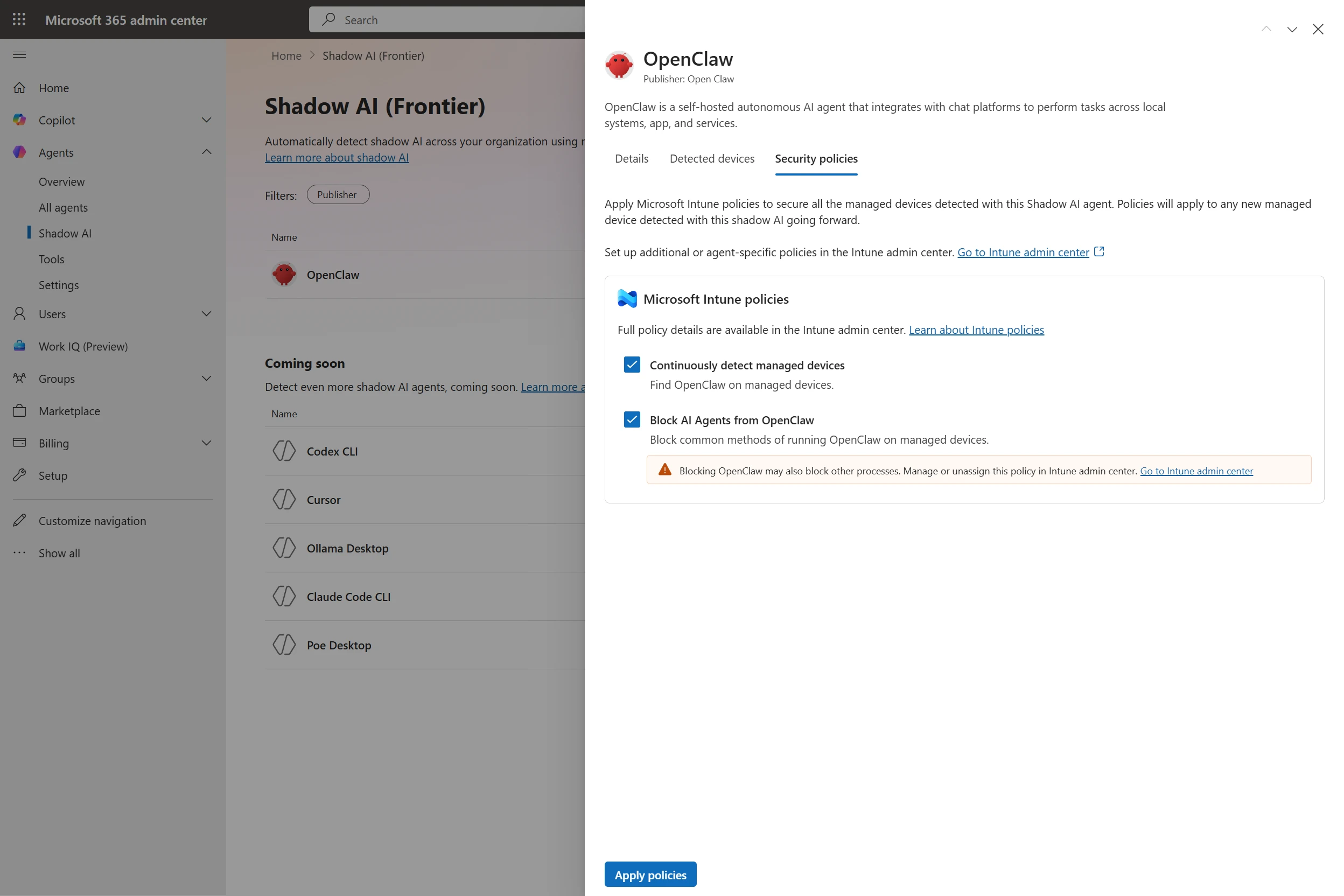
Microsoft 365 admin center showing Shadow AI OpenClaw agent with Intune security policies enabled to detect and block unmanaged AI agents.
In the Microsoft 365 admin center, an IT professional can apply Intune policies to continuously detect managed devices and block the common methods of running OpenClaw on them. 

Starting in June 2026, Microsoft Defender will also provide asset context mapping for each agent including the devices they run on, MCP servers configured for those agents, the identities associated with them, and the cloud resources those identities can reach. This will give security teams the context needed to assess exposure and potential blast radius. They can then investigate agent activity, such as file access and network behavior, using familiar endpoint data, and use those insights to identify misconfigurations and even define custom detections.
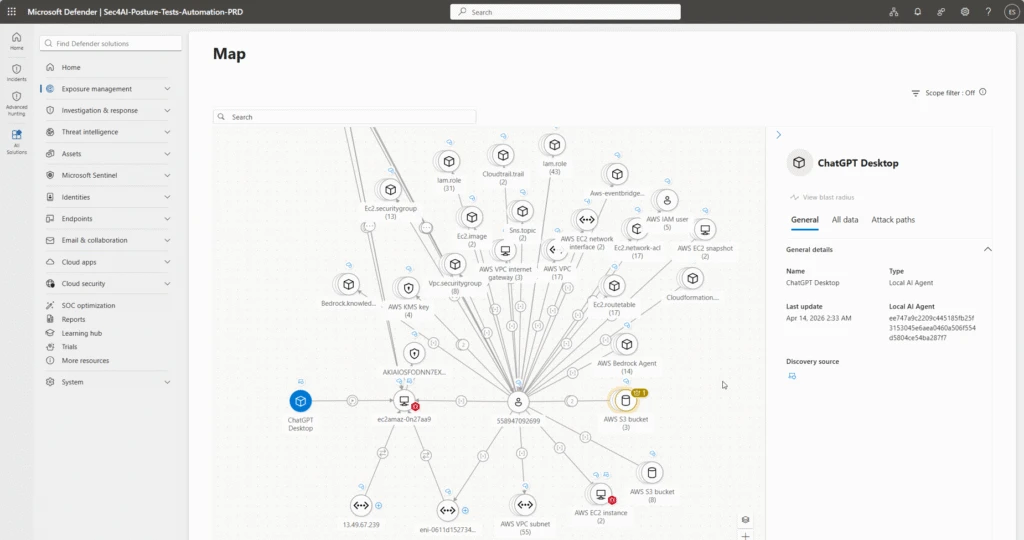
Microsoft Defender interface displaying a security graph map of connected AI agents and AWS resources with ChatGPT Desktop node highlighted.
Security teams can investigate local AI agent exposure in Microsoft Defender through a relationship map that shows where an agent runs, which MCP servers are configured for use, which identities are associated with it, and which cloud resources those identities can reach. Defender context such as resource criticality and sensitive-data exposure helps teams prioritize the agents and paths that matter most. 

Beyond monitoring, organizations will be able to apply policy-based controls to set guardrails for what agents are allowed to do—helping protect both agents and organizations from compromise and misuse—with initial support delivered for OpenClaw through Intune. If a managed agent exhibits malicious behavior patterns, such as attempting to access or exfiltrate sensitive data, Defender will be able to block coding agents in runtime and generate alerts with rich incident context to support investigation and response.  

Context mapping capabilities, policy-based controls, plus runtime blocking and alerts will be available in Agent 365 through Intune and Defender public preview in June 2026. 

Visibility across clouds and AI-builder platforms

As developers are rapidly building agents with Microsoft Foundry, AWS Bedrock, and Google Gemini Enterprise Agent Platform (formerly Google Vertex AI) and deploying cloud agents across multicloud and multi-platform environments, the agent sprawl challenge intensifies. To manage potential security risks or vulnerabilities before they become breaches, security and IT teams need visibility to which cloud agents are running, what models these agents are built on, and what resources they’re accessing.

Today, we are excited to announce the public preview of Agent 365 registry sync with AWS Bedrock and Google Cloud connections, enabling IT teams to automatically discover, inventory, and, soon, perform basic lifecycle governance—for example, start, stop, delete agents—across these platforms.
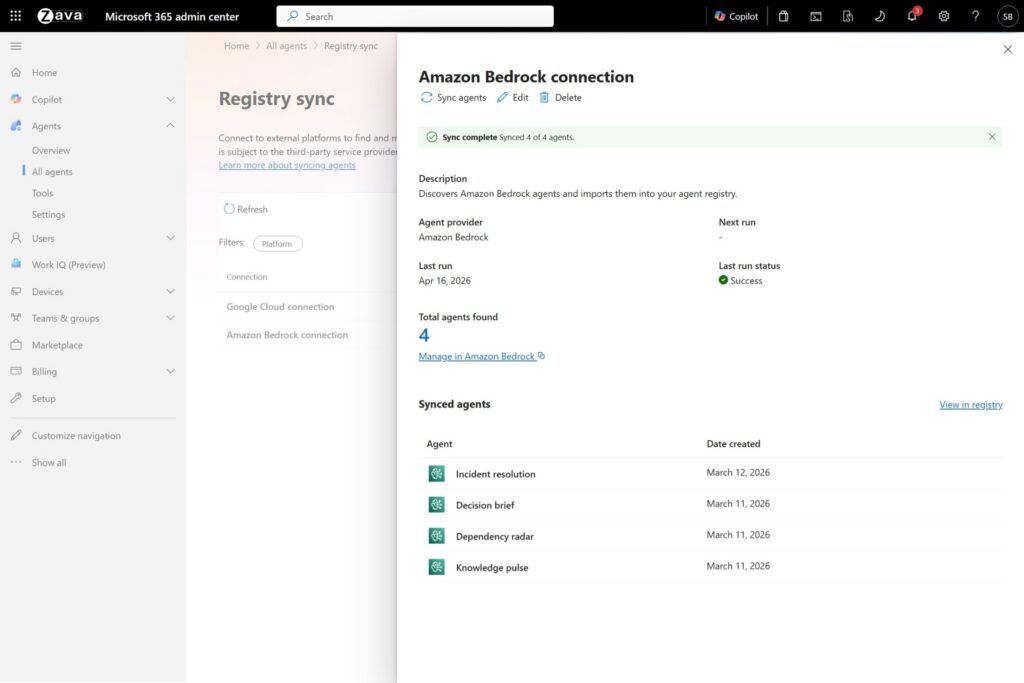
Microsoft 365 admin center Registry sync page showing successful Amazon Bedrock connection with four synced AI agents listed.
Now in public preview, Microsoft 365 admins can connect and sync the Agent 365 registry with Amazon Bedrock and Google Cloud for cross-platform observability and governance. 

Manage a wide ecosystem of SaaS agents 

Agent 365 works with prebuilt agents in Microsoft 365 Copilot and Teams, agents built with Microsoft Copilot Studio or Microsoft Foundry for your organization, and agents built by software development companies partnered with Microsoft.

Delivering on our promise of control plane for the broad agent ecosystem, we’re excited to announce ecosystem partner agents fully configured to be managed by Agent 365, including Genspark, Zensai, Egnyte, and Zendesk, and agents built on agent factories, including Kasisto, Kore, and n8n. Organizations can observe, govern, and secure these agents in the Agent 365 control plane, with no integration work by IT or security teams.  
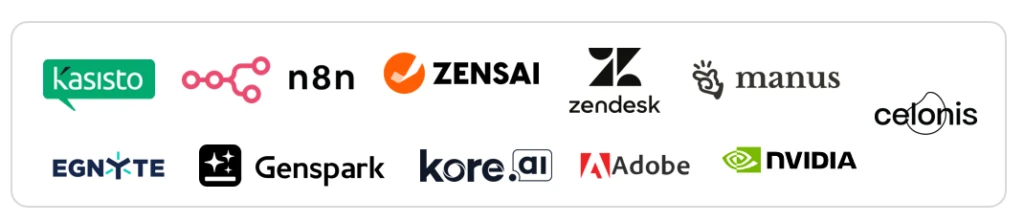
Agent 365 software development company launch partners

Collection of AI and software vendor logos including Adobe, NVIDIA, Zendesk, n8n, Kore.ai, and Celonis.
Agent 365 Software Development Company Launch Partners have built agents fully enabled to be managed by Agent 365. 

Enterprises can easily build AI agents today, but scaling them with trust and governance is where most initiatives stall. With Kore.ai deeply integrated into Microsoft Agent 365, identity, security, and governance are built in from the start—empowering enterprises to move from pilots to AI at scale with confidence.

—– Raj Koneru, Chief Executive Officer of Kore.ai

The Agent 365 developer and ecosystem partners play a critical role in extending agents into line-of-business systems, building vertical and scenario-specific integrations, modernizing legacy automation into agent workflows, extending Copilot experiences with custom agents, and helping customers operationalize agent ecosystems at scale. These Agent 365 enabled agents are then observable, governable, and securable in the Agent 365 control plane, accelerating adoption for your organization.

Secure agents as they work in Windows 365 

While Agent 365 provides the control plane to observe, govern, and secure agent activity across the enterprise, Windows 365 for Agents—now available in public preview (in the United States only)—provides a secured, managed environment where agents can carry out that work. It introduces a new class of Cloud PCs purpose-built for agentic workloads and managed in Intune, allowing agents to run in policy-controlled environments, interact with applications, and operate with the same identity, security, and management controls already used for employees.

Now, with Agent 365, you can also observe and secure agents running on Windows 365 for Agents in Microsoft 365 admin center, understanding which agents are connected to the cloud-powered compute. Together, they enable organizations to move from visibility and governance of agents to confidently running them in production environments. 

Secure agents against internet threats with network controls  

AI agents can operate much faster than human users. Without proper guardrails, they can connect to risky web destinations, interact with unsanctioned AI services, handle sensitive files unsafely, or be manipulated through malicious prompt-based attacks. These risks are harder to manage when security teams lack consistent visibility and controls for agent traffic to internet, SaaS, and AI services. 

To give security teams a consistent way to inspect agent traffic at the network layer, in general availability today, Agent 365 extends Microsoft Entra network controls to Microsoft Copilot Studio agents and agents running on user endpoint devices, including local agents such as OpenClaw. These controls can help identify unsanctioned AI usage, restrict connections to only approved web destinations, filter risky file movement, and help block malicious prompt-based attacks before they lead to harmful actions. 

Confidently scale and govern AI agents while maintaining security and control 

Agent 365 extends even further beyond Microsoft platforms to discover, observe, govern, and secure local, SaaS, and cloud agents across your agentic AI ecosystem. Each of today’s announcements build upon Agent 365 capabilities we shared in March 2026 as well as detailed feedback of customers using the Frontier program, developers integrating with the platform, and partners testing Agent 365 capabilities. 

With Agent 365, we can scale and govern AI agents with confidence, while maintaining enterprise grade security and control. Agent 365 enables organizations to move beyond experimentation, driving tangible business value and innovation through trusted AI adoption. By providing a robust and integrated platform, Agent 365 empowers teams to confidently embrace AI and accelerate transformation across the enterprise.

—Yuji Shono, Head of the Global AI Office, NTT DATA Group Corporation, a global infrastructure, networking, and IT services provider.

As organizations begin to adopt Agent 365 at scale, we’ve collaborated with strategic partners to create targeted services to help customers onboard, tackle governance challenges and realize the platform’s full value.

Grid of enterprise services partner logos including Accenture, KPMG, Cognizant, Capgemini, Avanade, Deloitte, EY, PwC, and TCS.
Featured Agent 365 launch partners, including Accenture, Bechtle, Capgemini, Insight, KPMG, Protiviti and Slalom, collaborated with Microsoft engineering teams to develop services for planning, adopting, and managing your agent control plane implementation.

Partner services offered today include expertise and guidance for: 

  • Inventory and ownership: What agents exist, who owns them, and where they run.
  • Least privilege: Right-sizing permissions and enforcing access guardrails without slowing delivery.
  • Compliance and data protection: Preventing oversharing and producing audit-ready evidence.
  • Threats and multi-platform estates: Understanding attack paths and governing across vendors and clouds.
  • Ongoing operations: Lifecycle management, monitoring, and continuous governance hygiene. 

These valuable services are typically scoped as workshops and assessments (diagnose and roadmap), governance and enablement (stand up the control plane and guardrails), managed services (run and improve continuously), advisory and readiness (operating model and adoption readiness), and security and integration (harden posture and integrate third-party agents.)

How to get started with Agent 365  

Agent 365 is now available in Microsoft 365 E7 or standalone at USD15 per user per month. Each Agent 365 license covers an individual who manages or sponsors agents, or uses agents to do work on their behalf, ensuring all agent activity is consistently governed across the organization in a way that’s predictable for scaled growth.  

In addition to the expertise of your Microsoft 365 team and partners, Agent 365 resources to support your experience include:

Plus, on Tuesday, May 12, 2026, a team of Agent 365 experts are hosting a live “Ask Microsoft Anything” to answer your questions about Agent 365—we hope you’ll join for the discussion.

Choose an ecosystem partner for agent security and governance