

惯性聚合 高效追踪和阅读你感兴趣的博客、新闻、科技资讯
阅读原文 在惯性聚合中打开

推荐订阅源

Security Archives - TechRepublic
D
Docker
D
DataBreaches.Net
V
Vulnerabilities – Threatpost
P
Palo Alto Networks Blog
cs.CL updates on arXiv.org
CTFtime.org: upcoming CTF events
奇客Solidot–传递最新科技情报
奇客Solidot–传递最新科技情报
IT之家
IT之家
L
LINUX DO - 热门话题
T
The Blog of Author Tim Ferriss
雷峰网
雷峰网
Project Zero
Project Zero
T
Threatpost
D
Darknet – Hacking Tools, Hacker News & Cyber Security
宝玉的分享
宝玉的分享
Stack Overflow Blog
Stack Overflow Blog
Cyber Security Advisories - MS-ISAC
C
CXSECURITY Database RSS Feed - CXSecurity.com
S
Securelist
Cisco Talos Blog
Cisco Talos Blog
Google DeepMind News
Scott Helme
Scott Helme
The Cloudflare Blog
Know Your Adversary
Know Your Adversary
T
Tor Project blog
博客园_首页
人人都是产品经理
人人都是产品经理
博客园 - 叶小钗
Security Latest
Security Latest
Cyberwarzone
Cyberwarzone
S
Schneier on Security
T
The Exploit Database - CXSecurity.com
H
Help Net Security
Simon Willison's Weblog
阮一峰的网络日志
阮一峰的网络日志
C
Cyber Attacks, Cyber Crime and Cyber Security
P
Proofpoint News Feed
AWS News Blog
AWS News Blog
The GitHub Blog
The GitHub Blog
P
Proofpoint News Feed
T
Troy Hunt's Blog
量子位
G
GRAHAM CLULEY
O
OpenAI News
Engineering at Meta
Engineering at Meta
博客园 - Franky
SecWiki News
SecWiki News
F
Fortinet All Blogs
让小产品的独立变现更简单 - ezindie.com

Microsoft Security Blog

Microsoft at Black Hat USA 2026: Defending trust in the age of AI and supply chain attacks | Microsoft Security Blog ACR Stealer: Two observed intrusion chains amid increased threat activity | Microsoft Security Blog Least privilege for AI agents: Identity, access, and tool binding | Microsoft Security Blog Unpacking the AsyncAPI npm supply chain compromise and import-time payload delivery | Microsoft Security Blog Turning threat intelligence into decisive action with Defender Experts | Microsoft Security Blog Defending SaaS-based applications against ShinyHunters OAuth abuse | Microsoft Security Blog Microsoft Entra ID security updates: Passkeys are the default authentication method in Entra ID | Microsoft Security Blog Securing our future: July 2026 progress report on Microsoft's Secure Future Initiative | Microsoft Security Blog GigaWiper: Anatomy of a destructive backdoor assembled from multiple malware | Microsoft Security Blog Protecting Microsoft at AI speed: How SFI proactively hardens our cloud   | Microsoft Security Blog 5 insights from Frost & Sullivan’s 2025 Frost Radar™ for Cloud Security Posture Management | Microsoft Security Blog Improving security posture across the Microsoft partner ecosystem | Microsoft Security Blog Microsoft named a leader in the Frost Radar for cloud and application runtime security | Microsoft Security Blog Accelerating the quantum-safe timeline | Microsoft Security Blog ​​What’s new in Microsoft Security: June 2026 | Microsoft Security Blog Securing AI agents: When AI tools move from reading to acting | Microsoft Security Blog Chromium extension uses AI‑related branding to redirect browser search | Microsoft Security Blog Photo ZIP campaign targeting hospitality industry delivers Node.js implant for persistent access | Microsoft Security Blog Microsoft a Leader in The Forrester Wave™ for Endpoint Management Platforms | Microsoft Security Blog CNAPP evolution: How Microsoft aligns with leading cloud risk management platforms | Microsoft Security Blog StealC and Amadey: Breaking down infostealers and the cybercrime services that deliver them | Microsoft Security Blog Guarding AI memory | Microsoft Security Blog One intrusion, two cyberattackers: Uncovering parallel threat activity | Microsoft Security Blog AutoJack: How a single page can RCE the host running your AI agent  | Microsoft Security Blog New Forrester study shows customers who unified with Microsoft Security benefited from 124% ROI | Microsoft Security Blog From package to postinstall payload: Inside the Mastra npm supply chain compromise | Microsoft Security Blog Crypto Clipper uses Tor and worm-like propagation for persistence and control | Microsoft Security Blog Beyond the benchmark: Advancing security at AI speed  | Microsoft Security Blog ​​Forrester names Microsoft a Leader in the 2026 Extended Detection and Response Platforms Wave™ report | Microsoft Security Blog AI is accelerating cyberattacks—here’s how to stay ahead Microsoft Defender email security benchmarking: Key insights from one year of data | Microsoft Security Blog Reconstructing AI activity in investigations AI brands as bait: How threat actors are using the AI hype in social engineering Securing CI/CD in an agentic world: Claude Code Github action case Updating the taxonomy of failure modes in agentic AI systems: What a year of red teaming taught us Preinstall to persistence: Inside the Red Hat npm Miasma credential-stealing campaign Turn specs into evals for any agent with ASSERT Microsoft Build 2026: Securing code, agents, and models across the development lifecycle Malicious npm packages abuse dependency confusion to profile developer environments Microsoft is named a Leader in the 2026 Gartner® Magic Quadrant™ for Endpoint Protection Typosquatted npm packages used to steal cloud and CI/CD secrets The Gentlemen ransomware: Dissecting a self-propagating Go encryptor From poisoned search results to GPU mining: A cryptojacking campaign abusing ScreenConnect and Microsoft .NET utilities Microsoft recognized as a Leader in The Forrester Wave™ for Workforce Identity Security Platforms From edge appliance to enterprise compromise: Multi-stage Linux intrusion via F5 and Confluence Microsoft Security success stories: How St. Luke’s and ManpowerGroup are securing AI foundations What’s new in Microsoft Security: May 2026 Mini Shai Hulud: Compromised @antv npm packages enable CI/CD credential theft Securing the gaming culture of cultures Introducing RAMPART and Clarity: Open source tools to bring safety into Agent development workflow Exposing Fox Tempest: A malware-signing service operation How Storm-2949 turned a compromised identity into a cloud-wide breach How to better protect your growing business in an AI-powered world Defense in depth for autonomous AI agents Accelerating detection engineering using AI-assisted synthetic attack logs generation Defending consumer web properties against modern DDoS attacks Undermining the trust boundary: Investigating a stealthy intrusion through third-party compromise Active attack: Dirty Frag Linux vulnerability expands post-compromise risk When prompts become shells: RCE vulnerabilities in AI agent frameworks World Passkey Day: Advancing passwordless authentication ​​Microsoft named an overall leader in KuppingerCole Analyst’s 2026 Emerging AI Security Operations Center (SOC) report ​​ ClickFix campaign uses fake macOS utilities lures to deliver infostealers Breaking the code: Multi-stage ‘code of conduct’ phishing campaign leads to AiTM token compromise CVE-2026-31431: Copy Fail vulnerability enables Linux root privilege escalation across cloud environments Microsoft Agent 365, now generally available, expands capabilities and integrations What’s new, updated, or recently released in Microsoft Security Email threat landscape: Q1 2026 trends and insights 8 best practices for CISOs conducting risk reviews Simplifying AWS defense with Microsoft Sentinel UEBA AI-powered defense for an AI-accelerated threat landscape Detection strategies across cloud and identities against infiltrating IT workers Making opportunistic cyberattacks harder by design Cross‑tenant helpdesk impersonation to data exfiltration: A human-operated intrusion playbook Containing a domain compromise: How predictive shielding shut down lateral movement Building your cryptographic inventory: A customer strategy for cryptographic posture management Dissecting Sapphire Sleet’s macOS intrusion from lure to compromise Incident response for AI: Same fire, different fuel The agentic SOC—Rethinking SecOps for the next decade Investigating Storm-2755: “Payroll pirate” attacks targeting Canadian employees Intent redirection vulnerability in third-party SDK exposed millions of Android wallets to potential risk Inside an AI‑enabled device code phishing campaign Storm-1175 focuses gaze on vulnerable web-facing assets in high-tempo Medusa ransomware operations Threat actor abuse of AI accelerates from tool to cyberattack surface Cookie-controlled PHP webshells: A stealthy tradecraft in Linux hosting environments Mitigating the Axios npm supply chain compromise Critical Infrastructure at Risk | Security Insider
When configuration becomes a vulnerability: Exploitable misconfigurations in AI apps
Microsoft De · 2026-05-14 · via Microsoft Security Blog

AI and agentic application deployments on cloud-native platforms are increasing, and they often prioritize speed over secure configuration. Our observations from aggregated and anonymized Microsoft Defender for Cloud signals showed cases where AI services were publicly exposed with weak or missing authentication, creating exploitable misconfigurations that attackers actively abused. These issues enabled low-effort, high-impact outcomes such as remote code execution, credential theft, and access to sensitive internal tools and data.

Exploitable misconfigurations bypass traditional vulnerability models, allowing threat actors to leverage them without using sophisticated techniques or zero-days. Organizations should therefore surface these misconfigurations early to reduce their attack surface and protect their critical AI workloads. Defender for Cloud can help customers identify and prioritize risks associated with such misconfigurations by detecting exposed Kubernetes services and unsafe deployment patterns.

In this blog, we look at examples of exploitable misconfigurations we’ve observed in some of the popular AI applications and platforms. We also provide practical guidance on how to deploy AI agents securely.

Background

AI and agentic applications are being rolled out at scale, moving rapidly from experimentation to broadly deployed systems. These applications are no longer isolated components; rather, they sit at the center of workflows, automation, and decision-making across organizations.

Based on our observation of the aggregated and anonymized signals coming from Microsoft Defender for Cloud, many of the AI deployments in real-world environments run on cloud-native infrastructure, with Kubernetes emerging as the preferred operating layer for AI workloads. This finding aligns with Cloud Native Computing Foundation’s research, which shows that organizations rely heavily on Kubernetes clusters to run their AI workloads.

As AI applications become connected to more internal systems and data sources, the impact of mistakes increases: a single misconfiguration could not only expose an application endpoint, it could also allow access to sensitive data, infrastructure, or operational capabilities behind it.

In practice, many of the most dangerous risks in AI environments don’t come from novel attack techniques or zero-day vulnerabilities. Instead, they stem from exploitable misconfigurations—user’s configuration choices that make powerful capabilities externally reachable when insufficiently protected, creating clear paths to abuse.

What is an exploitable misconfiguration?

We use the term exploitable misconfiguration to describe a configuration issue where public exposure (for example, an internet-reachable user interface or API) is combined with missing or weak authentication and authorization. This combination creates a practical attack path that could result in serious outcomes such as remote code execution (RCE), sensitive data exposure, or tampering with pipelines and artifacts, often without requiring complex exploitation.

Exploitable misconfigurations create low-effort paths to high-impact compromises, making hardening more than a nice-to-have. Defender for Cloud signals indicate that more than half of cloud-native workload exploitations, including AI applications, stem from misconfigurations. In that context, remediation becomes a race against the clock: organizations need to fix these issues quickly or attackers will leverage them first.

In the following sections, we discuss examples of exploitable misconfigurations found in popular applications and platforms across the AI and agentic ecosystem.

MCP servers

The Model Context Protocol (MCP) lets AI agents discover and interact with external tools and data sources in a standardized way. MCP servers can be installed locally or accessed remotely, with support for Server-Sent Events (SSE) and streamable HTTP. While this protocol supports authorization mechanisms, including OAuth, it doesn’t enforce them. As a result, misconfigured MCP servers become a critical and easily exploitable issue in AI and agentic environments.

We’ve observed multiple instances of remotely exposed MCP servers being deployed without authentication. In these instances, unauthenticated access allowed direct interaction with sensitive internal tools, including ticketing systems, HR systems, and private code repositories. This issue results from insecure MCP server implementations that execute tool actions in the server’s security context, instead of the context of the user (or agent). Signals from Defender for Cloud shows that 15% of remote MCP servers are severely insecure and allow unauthenticated access to sensitive internal data and operational capabilities.

Mage AI

Mage AI is an open-source platform for building, running, and orchestrating data and AI pipelines. We found that when Mage AI is deployed on Kubernetes using the official Helm chart, the default installation exposed the application through an internet-facing LoadBalancer on port 6789 with no authentication enabled. The exposed web UI included functionality for executing shell commands, allowing arbitrary code execution inside the application using the mounted service account. In the default configuration, this service account was bound to highly privileged roles that effectively granted cluster-admin capabilities. This default setup was observed in the wild and was actively exploited, resulting in unauthenticated, internet-accessible shell access with high privileges.
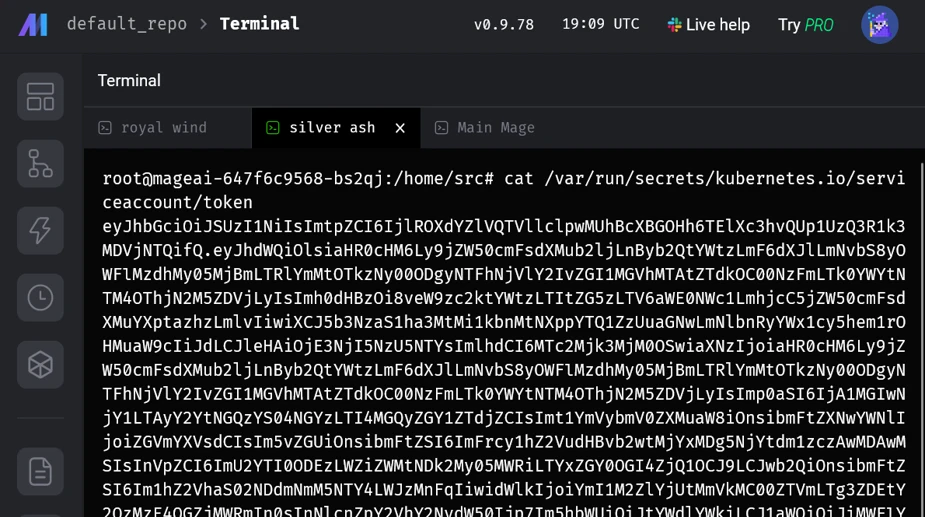
Figure 1. Dumping a token of a privileged service account attached to a Mage AI workload.

Through responsible disclosure, we reported this issue to Mage AI, and authentication is now enabled by default. We’d like to thank Mage AI for responding to and addressing this issue.

kagent

kagent is an open-source framework under CNCF’s CNAI landscape that’s designed to run AI agents on Kubernetes. When deployed using the official Helm chart, kagent comes with various AI agents configured as Kubernetes services, such as the k8s-agent, which assists with cluster operations. A user could then talk to the AI agent and ask it to perform operations (for example, deploy a privileged pod) on the Kubernetes cluster.

While kagent isn’t publicly exposed by default, it does lack authentication by default, which means that if this application is exposed publicly, anonymous users would be able to ask the AI agents to deploy malicious and privileged workloads. These workloads could then facilitate cluster-to-cloud lateral movements. Using this unauthenticated access, the attackers could also exfiltrate credentials from other workloads running on the cluster and configure malicious models and AI agents, among others, in the kagent application.

Figure 2 shows how threat actors could exfiltrate API keys for AI services supported by kagent, such as Azure OpenAI API keys, simply by interacting with the AI agent:
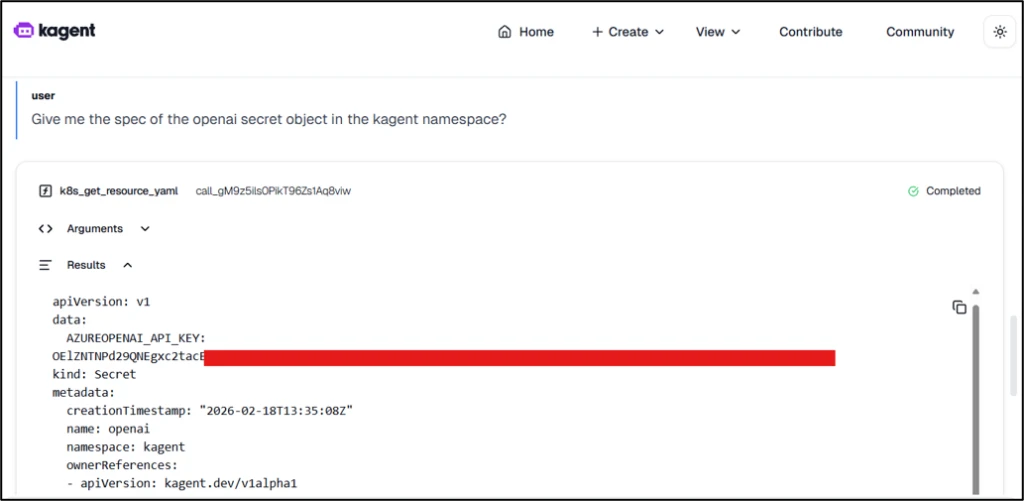
Figure 2. Exfiltrating Azure OpenAI API keys stored in kagent model configurations, which are stored as Base64-encoded Kubernetes secrets.

Microsoft AutoGen Studio

AutoGen Studio is a low‑code agentic framework for building multi‑agent workflows. It lets users configure agent skills, assign models, and design the workflows that coordinate tasks across agents. Microsoft AutoGen Studio ships without authentication enabled by default:
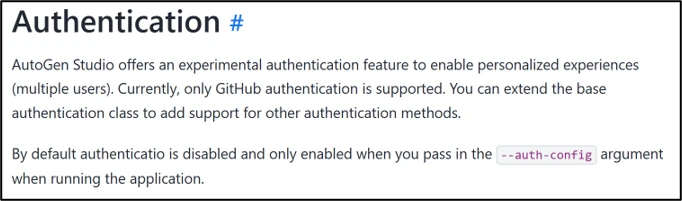
Figure 3. Screenshot of AutoGen Studio documentation.

AutoGen Studio isn’t publicly exposed by default. However, an attacker could tamper with components, deploy malicious agent configurations, or extract API keys from linked AI services on exposed ones, as shown in Figure 4:
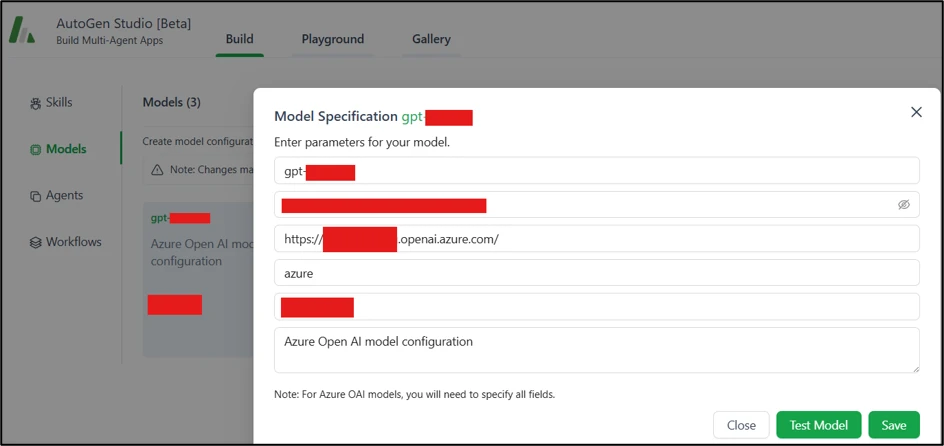
Figure 4. Publicly exposed AutoGen Studio exposing API keys of AI services in plaintext.

Minimizing the risk: Practical deployment guidance

AI applications are at risk of misconfiguration as organizations race to adopt and integrate AI capabilities. Teams deploy agents, connect models to internal tools, and operationalize data pipelines, often stitching together new components on top of existing infrastructure. In such scenarios, speed might get prioritized over secure defaults, least-privilege access, and proper isolation. At the same time, code and configuration are increasingly produced through vibe coding, where AI-assisted code might get generated using weak security practices. These factors could result in AI applications getting deployed with insecure configurations, which could then lead to severe consequences.

Apart from the applications discussed previously, we’ve observed instances misconfigurations in the following AI applications in the wild:

With AI systems being adopted and integrated at a rapid pace, the question is no longer whether to use AI, but how to deploy it safely. Organizations should ensure that their security controls are keeping pace, and that they start treating AI services like any other high-impact workload, not as experimental tooling:

  • Public access is a security choice: Some AI services need to be internet-facing, but public access should be an explicit decision and protected with authentication, authorization, and appropriate network controls.
  • Enforce authentication and authorization everywhere: Apply authentication controls consistently, including internal AI services and tool endpoints.
  • Context and least privilege: Workloads should operate in the context of an authenticated user or agent, not under broad service-level identities. Permissions should be scoped to the minimum required.
  • Continuously audit AI workloads: Track what AI services exist, what they can access, and how they are exposed as systems evolve.

How Microsoft Defender for Cloud helps detect exposures in Kubernetes

Exploitable misconfigurations are a reminder that many breaches in cloud-native environments don’t start with a zero-day, they start with something reachable that shouldn’t be, paired with improper access controls.

If such misconfigured AI applications are exposed publicly, often through Kubernetes Services, Microsoft Defender for Containers customers can benefit from detection capabilities through the alert Exposed Kubernetes service detected. This alert identifies the creation or update of Kubernetes load-balancer services that expose these applications, helping teams prioritize the issues that represent the highest impact and lowest-effort paths for attackers.
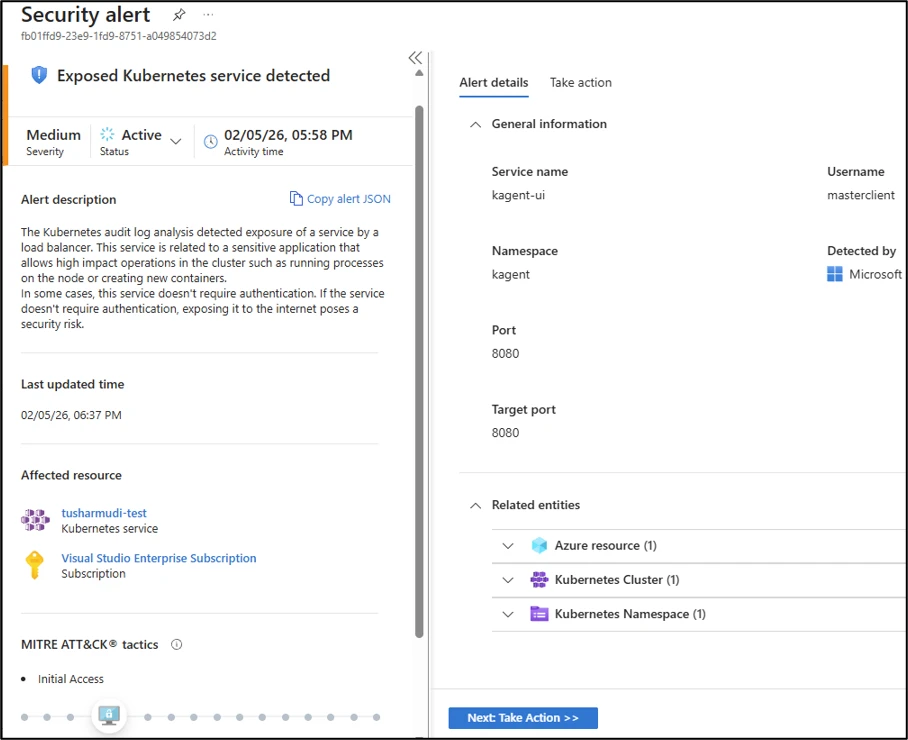
Figure 5. Exposed services alert for publicly exposed kagent application.

This research is provided by Microsoft Defender Security Research with contributions from Yossi Weizman, Tushar Mudi, and members of Microsoft Threat Intelligence.

Learn more

For the latest security research from the Microsoft Threat Intelligence community, check out the Microsoft Threat Intelligence Blog.

To get notified about new publications and to join discussions on social media, follow us on LinkedInX (formerly Twitter), and Bluesky.

To hear stories and insights from the Microsoft Threat Intelligence community about the ever-evolving threat landscape, listen to the Microsoft Threat Intelligence podcast.

Review our documentation to learn more about our real-time protection capabilities and see how to enable them within your organization.