




惯性聚合 高效追踪和阅读你感兴趣的博客、新闻、科技资讯
阅读原文 在惯性聚合中打开

推荐订阅源

人人都是产品经理
人人都是产品经理
MyScale Blog
MyScale Blog
Y
Y Combinator Blog
罗磊的独立博客
奇客Solidot–传递最新科技情报
奇客Solidot–传递最新科技情报
P
Proofpoint News Feed
Google DeepMind News
V
Vulnerabilities – Threatpost
T
The Blog of Author Tim Ferriss
云风的 BLOG
云风的 BLOG
Recorded Future
Recorded Future
N
News and Events Feed by Topic
B
Blog RSS Feed
阮一峰的网络日志
阮一峰的网络日志
博客园_首页
C
CXSECURITY Database RSS Feed - CXSecurity.com
博客园 - 【当耐特】
N
Netflix TechBlog - Medium
博客园 - 叶小钗
B
Blog
Vercel News
Vercel News
T
Tenable Blog
T
The Exploit Database - CXSecurity.com
Spread Privacy
Spread Privacy
T
Threat Research - Cisco Blogs
Cyber Security Advisories - MS-ISAC
Last Week in AI
Last Week in AI
F
Fortinet All Blogs
cs.CL updates on arXiv.org
Microsoft Security Blog
S
Securelist
Microsoft Azure Blog
钛媒体:引领未来商业与生活新知
钛媒体:引领未来商业与生活新知
P
Palo Alto Networks Blog
让小产品的独立变现更简单 - ezindie.com
D
DataBreaches.Net
Cyberwarzone
Cyberwarzone
Engineering at Meta
Engineering at Meta
Martin Fowler
Martin Fowler
G
GRAHAM CLULEY
Project Zero
Project Zero
Cisco Talos Blog
Cisco Talos Blog
A
Arctic Wolf
C
CERT Recently Published Vulnerability Notes
L
LangChain Blog
cs.AI updates on arXiv.org
C
Check Point Blog
A
About on SuperTechFans
W
WeLiveSecurity
The GitHub Blog
The GitHub Blog

Help Net Security

ChatGPT advanced account security adds passkeys and hardware keys Week in review: High-severity LPE vulnerability in the Linux kernel, cPanel 0-day exploited for months Automating Pentest Delivery: A Step-by-Step Guide - PlexTrac Open-source privacy proxy masks PII before prompts reach external AI services Shadow AI risks deepen as 31% of users get no employer training Identity is the control plane for distributed infrastructure AI traffic is getting bigger, louder, and less predictable New infosec products of the month: April 2026 cPanel zero-day exploited for months before patch release (CVE-2026-41940) Cisco releases open-source toolkit for verifying AI model lineage Met Police face criticism for using AI to spy on their own officers Nine-year-old Linux kernel flaw enables reliable local privilege escalation (CVE-2026-31431) Hacker with a special interest in breaching sports institutions ends behind bars - Help Net Security IP Fabric MCP server adds governance and control to enterprise AIOps workflows - Help Net Security Aqua Compass MCP server enables real-time investigation and containment of runtime threats - Help Net Security Google brings instant email verification to Android, no OTP needed - Help Net Security If cyber espionage via HDMI worries you, NCSC built a device to stop it - Help Net Security Apple fixes iPhone bug that let FBI retrieve deleted Signal messages(CVE-2026-28950) - Help Net Security GopherWhisper APT group hides command and control traffic in Slack and Discord - Help Net Security OpenAI tackles a bad habit people have when interacting with AI - Help Net Security A year in, Zoom's CISO reflects on balancing security and business - Help Net Security Scenario: Open-source framework for automated AI app red-teaming - Help Net Security GDPR works, but only where someone enforces it - Help Net Security Ransomware, fraud, and lawsuits drive cyber insurance claims to new peaks - Help Net Security Google’s Workspace Intelligence promises privacy while running on your data - Help Net Security Cyberattack on French government agency triggers phishing alert - Help Net Security Claude Mythos finds 271 Firefox flaws, Mozilla believes zero-days are numbered - Help Net Security Prove Identity Platform connects verification, authentication, and fraud prevention - Help Net Security New Mirai variants target routers and DVRs in parallel campaigns - Help Net Security Acronis GenAI Protection gives MSPs control over AI usage and data risks - Help Net Security Elastic MCP Apps bring security and observability workflows into AI tools - Help Net Security Progress Software fixes sneaky WAF bypass vulnerability (CVE-2026-21876) - Help Net Security Tencent's QClaw AI agent app arrives on Windows and macOS - Help Net Security Phishing reclaims the top initial access spot, attackers experiment with AI tools - Help Net Security OneDrive updates focus on AI, access control, and compliance - Help Net Security PentAGI: Open-source autonomous AI penetration testing system - Help Net Security Apple Intelligence flaw kept stolen tokens reusable on another device - Help Net Security Shadow AI, deepfakes, and supply chain compromise are rewriting the financial sector threat playbook - Help Net Security Thunderbird 150 arrives with encrypted message search and OpenPGP improvements - Help Net Security VirtualBox 7.2.8 is out with Linux kernel 7.0 support and crash fixes - Help Net Security Ransomware negotiator admits role in attacks he was hired to resolve - Help Net Security Scattered Spider hacker pleads guilty to stealing $8 million in cryptocurrency Ivanti Neurons AI automates IT operations, reducing manual work and security risk Silobreaker Mimir adds agentic AI to intelligence workflows with governance and transparency - Help Net Security OpenAI’s Chronicle feature lets Codex read your screen, raising privacy concerns CISA flags another Cisco Catalyst SD-WAN Manager bug as exploited (CVE-2026-20133) A single platform powers SIM farm proxy networks across 17 countries - Help Net Security NGate NFC malware targets Android users through trojanized payment app - Help Net Security Meta and PortSwigger drive offensive security further to find what others miss - Help Net Security EU pushes for stronger cloud sovereignty, awards €180 million to four providers - Help Net Security SmokedMeat: Open-source tool shows what attackers do inside CI/CD pipelines - Help Net Security How to spot a North Korean fake in a job interview - Help Net Security Product showcase: Syncthing for secure, private file synchronization - Help Net Security Week in review: Acrobat Reader flaw exploited, Claude Mythos offensive capabilities and limits Google wipes out 602 million scam ads with Gemini on duty Researcher drops two more Microsoft Defender zero-days, all three now exploited in the wild GitLab 18.11 brings agentic AI to security fixes, CI pipelines, and delivery analytics Liongard upgrades LiongardIQ with AI access, live asset data, and deeper discovery Mozilla challenges enterprise AI providers with Thunderbolt, open-source AI client under your control Codex can now operate between apps. Where are the boundaries? Android 17 Beta 4 arrives with post-quantum cryptography and new memory limits Apple AirTag tracking can be misled by replayed Bluetooth signals Social media bans might steer kids into riskier corners of the internet Workplace stress in 2026 is still worse than before the pandemic New infosec products of the week: April 17, 2026 - Help Net Security ImmuniWeb brings AI upgrades, post-quantum detection and more in Q1 2026 NIST admits defeat on NVD backlog, will enrich only highest-risk CVEs going forward Anthropic releases Claude Opus 4.7 with automated cybersecurity safeguards - Help Net Security Fortinet fixes critical FortiSandbox vulnerabilities (CVE-2026-39813, CVE-2026-39808) - Help Net Security Google Play is changing how Android apps access your contacts and location Tails 7.6.2 patches vulnerability that could expose saved files Cargo theft malware actor spent a month inside a decoy network before researchers pulled the plug Two US nationals jailed over scheme that generated $5 million for the North Korean regime Product showcase: Ente Auth encrypts, backs up, and syncs 2FA Wi-Fi roaming security practices for access network providers and identity providers European AI spending set to hit $290 billion by 2029 Windows is getting stronger RDP file protections to fight phishing attacks Capsule Security debuts with $7 million funding to secure AI agent behavior Hackers hijacked CPUID downloads, served STX RAT to victims $12 million frozen, 20,000 victims identified in crypto scam crackdown Rockstar Games receives “pay or leak” warning after cyberattack Google makes it harder to exploit Pixel 10 modem firmware Siemens expands Industrial Automation DataCenter with edge AI and cybersecurity Adobe issues emergency fix for Acrobat Reader flaw exploited in the wild (CVE-2026-34621) Seized VerifTools servers expose 915,655 fake IDs, 8 arrested Fixing vulnerability data quality requires fixing the architecture first ZeroID: Open-source identity platform for autonomous AI agents MITRE releases a shared fraud-cyber framework built from real attack data The fully free Linux OS Trisquel gets a major update with version 12.0 Ecne Week in review: Windows zero-day exploit leaked, Patch Tuesday forecast ClickFix campaign delivers Mac malware via fake Apple page Poisoned “Office 365” search results lead to stolen paychecks Gmail’s end-to-end encryption comes to mobile, no extra apps required To counter cookie theft, Chrome ships device-bound session credentials Product showcase: Session, a messenger without phone numbers or metadata Little Snitch for Linux shows what your apps are connecting to - Help Net Security Apiiro CLI turns AI coding assistants into full-stack security engineers - Help Net Security April 2026 Patch Tuesday forecast: Spring-cleaning of a preview - Help Net Security What vibe hunting gets right about AI threat hunting, and where it breaks down - Help Net Security Health insurance lead sites sell personal data within seconds of form submission - Help Net Security
OpenAI wants AI to fix vulnerabilities, not just find them - Help Net Security
Anamarija Pogorelec · 2026-06-23 · via Help Net Security

OpenAI expanded Daybreak, its cybersecurity initiative that combines AI models, Codex Security, security researchers, maintainers, industry partners, and access controls to support vulnerability discovery and remediation. Organizations can use the initiative to identify, validate, and fix software vulnerabilities, while developers, maintainers, and security teams can use its tools to strengthen defensive security capabilities.
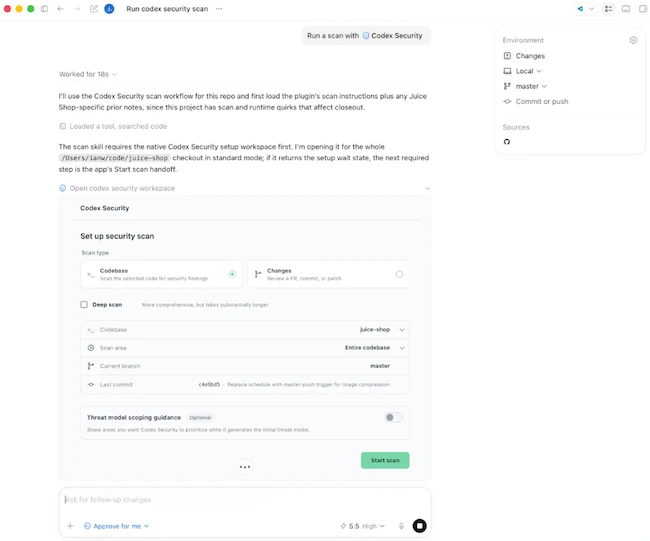
OpenAI expanded Daybreak

Codex Security scan (Source: OpenAI)

Codex Security targets remediation bottlenecks

Advances in vulnerability discovery are exposing more issues, increasing the pressure on teams responsible for fixing them.

OpenAI launched the Codex Security cloud research preview in March. Since then, it has scanned more than 30 million commits across 30,000 codebases, and more than 500,000 findings have been automatically determined to be fixed.

The platform understands a team’s codebase and threat model, or creates one when needed. It identifies plausible vulnerabilities, determines whether affected code is reachable, gathers evidence to support validation, develops targeted patches, and verifies results. Human operators remain in control of which findings to investigate, which changes to apply, and what information to share.

With the updated Codex Security plugin, developers can run deep scans or review recent changes in repositories, pull requests, and local code, generate reports that include severity ratings, affected code locations, validation evidence, and remediation guidance, trace attack paths, build threat models, validate findings, and generate codebase-specific patches for review.

“The plugin can also triage and validate existing findings from scanners, advisories, bug bounty reports, or ticketing systems, then automate patch generation at scale to help reduce vulnerability backlogs. When Codex Security completes a scan, it can export findings to an existing vulnerability management system or integrate with other tools through SARIF files, CodeQL queries, and more. The plugin makes these capabilities more accessible for automated pipelines using Codex CLI and for developer workflows in the Codex app,” the company said.

GPT-5.5-Cyber gains new security capabilities

OpenAI’s initial preview of GPT-5.5-Cyber, which remains available to verified defenders whose authorized work requires OpenAI’s most advanced cyber capabilities, focused on reducing unnecessary refusals in specialized workflows. The model can identify security-relevant components, determine whether code is reachable, validate likely issues in controlled environments, develop and test patches, and prepare evidence for human review.

GPT-5.5-Cyber outperformed GPT-5.5 on the CyberGym, ExploitGym, and SEC-bench Pro security benchmarks, scoring 85.6%, 39.5%, and 69.8%, respectively.

“We are continuing to evaluate the model’s performance on complex repositories and real remediation workflows as coordinated disclosures conclude,” OpenAI added.

OpenAI launches cyber partner program

OpenAI launched the OpenAI Daybreak Cyber Partner Program, which allows participating security vendors to integrate GPT-5.5 with Trusted Access for Cyber into customer-facing products and services.

Trusted Access for Cyber provides access to advanced cyber capabilities alongside additional safeguards, monitoring, and verification measures.

The company said it plans to expand the program to additional organizations in the coming months.

Patch the Planet supports open-source security

OpenAI launched the Patch the Planet initiative with Trail of Bits and in collaboration with HackerOne and CALIF. It funds security researchers and equips them with Codex Security and advanced AI models to work with open-source maintainers.

The initiative combines AI-assisted vulnerability discovery with expert human review to reduce false positives and ease the burden on software maintainers.

OpenAI security researchers work with open-source maintainers to validate vulnerabilities, remove duplicate reports, and verify patches before submission. Participating projects receive ChatGPT Pro, API credits, and conditional access to Codex Security.

According to OpenAI, an initial five-day sprint identified hundreds of potential issues, led to dozens of merged fixes, and produced reusable testing workflows to support future vulnerability discovery and remediation.

The company is working with governments and institutions worldwide strengthen cybersecurity defenses and protect critical infrastructure.

“We plan to work directly with eligible operators of critical infrastructure, including government networks, to develop safeguards tailored to the systems they operate. The focus of this work is to make advanced AI more useful to defenders while making it harder for malicious actors to cause real-world harm,” the company said.

OpenAI plans to work with enterprise customers and partners to strengthen cybersecurity safeguards and help prevent attacks targeting critical services.