

惯性聚合 高效追踪和阅读你感兴趣的博客、新闻、科技资讯
阅读原文 在惯性聚合中打开

推荐订阅源

D
DataBreaches.Net
N
Netflix TechBlog - Medium
P
Proofpoint News Feed
D
Docker
J
Java Code Geeks
L
LangChain Blog
Microsoft Security Blog
The GitHub Blog
The GitHub Blog
I
InfoQ
Stack Overflow Blog
Stack Overflow Blog
云风的 BLOG
云风的 BLOG
Engineering at Meta
Engineering at Meta
MongoDB | Blog
MongoDB | Blog
月光博客
月光博客
T
Tailwind CSS Blog
M
MIT News - Artificial intelligence
Blog — PlanetScale
Blog — PlanetScale
Google DeepMind News
腾讯CDC
罗磊的独立博客
U
Unit 42
爱范儿
爱范儿
Vercel News
Vercel News
MyScale Blog
MyScale Blog

Help Net Security

Your work apps are quietly handing 19 data points to someone ChatGPT advanced account security adds passkeys and hardware keys Week in review: High-severity LPE vulnerability in the Linux kernel, cPanel 0-day exploited for months Automating Pentest Delivery: A Step-by-Step Guide - PlexTrac Open-source privacy proxy masks PII before prompts reach external AI services Shadow AI risks deepen as 31% of users get no employer training Identity is the control plane for distributed infrastructure AI traffic is getting bigger, louder, and less predictable New infosec products of the month: April 2026 cPanel zero-day exploited for months before patch release (CVE-2026-41940) Cisco releases open-source toolkit for verifying AI model lineage Met Police face criticism for using AI to spy on their own officers Hacker with a special interest in breaching sports institutions ends behind bars - Help Net Security IP Fabric MCP server adds governance and control to enterprise AIOps workflows - Help Net Security Aqua Compass MCP server enables real-time investigation and containment of runtime threats - Help Net Security Google brings instant email verification to Android, no OTP needed - Help Net Security If cyber espionage via HDMI worries you, NCSC built a device to stop it - Help Net Security Apple fixes iPhone bug that let FBI retrieve deleted Signal messages(CVE-2026-28950) - Help Net Security GopherWhisper APT group hides command and control traffic in Slack and Discord - Help Net Security OpenAI tackles a bad habit people have when interacting with AI - Help Net Security A year in, Zoom's CISO reflects on balancing security and business - Help Net Security Scenario: Open-source framework for automated AI app red-teaming - Help Net Security GDPR works, but only where someone enforces it - Help Net Security Ransomware, fraud, and lawsuits drive cyber insurance claims to new peaks - Help Net Security Google’s Workspace Intelligence promises privacy while running on your data - Help Net Security Cyberattack on French government agency triggers phishing alert - Help Net Security Claude Mythos finds 271 Firefox flaws, Mozilla believes zero-days are numbered - Help Net Security Prove Identity Platform connects verification, authentication, and fraud prevention - Help Net Security New Mirai variants target routers and DVRs in parallel campaigns - Help Net Security Acronis GenAI Protection gives MSPs control over AI usage and data risks - Help Net Security
Nine-year-old Linux kernel flaw enables reliable local pr...
Zeljka Zorz · 2026-04-30 · via Help Net Security

Security researchers at Theori have disclosed a high-severity local privilege escalation (LPE) vulnerability (CVE-2026-31431) in the Linux kernel.

The flaw, nicknamed “Copy Fail”, has affected virtually every major Linux distribution shipped since 2017, and a working proof-of-concept (PoC) exploit is publicly available.

About CVE-2026-31431

According to Theori researchers, CVE-2026-31431 originates from the interaction of three reasonable kernel changes made over several years: the addition of authencesn (an AEAD cryptographic wrapper used by IPsec) in 2011, the introduction of AF_ALG AEAD socket support in 2015, and an in-place optimization added to algif_aead.c in 2017.

It’s a logic bug in the authencesn cryptographic template and allows an unprivileged local user to write 4 controlled bytes into the page cache of any readable file on a Linux system, and use that to gain root.

The technical write-up is more detailed, of course.

The good news is that CVE-2026-31431 exploitation requires local code execution as a regular user, which means that, by itself, it can’t be exploited remotely. But “chain it with anything that gives you that (web RCE landing in an unprivileged service account, an SSH foothold, a malicious PR on a CI runner) and you’re root,” the researchers pointed out.

The bad news is that unlike the Dirty Cow and Dirty Pipe Linux kernel LPE vulnerabilities, Copy Fail can be exploited without having to win a race condition, and the same exploit will work on many systems.

What to do?

CVE-2026-31431 affects every Linux distribution that uses a kernel that has been released since 2017.

The exploit script is tiny, doesn’t rely on additional software being installed, will work on almost all Linux distributions released since 2017, will work each time it’s run on a vulnerable system, doesn’t change files on disk and won’t be flagged by tools that monitor files for tampering, leaves no forensic trace on disk and, finally, it can break out of container isolation.

For all of these reasons, the researchers advise admins to prioritize patching the vulnerability on multi-tenant Linux systems, CI runners, cloud SaaS running user code, and container clusters first, and then on standard Linux servers and single-user workstations:
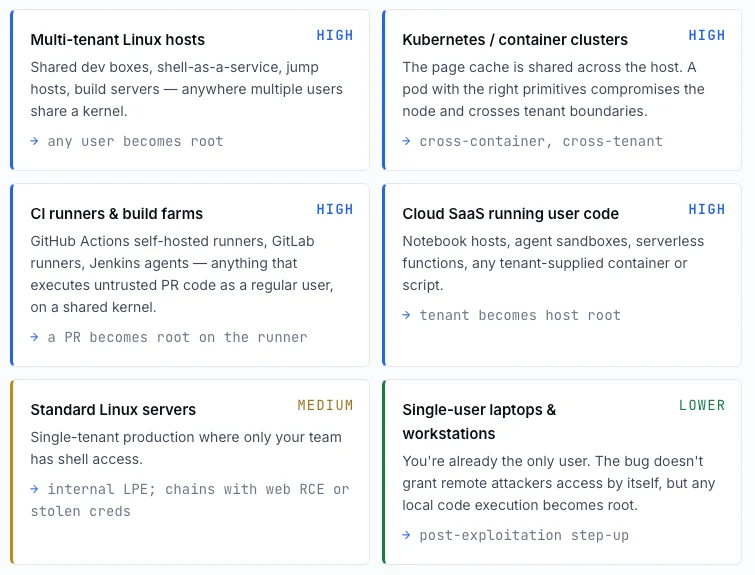
Linux LPE vulnerability CVE-2026-31431

CopyFail patching prioritization (Source: Theori)

The researchers verified that Ubuntu 24.04 LTS, Amazon Linux 2023, RHEL 10.1, and SUSE 16 are vulnerable. Openwall Project founder Alexander Peslyak (aka Solar Designer) confirmed that the exploit provided worked on Rocky Linux 9.7.

Linux distros have been notified of the existence of the vulnerability in advance, and many have already released kernel packages that include the commit that patched it.

Admins/users who, for whatever reason, can’t update their distribution’s kernel package, can temporarilty mitigate the risk by:

  • Blocking AF_ALG socket creation via seccomp, or
  • Blacklisting the algif_aead module.

Subscribe to our breaking news e-mail alert to never miss out on the latest breaches, vulnerabilities and cybersecurity threats. Subscribe here!