


惯性聚合 高效追踪和阅读你感兴趣的博客、新闻、科技资讯
阅读原文 在惯性聚合中打开

推荐订阅源

D
Docker
大猫的无限游戏
大猫的无限游戏
Jina AI
Jina AI
酷 壳 – CoolShell
酷 壳 – CoolShell
博客园 - 司徒正美
美团技术团队
雷峰网
雷峰网
阮一峰的网络日志
阮一峰的网络日志
WordPress大学
WordPress大学
T
Tailwind CSS Blog
U
Unit 42
C
Check Point Blog
S
SegmentFault 最新的问题
Martin Fowler
Martin Fowler
Stack Overflow Blog
Stack Overflow Blog
云风的 BLOG
云风的 BLOG
L
LangChain Blog
钛媒体:引领未来商业与生活新知
钛媒体:引领未来商业与生活新知
腾讯CDC
罗磊的独立博客
小众软件
小众软件
Recent Announcements
OSCHINA 社区最新新闻
OSCHINA 社区最新新闻
D
DataBreaches.Net

Help Net Security

ChatGPT advanced account security adds passkeys and hardware keys Week in review: High-severity LPE vulnerability in the Linux kernel, cPanel 0-day exploited for months Automating Pentest Delivery: A Step-by-Step Guide - PlexTrac Open-source privacy proxy masks PII before prompts reach external AI services Shadow AI risks deepen as 31% of users get no employer training Identity is the control plane for distributed infrastructure AI traffic is getting bigger, louder, and less predictable New infosec products of the month: April 2026 cPanel zero-day exploited for months before patch release (CVE-2026-41940) Cisco releases open-source toolkit for verifying AI model lineage Met Police face criticism for using AI to spy on their own officers Nine-year-old Linux kernel flaw enables reliable local privilege escalation (CVE-2026-31431) Hacker with a special interest in breaching sports institutions ends behind bars - Help Net Security IP Fabric MCP server adds governance and control to enterprise AIOps workflows - Help Net Security Aqua Compass MCP server enables real-time investigation and containment of runtime threats - Help Net Security Google brings instant email verification to Android, no OTP needed - Help Net Security If cyber espionage via HDMI worries you, NCSC built a device to stop it - Help Net Security Apple fixes iPhone bug that let FBI retrieve deleted Signal messages(CVE-2026-28950) - Help Net Security GopherWhisper APT group hides command and control traffic in Slack and Discord - Help Net Security OpenAI tackles a bad habit people have when interacting with AI - Help Net Security A year in, Zoom's CISO reflects on balancing security and business - Help Net Security Scenario: Open-source framework for automated AI app red-teaming - Help Net Security GDPR works, but only where someone enforces it - Help Net Security Ransomware, fraud, and lawsuits drive cyber insurance claims to new peaks - Help Net Security Google’s Workspace Intelligence promises privacy while running on your data - Help Net Security Cyberattack on French government agency triggers phishing alert - Help Net Security Claude Mythos finds 271 Firefox flaws, Mozilla believes zero-days are numbered - Help Net Security Prove Identity Platform connects verification, authentication, and fraud prevention - Help Net Security New Mirai variants target routers and DVRs in parallel campaigns - Help Net Security Acronis GenAI Protection gives MSPs control over AI usage and data risks - Help Net Security
ASAPP expands adversarial testing for enterprise AI systems
Industry New · 2026-05-21 · via Help Net Security

ASAPP has launches Continuous Red Teaming, a new capability that integrates adversarial AI testing directly into ASAPP’s model evaluation framework. The new capability is built on Promptfoo, an AI security platform that helps enterprises detect and address vulnerabilities in AI systems during development.

Promptfoo continuously runs automated tests across ASAPP’s AI systems, screening for more than 50 vulnerability types to give enterprise customers the real-time data they need to trust their AI in production.
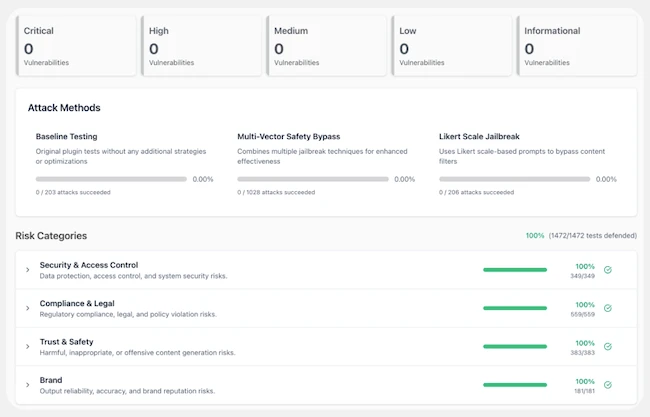
ASAPP Continuous Red Teaming

As AI agents shift from answering questions to taking actions, the potential for security threats increases. Static safety filters and one-time audits are no longer enough. Adversarial techniques have advanced, exploiting the same reasoning skills that make large language models effective. Enterprises using AI at scale are being asked to trust systems they can’t continuously verify. ASAPP’s Continuous Red Teaming is designed to bridge that gap.

“Enterprise AI builds trust through proven results at scale,” stated Priya Vijayarajendran, CEO of ASAPP. “Organizations using AI for essential customer interactions deserve solid proof, not just promises. Our dedication to Continuous Red Teaming guarantees we meet and exceed that commitment every single day.”

The capability operates across three critical security domains:

  • Core model integrity & control: ASAPP’s agentic platform continuously tests against adversarial jailbreaking techniques, including many-shot attacks and character-level obfuscations, as well as system override attempts and probes for hallucinated authority, where a model might be coerced into making unauthorized legal or business commitments.
  • Data privacy & knowledge base security: In RAG-driven deployments, retrieved data is as vulnerable as the model itself. ASAPP tests against indirect prompt injection via poisoned documents, knowledge base exfiltration, and cross-session PII leakage to ensure that sensitive data never bleeds across sessions or tenants.
  • Agentic & operational security: As AI moves from conversation to action, ASAPP validates that its agents cannot be manipulated into unauthorized data access, cannot be used as proxies for internal network reconnaissance, and cannot expose underlying system architecture through tool-calling exploitation.

The core capability features a risk benchmarking framework where ASAPP tracks the Attack Success Rate (ASR) for each model update. It uses automated graders to minimize human bias in safety evaluations and aligns results with the OWASP Top 10 for LLMs and the NIST AI Risk Management Framework, ensuring audit-ready safety metrics from day one.

“CISOs and procurement teams looking at enterprise AI need more than a vendor’s word that their systems are safe,” said Khash Kiani, CISO of ASAPP. “Trust has to be earned through specific metrics, a clear approach, and a regular reporting system to share with their boards. We have created a safety architecture that automatically identifies and fixes weaknesses in real time. This is the standard that enterprise AI should aim for, and we are committed to leading the way.”