
惯性聚合 高效追踪和阅读你感兴趣的博客、新闻、科技资讯
阅读原文 在惯性聚合中打开

推荐订阅源

T
Threat Research - Cisco Blogs
freeCodeCamp Programming Tutorials: Python, JavaScript, Git & More
cs.AI updates on arXiv.org
V
Vulnerabilities – Threatpost
GbyAI
GbyAI
P
Proofpoint News Feed
L
LINUX DO - 热门话题
P
Palo Alto Networks Blog
A
About on SuperTechFans
T
Tenable Blog
M
MIT News - Artificial intelligence
IT之家
IT之家
I
Intezer
D
DataBreaches.Net
爱范儿
爱范儿
T
Threatpost
C
CERT Recently Published Vulnerability Notes
云风的 BLOG
云风的 BLOG
博客园 - 三生石上(FineUI控件)
WordPress大学
WordPress大学
K
Kaspersky official blog
大猫的无限游戏
大猫的无限游戏
A
Arctic Wolf
Y
Y Combinator Blog
Cyberwarzone
Cyberwarzone
酷 壳 – CoolShell
酷 壳 – CoolShell
D
Darknet – Hacking Tools, Hacker News & Cyber Security
H
Help Net Security
Microsoft Security Blog
Spread Privacy
Spread Privacy
奇客Solidot–传递最新科技情报
奇客Solidot–传递最新科技情报
AWS News Blog
AWS News Blog
博客园 - 聂微东
C
Check Point Blog
S
Securelist
有赞技术团队
有赞技术团队
雷峰网
雷峰网
aimingoo的专栏
aimingoo的专栏
Last Week in AI
Last Week in AI
Stack Overflow Blog
Stack Overflow Blog
MongoDB | Blog
MongoDB | Blog
D
Docker
G
GRAHAM CLULEY
T
The Exploit Database - CXSecurity.com
C
Cybersecurity and Infrastructure Security Agency CISA
T
Tailwind CSS Blog
L
Lohrmann on Cybersecurity
G
Google Developers Blog
C
Cyber Attacks, Cyber Crime and Cyber Security
L
LangChain Blog

Help Net Security

Manage machine identities: The hidden privileged access layer you need to manage Cybersecurity jobs available right now: May 26, 2026 Anthropic adds 28 security and compliance integrations for Claude Cisco refines its risk-based vulnerability disclosure for the AI era Authorities seize 800 servers used for cyberattacks and disinformation US states step up cyber defenses to protect local communities Lessons for organizations from the Verizon 2026 Data Breach Investigations Report OpenHack: Open-source AI-powered vulnerability research Boards want cyber risk in dollars, not CVE counts Turns out the C-suite loves shadow AI Week in review: GitHub breached via poisoned VS Code extension, critical NGINX flaw exploited $20 per zero-day is already the WordPress plugin reality Deleted Google API keys keep working for up to 23 minutes, researchers warn Kore.ai unveils AI-native platform for enterprise multiagent systems Suspected KimWolf botnet admin arrested over DDoS-for-hire operation Versa extends zero trust principles to AI agents and MCP workflows GitLab 19.0 adds AI workflows, secrets management, and self-hosted model support Proton Pass adds monitored credential sharing for AI agents Keepnet contributes voice and SMS phishing data to the 2026 Verizon DBIR CISA’s new KEV nomination form opens reporting to vendors and researchers Microsoft 365 users targeted by new phishing threat that bypasses MFA Meet Fractal, an OS made for microarchitecture reverse engineering Downtime has become a $600 billion business problem The new economics of fraud: Cheaper, faster, more convincing New infosec products of the week: May 22, 2026 Microsoft open-sources tools for designing and testing AI agents Authorities dismantle First VPN, used by ransomware actors GitHub, Grafana Labs breaches traced back to TanStack supply chain compromise Microsoft Defender vulnerabilities exploited in the wild (CVE-2026-41091, CVE-2026-45498) Virtru centers file collaboration around data-level protection ASAPP expands adversarial testing for enterprise AI systems Tenable Hexa AI automates remediation across attack surfaces Riverbed introduces new Aternity tools for autonomous IT operations Forward launches Predict to test network changes before deployment CTERA brings AI insights and automation for unstructured data Terra adds continuous network exploitation validation to its platform Why AI changed the threat model for travel technology Most dark web activity revolves around a handful of topics AI red teaming agents change how LLMs get tested Product showcase: Bitdefender Mobile Security for iOS protects privacy where scams begin Cyber threats push SMBs to spend more on security Webworm APT targets European government organizations with new backdoors Verizon DBIR: Vulnerability exploitation is the dominant initial access vector NanoCo lands $12 million seed funding, launches enterprise assistant built on NanoClaw FBI: $388 million lost in crypto ATM scams in 2026 ArmorCode gives security teams AI workers for exposure and remediation Novata uses AI to map risk across portfolios and supply chains TeamPCP breached GitHub’s internal codebase via poisoned VS Code extension Trust3 AI focuses on AI agent risks with MCP Security layer Encryption Consulting launches CertSecure Manager v3.3 with zero-touch certificate renewals Darwinium updates mobile SDKs to detect remote access scam activity Microsoft provides mitigation for “YellowKey” BitLocker bypass flaw (CVE-2026-45585) Communicating cyber risk in dollars boards understand CVE Lite CLI: Open-source dependency vulnerability scanner When your AI assistant has the keys to production 7 hard truths security pros should know: 2026 DevOps Threats Report What happens when your identity provider becomes the kill chain PureLogs infostealer is stealing credentials worldwide Selector extends AI-driven observability into multi-cloud environments LaunchDarkly adds real-time controls for AI agents in production Canonical ships Ubuntu Core 26 with 15 years of security maintenance New macOS infostealer impersonates Apple, Microsoft, and Google in a single attack chain The end of unencrypted Discord calls is here Babel Street targets AI-driven threats with new agentic investigation capabilities iProov brings identity verification to video meetings to reduce fraud risks Egnyte unveils Email Capture and AI features to unify fragmented data Public Instagram posts provide raw material for AI phishing campaigns Earbud sensors can authenticate users by their heartbeat, study finds AI infrastructure is cracking under sovereignty demands Cybersecurity jobs available right now: May 19, 2026 AI is drowning software maintainers in junk security reports Game over for 74 suspected scammers after Dutch cops plastered their faces on billboards Attackers are exploiting critical NGINX vulnerability (CVE-2026-42945) SmartBear expands ReadyAPI with AI-powered API testing capabilities Attackers accessed, downloaded code from Grafana Labs’ GitHub 201 arrested in INTERPOL disruption of phishing and fraud networks The AI backdoor your security stack is not built to see Lyrie: Open-source autonomous pentesting agent AI shrinks vulnerability exploitation window to hours Product showcase: McAfee + ChatGPT integration turns doubt into a scam check When ransomware hits, confidence doesn’t restore endpoints Debian 13.5 point release lands with security fixes, bug patches Week in review: Cisco patches SD-WAN 0-day, unpatched Microsoft Exchange Server flaw exploited Google lets Workspace admins apply one policy across all SAML apps Critical MOVEit Automation auth bypass vulnerability fixed (CVE-2026-4670) Penske Logistics launches platform for real-time supply chain visibility DigiCert breached via malicious screensaver file Operant AI Endpoint Protector secures AI agents and MCP tools Owl IRD enables one-way forensic data transfer for incident response teams Multiple threat actors actively exploit cPanel vulnerability (CVE-2026-41940) Blend Autopilot MCP brings AI agent orchestration to lending platforms Two cybersecurity pros get prison time for helping ransomware gang Claude Security enters public beta with Opus 4.7 vulnerability scanning and patching 15-year-old detained over massive data breach at French government agency Lens Agents brings policy control to AI across cloud and desktop Brush shell 0.4.0 tightens script safety, widens platform support Pipelock: Open-source AI agent firewall Spotting third-party cyber risk before attackers do What researchers learned about building an LLM security workflow Your work apps are quietly handing 19 data points to someone
Cybercriminals are moving away from mass phishing campaigns
Sinisa Markovic · 2026-06-12 · via Help Net Security

Phishing activity declined by roughly 20% in both 2024 and 2025, according to research from Zscaler’s ThreatLabz team. The drop followed years of growth that pushed phishing activity above 2 billion hits in 2023.

“Phishing volume measured by blocked emails is no longer a reliable proxy for phishing risk.”

Researchers found greater use of targeted phishing campaigns designed to resemble routine business communications. The services sector recorded a 65.5% year-over-year increase in phishing activity, making it the most targeted industry in the dataset.
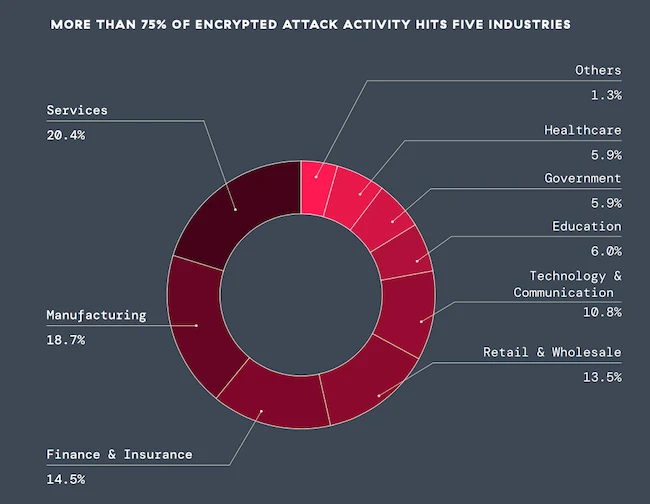
phishing activity trends

Encrypted attack hits by industry (Source: Zscaler)

Billing notices, onboarding documents, renewals, support requests, and document-sharing workflows appeared frequently in campaigns targeting the sector. One campaign cited by Zscaler used tax-themed lures and legitimate services such as OneDrive to target more than 29,000 users across 10,000 services organizations.

Microsoft and Google topped the list of brands most frequently impersonated in phishing campaigns. Credentials tied to those platforms often provide access to multiple business services through a single account.

A Microsoft 365 login can unlock email, files, Teams, SharePoint, OneDrive, and connected SaaS applications. Access to one account can expose a much larger portion of an organization’s environment.

AI site builders are becoming part of phishing operations

ThreatLabz identified 413,524 AI-generated website instances and classified 37,447 of them as malicious.

The activity was associated with platforms including Manus AI, Blackbox AI, Anything AI, Bolt AI, Vercel v0, and Framer AI. Unattributed AI tooling accounted for the largest share of observed activity, followed by Manus AI and Blackbox AI.

Researchers documented phishing pages, fake applications, and brand impersonation sites created through these services.

One case involved a counterfeit Coinbase Wallet website generated with an AI application builder. The site promoted a fake browser extension and was hosted on a legitimate platform. Researchers noted that branding from the AI platform remained embedded in parts of the page metadata.

“What used to require a developer, a template kit, and time now often takes little more than a prompt and a few iterations.”

More phishing activity is hidden inside encrypted traffic

More than 95% of phishing activity observed by Zscaler was delivered over encrypted channels.

Researchers also found that 87% of all malicious activity blocked during 2025 was delivered over HTTPS. Credential theft, session abuse, and redirects increasingly occur through the same encrypted connections employees use to access cloud applications and business services.

“What makes this shift more dangerous is where compromise actually happens: in the browser, over HTTPS.”

Attackers are bypassing MFA in real time

ThreatLabz identified phishing kits that combine adversary-in-the-middle (AiTM) and browser-in-the-middle (BiTM) techniques to intercept login sessions and capture credentials, MFA codes, and session tokens in real time.

BlackForce, a phishing-as-a-service platform cited by ThreatLabz, was among the examples. The kit captures credentials, MFA codes, and session information during the login process, turning a single click into a session-level compromise.

Attack surface discovery is happening at scale

Between October 2025 and March 2026, external decoys deployed in customer environments recorded 89.9 million hostile interactions from 1.37 million unique attacker IP addresses.

Attackers were probing exposed services and looking for assets that could provide a path into an organization. Researchers described reconnaissance efforts focused on exposed assets, leaked credentials, misconfigured applications, and forgotten subdomains.

Cloud infrastructure is fueling scanning activity

ThreatLabz observed more than 121,000 AWS-hosted IP addresses probing customer environments.

Public cloud platforms accounted for a significant share of the attacker infrastructure observed in the dataset. Researchers said cloud-hosted infrastructure can be provisioned quickly, used for reconnaissance, and replaced when it is blocked or detected.

Zscaler expects phishing campaigns to become more automated in 2026, with AI agents targeting other AI agents, attacks moving between email, messaging apps, SMS, and voice channels, and attackers focusing on active sessions and identities instead of credentials alone.