



惯性聚合 高效追踪和阅读你感兴趣的博客、新闻、科技资讯
阅读原文 在惯性聚合中打开

推荐订阅源

F
Fortinet All Blogs
爱范儿
爱范儿
freeCodeCamp Programming Tutorials: Python, JavaScript, Git & More
B
Blog
WordPress大学
WordPress大学
Jina AI
Jina AI
GbyAI
GbyAI
aimingoo的专栏
aimingoo的专栏
N
Netflix TechBlog - Medium
腾讯CDC
Cyber Security Advisories - MS-ISAC
阮一峰的网络日志
阮一峰的网络日志
The GitHub Blog
The GitHub Blog
V
Visual Studio Blog
Google DeepMind News
月光博客
月光博客
博客园 - Franky
Y
Y Combinator Blog
MyScale Blog
MyScale Blog
大猫的无限游戏
大猫的无限游戏
Martin Fowler
Martin Fowler
雷峰网
雷峰网
小众软件
小众软件
H
Hackread – Cybersecurity News, Data Breaches, AI and More

Help Net Security

Your work apps are quietly handing 19 data points to someone Week in review: High-severity LPE vulnerability in the Linux kernel, cPanel 0-day exploited for months Automating Pentest Delivery: A Step-by-Step Guide - PlexTrac Open-source privacy proxy masks PII before prompts reach external AI services Shadow AI risks deepen as 31% of users get no employer training Identity is the control plane for distributed infrastructure AI traffic is getting bigger, louder, and less predictable New infosec products of the month: April 2026 cPanel zero-day exploited for months before patch release (CVE-2026-41940) Cisco releases open-source toolkit for verifying AI model lineage Met Police face criticism for using AI to spy on their own officers Nine-year-old Linux kernel flaw enables reliable local privilege escalation (CVE-2026-31431) Hacker with a special interest in breaching sports institutions ends behind bars - Help Net Security IP Fabric MCP server adds governance and control to enterprise AIOps workflows - Help Net Security Aqua Compass MCP server enables real-time investigation and containment of runtime threats - Help Net Security Google brings instant email verification to Android, no OTP needed - Help Net Security If cyber espionage via HDMI worries you, NCSC built a device to stop it - Help Net Security Apple fixes iPhone bug that let FBI retrieve deleted Signal messages(CVE-2026-28950) - Help Net Security GopherWhisper APT group hides command and control traffic in Slack and Discord - Help Net Security OpenAI tackles a bad habit people have when interacting with AI - Help Net Security A year in, Zoom's CISO reflects on balancing security and business - Help Net Security Scenario: Open-source framework for automated AI app red-teaming - Help Net Security GDPR works, but only where someone enforces it - Help Net Security Ransomware, fraud, and lawsuits drive cyber insurance claims to new peaks - Help Net Security Google’s Workspace Intelligence promises privacy while running on your data - Help Net Security Cyberattack on French government agency triggers phishing alert - Help Net Security Claude Mythos finds 271 Firefox flaws, Mozilla believes zero-days are numbered - Help Net Security Prove Identity Platform connects verification, authentication, and fraud prevention - Help Net Security New Mirai variants target routers and DVRs in parallel campaigns - Help Net Security Acronis GenAI Protection gives MSPs control over AI usage and data risks - Help Net Security
ChatGPT advanced account security adds passkeys and hardw...
Anamarija Po · 2026-05-04 · via Help Net Security

Journalists, elected officials, researchers, and political dissidents have spent years adapting their accounts to phishing-resistant authentication on consumer platforms. ChatGPT now joins that list. OpenAI has introduced Advanced Account Security, an opt-in setting that strips password-based sign-in from ChatGPT and Codex accounts and replaces it with passkeys or physical security keys.
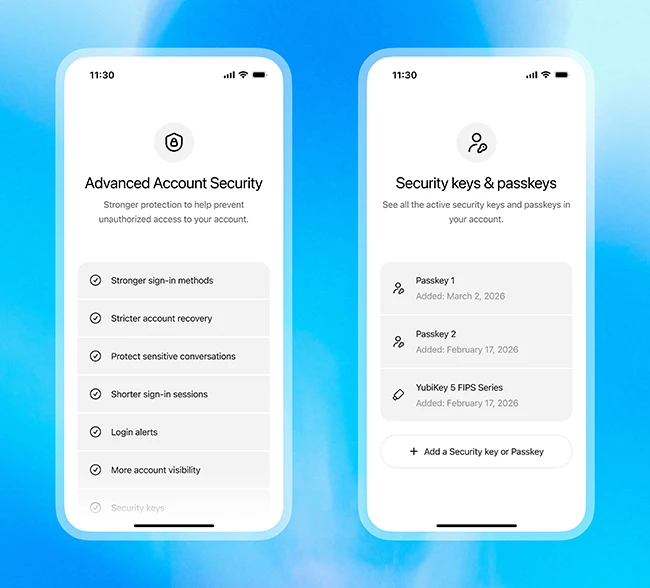
ChatGPT advanced account security

What enrollment changes

Enrolled accounts use passkeys or hardware security keys for sign-in, with password login disabled. Email and SMS account recovery are removed, closing a path attackers commonly exploit when a victim’s phone number or inbox has been compromised. Recovery is limited to backup passkeys, security keys, and recovery keys held by the user. Once a user enrolls, OpenAI Support cannot assist with recovery, placing responsibility for backup credentials on the account holder.

Sign-in sessions are shortened to limit exposure if a device or active session is compromised. The setting covers ChatGPT and Codex under the same login, so a single enrollment carries across both products.

Conversations from accounts with the setting enabled are excluded from model training automatically. The default opt-out targets users handling sensitive personal or professional material who want assurance that their inputs stay out of training data without managing the preference manually.

Yubico partnership and FIDO support

OpenAI has partnered with Yubico to offer preferred pricing on a bundle of two YubiKeys aimed at the new security setting. The bundle includes the YubiKey C Nano, designed to remain seated in a laptop port for daily authentication, and the YubiKey C NFC for backup and cross-device use across laptops and mobile devices.

Users are free to use any FIDO-compliant security key or software-based passkeys. The setting follows the same standards already adopted by Google, Microsoft, GitHub, and other vendors that built phishing-resistant authentication around the FIDO2 and WebAuthn specifications.

Mandatory enrollment for Trusted Access for Cyber

“Individual members of Trusted Access for Cyber accessing our most cyber capable and permissive models will be required to enable Advanced Account Security beginning June 1, 2026. Organizations with trusted access can, as an alternative, attest that they have phishing resistant authentication as part of their single sign-on workflow,” OpenAI explained.

Download: Automating Pentest Delivery Guide