


惯性聚合 高效追踪和阅读你感兴趣的博客、新闻、科技资讯
阅读原文 在惯性聚合中打开

推荐订阅源

aimingoo的专栏
aimingoo的专栏
WordPress大学
WordPress大学
阮一峰的网络日志
阮一峰的网络日志
博客园 - 司徒正美
月光博客
月光博客
宝玉的分享
宝玉的分享
Recent Announcements
小众软件
小众软件
H
Hackread – Cybersecurity News, Data Breaches, AI and More
美团技术团队
博客园 - 三生石上(FineUI控件)
A
About on SuperTechFans
J
Java Code Geeks
云风的 BLOG
云风的 BLOG
罗磊的独立博客
大猫的无限游戏
大猫的无限游戏
IT之家
IT之家
Vercel News
Vercel News
量子位
Martin Fowler
Martin Fowler
OSCHINA 社区最新新闻
OSCHINA 社区最新新闻
V
Visual Studio Blog
腾讯CDC
有赞技术团队
有赞技术团队

Help Net Security

Your work apps are quietly handing 19 data points to someone ChatGPT advanced account security adds passkeys and hardware keys Week in review: High-severity LPE vulnerability in the Linux kernel, cPanel 0-day exploited for months Automating Pentest Delivery: A Step-by-Step Guide - PlexTrac Open-source privacy proxy masks PII before prompts reach external AI services Shadow AI risks deepen as 31% of users get no employer training Identity is the control plane for distributed infrastructure AI traffic is getting bigger, louder, and less predictable New infosec products of the month: April 2026 cPanel zero-day exploited for months before patch release (CVE-2026-41940) Cisco releases open-source toolkit for verifying AI model lineage Met Police face criticism for using AI to spy on their own officers Nine-year-old Linux kernel flaw enables reliable local privilege escalation (CVE-2026-31431) Hacker with a special interest in breaching sports institutions ends behind bars - Help Net Security IP Fabric MCP server adds governance and control to enterprise AIOps workflows - Help Net Security Aqua Compass MCP server enables real-time investigation and containment of runtime threats - Help Net Security Google brings instant email verification to Android, no OTP needed - Help Net Security If cyber espionage via HDMI worries you, NCSC built a device to stop it - Help Net Security Apple fixes iPhone bug that let FBI retrieve deleted Signal messages(CVE-2026-28950) - Help Net Security GopherWhisper APT group hides command and control traffic in Slack and Discord - Help Net Security OpenAI tackles a bad habit people have when interacting with AI - Help Net Security A year in, Zoom's CISO reflects on balancing security and business - Help Net Security Scenario: Open-source framework for automated AI app red-teaming - Help Net Security GDPR works, but only where someone enforces it - Help Net Security Ransomware, fraud, and lawsuits drive cyber insurance claims to new peaks - Help Net Security Google’s Workspace Intelligence promises privacy while running on your data - Help Net Security Cyberattack on French government agency triggers phishing alert - Help Net Security Claude Mythos finds 271 Firefox flaws, Mozilla believes zero-days are numbered - Help Net Security Prove Identity Platform connects verification, authentication, and fraud prevention - Help Net Security New Mirai variants target routers and DVRs in parallel campaigns - Help Net Security
SmokedMeat: Open-source tool shows what attackers do insi...
Mirko Zorz · 2026-04-20 · via Help Net Security

Boost Security has released SmokedMeat, an open-source framework that runs attack chains against CI/CD infrastructure so engineering and security teams can see what an attacker would do in their specific environment.
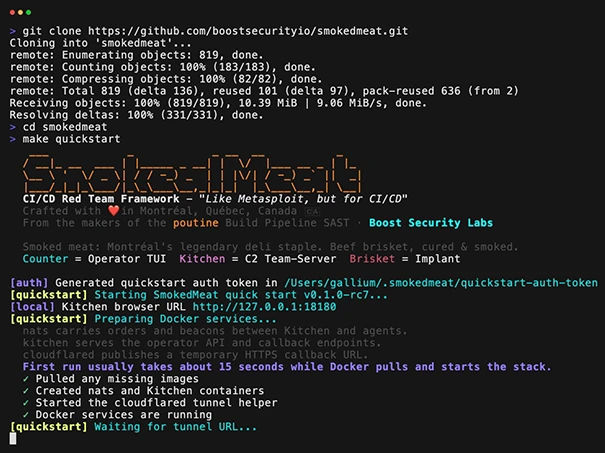
SmokedMeat

What the tool does

SmokedMeat takes a flagged pipeline vulnerability and executes a live demonstration against a team’s own infrastructure. Starting from a single vulnerability, it deploys a payload, compromises the runner, harvests credentials from process memory, exchanges those credentials for cloud access, exposes private repositories, and maps the blast radius of the attack.

Zaid Al Hamami, CEO of Boost Security, described the scope: “This tool is showing what attackers can do; they can find a vulnerability in an open source repo, craft an exploit payload, steal credentials in that repo, and use those credentials to pivot to other areas, insert malware, infect developers working on those repos.”

The TeamPCP attack that changed the conversation

In March 2026, a coordinated campaign known as TeamPCP compromised Trivy, Checkmarx, LiteLLM, and dozens of npm packages. The attack used techniques that Boost Labs had documented in prior research. Boost’s open-source scanner, Poutine, had flagged vulnerabilities in Trivy’s pipeline months before the attack. Those findings went unpatched. Al Hamami described the campaign as the largest cascade supply chain attack to date.

The backlog problem

Boost Labs had been publishing research on CI/CD attack techniques for years, documenting how attackers move through build pipelines, steal credentials, and pivot into cloud environments. A static scan result that flags “workflow injection possible” does not convey what an attacker can do with that injection in a matter of seconds. Without a concrete demonstration, remediation work tends to stay deprioritized.

SmokedMeat is designed to close that gap by running the attack scenario against real infrastructure, giving security teams and engineering leaders a concrete view of what exploitation looks like in their own environment.

SmokedMeat is available for free on GitHub.

Must read:

Subscribe to the Help Net Security ad-free monthly newsletter to stay informed on the essential open-source cybersecurity tools. Subscribe here!