

惯性聚合 高效追踪和阅读你感兴趣的博客、新闻、科技资讯
阅读原文 在惯性聚合中打开

推荐订阅源

让小产品的独立变现更简单 - ezindie.com
WordPress大学
WordPress大学
人人都是产品经理
人人都是产品经理
Engineering at Meta
Engineering at Meta
小众软件
小众软件
I
InfoQ
有赞技术团队
有赞技术团队
Cyber Security Advisories - MS-ISAC
Martin Fowler
Martin Fowler
月光博客
月光博客
雷峰网
雷峰网
aimingoo的专栏
aimingoo的专栏
云风的 BLOG
云风的 BLOG
Last Week in AI
Last Week in AI
OSCHINA 社区最新新闻
OSCHINA 社区最新新闻
S
SegmentFault 最新的问题
The GitHub Blog
The GitHub Blog
Y
Y Combinator Blog
V
Visual Studio Blog
博客园 - 叶小钗
钛媒体:引领未来商业与生活新知
钛媒体:引领未来商业与生活新知
GbyAI
GbyAI
P
Proofpoint News Feed
Apple Machine Learning Research

Help Net Security

ChatGPT advanced account security adds passkeys and hardware keys Week in review: High-severity LPE vulnerability in the Linux kernel, cPanel 0-day exploited for months Automating Pentest Delivery: A Step-by-Step Guide - PlexTrac Open-source privacy proxy masks PII before prompts reach external AI services Shadow AI risks deepen as 31% of users get no employer training Identity is the control plane for distributed infrastructure AI traffic is getting bigger, louder, and less predictable New infosec products of the month: April 2026 cPanel zero-day exploited for months before patch release (CVE-2026-41940) Cisco releases open-source toolkit for verifying AI model lineage Met Police face criticism for using AI to spy on their own officers Nine-year-old Linux kernel flaw enables reliable local privilege escalation (CVE-2026-31431) Hacker with a special interest in breaching sports institutions ends behind bars - Help Net Security IP Fabric MCP server adds governance and control to enterprise AIOps workflows - Help Net Security Aqua Compass MCP server enables real-time investigation and containment of runtime threats - Help Net Security Google brings instant email verification to Android, no OTP needed - Help Net Security If cyber espionage via HDMI worries you, NCSC built a device to stop it - Help Net Security Apple fixes iPhone bug that let FBI retrieve deleted Signal messages(CVE-2026-28950) - Help Net Security GopherWhisper APT group hides command and control traffic in Slack and Discord - Help Net Security OpenAI tackles a bad habit people have when interacting with AI - Help Net Security A year in, Zoom's CISO reflects on balancing security and business - Help Net Security Scenario: Open-source framework for automated AI app red-teaming - Help Net Security GDPR works, but only where someone enforces it - Help Net Security Ransomware, fraud, and lawsuits drive cyber insurance claims to new peaks - Help Net Security Google’s Workspace Intelligence promises privacy while running on your data - Help Net Security Cyberattack on French government agency triggers phishing alert - Help Net Security Claude Mythos finds 271 Firefox flaws, Mozilla believes zero-days are numbered - Help Net Security Prove Identity Platform connects verification, authentication, and fraud prevention - Help Net Security New Mirai variants target routers and DVRs in parallel campaigns - Help Net Security Acronis GenAI Protection gives MSPs control over AI usage and data risks - Help Net Security
FBI: $388 million lost in crypto ATM scams in 2026
Anamarija Po · 2026-05-20 · via Help Net Security

Americans lost more than $388 million to crypto kiosk scams in 2025, with the FBI warning that criminals are increasingly directing victims to transfer funds through these machines.

Cryptocurrency kiosks, popularly known as Bitcoin ATMs, are physical automated teller machines that allow users to buy cryptocurrencies with cash or card, and some also let users sell digital assets for cash. Like regular ATMs, they are commonly located in public places with high foot traffic.

“In typical [Internet Crime Complaint Center] complaints involving cryptocurrency kiosks, criminals give detailed instructions to individuals, including how to withdraw cash from their bank, how to locate a kiosk, and how to deposit and send funds using the kiosk,” the FBI said.

In 2025, IC3 received more than 13,400 complaints tied to these machines, with losses exceeding $388 million. More than half involved individuals over 50, who reported losses exceeding $302 million.
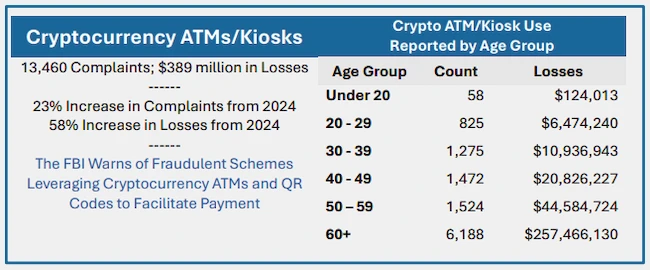
US crypto ATM scams

Cryptocurrency fraud trends (Source: FBI)

The IC3 received a total of 1,008,597 complaints in 2025, and the FBI says that cyber-enabled fraud complaints resulted in losses exceeding $17.7 billion.

Crypto ATMs bans

Over the years, regulations for Bitcoin ATM operators have become stricter, introducing new compliance requirements and transaction limits.

More recently, the machines have been banned in Indiana, Tennessee, and Minnesota.

Bitcoin Depot, one of the largest US crypto ATM operators, announced on Monday that it has filed for Chapter 11 bankruptcy protection “to effect an orderly wind-down of the Company’s operations and facilitate a sale of its assets.”

They cited the aforementioned regulatory limitations and state-wide bans for making the company’s business model unsustainable.

Advice for users

The FBI advises users not to send money to individuals they only know through online interactions, or follow instructions from unknown parties to scan QR codes or transfer funds through cryptocurrency kiosks.

Requests for cryptocurrency payments from individuals claiming to represent companies, government agencies, law enforcement, legal offices, or utility providers should be verified directly with the organization through official contact channels.

“No legitimate law enforcement or government official will call to demand payment via a cryptocurrency kiosk,” the FBI warned.

People using cryptocurrency kiosks should pay attention to fraud warnings displayed by the kiosk or warning from kiosk operators, and stop or cancel a transaction if they see/receive it.