

惯性聚合 高效追踪和阅读你感兴趣的博客、新闻、科技资讯
阅读原文 在惯性聚合中打开

推荐订阅源

云风的 BLOG
云风的 BLOG
V
Visual Studio Blog
人人都是产品经理
人人都是产品经理
The GitHub Blog
The GitHub Blog
月光博客
月光博客
T
Tailwind CSS Blog
小众软件
小众软件
Y
Y Combinator Blog
钛媒体:引领未来商业与生活新知
钛媒体:引领未来商业与生活新知
P
Proofpoint News Feed
B
Blog RSS Feed
博客园 - 司徒正美
A
About on SuperTechFans
Cyber Security Advisories - MS-ISAC
博客园 - 聂微东
Microsoft Security Blog
Recent Announcements
博客园 - Franky
U
Unit 42
奇客Solidot–传递最新科技情报
奇客Solidot–传递最新科技情报
Microsoft Azure Blog
T
The Blog of Author Tim Ferriss
GbyAI
GbyAI
Apple Machine Learning Research

Help Net Security

ChatGPT advanced account security adds passkeys and hardware keys Week in review: High-severity LPE vulnerability in the Linux kernel, cPanel 0-day exploited for months Automating Pentest Delivery: A Step-by-Step Guide - PlexTrac Open-source privacy proxy masks PII before prompts reach external AI services Shadow AI risks deepen as 31% of users get no employer training Identity is the control plane for distributed infrastructure AI traffic is getting bigger, louder, and less predictable New infosec products of the month: April 2026 cPanel zero-day exploited for months before patch release (CVE-2026-41940) Cisco releases open-source toolkit for verifying AI model lineage Met Police face criticism for using AI to spy on their own officers Nine-year-old Linux kernel flaw enables reliable local privilege escalation (CVE-2026-31431) Hacker with a special interest in breaching sports institutions ends behind bars - Help Net Security IP Fabric MCP server adds governance and control to enterprise AIOps workflows - Help Net Security Aqua Compass MCP server enables real-time investigation and containment of runtime threats - Help Net Security Google brings instant email verification to Android, no OTP needed - Help Net Security If cyber espionage via HDMI worries you, NCSC built a device to stop it - Help Net Security Apple fixes iPhone bug that let FBI retrieve deleted Signal messages(CVE-2026-28950) - Help Net Security GopherWhisper APT group hides command and control traffic in Slack and Discord - Help Net Security OpenAI tackles a bad habit people have when interacting with AI - Help Net Security A year in, Zoom's CISO reflects on balancing security and business - Help Net Security Scenario: Open-source framework for automated AI app red-teaming - Help Net Security GDPR works, but only where someone enforces it - Help Net Security Ransomware, fraud, and lawsuits drive cyber insurance claims to new peaks - Help Net Security Google’s Workspace Intelligence promises privacy while running on your data - Help Net Security Cyberattack on French government agency triggers phishing alert - Help Net Security Claude Mythos finds 271 Firefox flaws, Mozilla believes zero-days are numbered - Help Net Security Prove Identity Platform connects verification, authentication, and fraud prevention - Help Net Security New Mirai variants target routers and DVRs in parallel campaigns - Help Net Security Acronis GenAI Protection gives MSPs control over AI usage and data risks - Help Net Security
F5 launches AI Security Platform to uncover and secure sh...
Industry News · 2026-06-23 · via Help Net Security

F5 has introduced the F5 AI Security Platform to give CISOs continuous visibility, governance, and protection across enterprise AI applications, models, agents, and the APIs connecting them. F5 also announced the acquisition of SurePath AI, as a key component in the launch of the new F5 AI Security Platform to safeguard enterprise AI deployments.
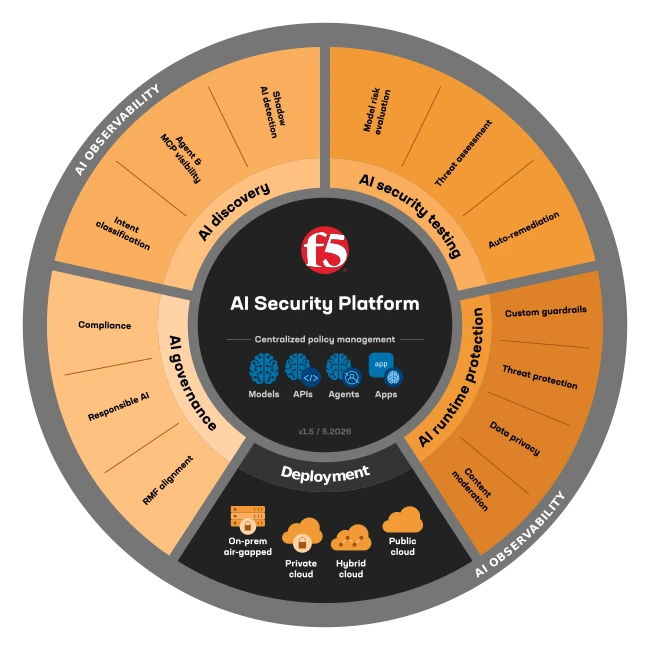
F5 AI Security Platform

Through a continuous, adaptive loop approach to governing, discovering, testing, and protecting enterprise AI workloads, the new platform is designed to extend F5’s Application Delivery and Security Platform (ADSP) strategy to enterprise AI.

F5 recognized the AI deployment realities of large enterprises, building the F5 AI Security Platform to support on-premises, air-gapped, private cloud, hybrid, and public cloud environments. This is intended to give organizations greater control over AI security where data residency, sovereignty, and operational requirements are non-negotiable.

AI systems now operate with more access, autonomy, and speed than even the most over-privileged human users, creating new risks for security teams and business leaders. A prompt injection, data leak, or agent acting beyond its authorized scope can expose sensitive information, disrupt operations, and erode customer trust.

At the same time, employees are adopting unauthorized tools and unsanctioned integrations, creating shadow AI footprints that most security teams cannot see, let alone govern. According to F5’s 2026 State of Application Strategy (SOAS) Report, 88% of organizations report at least one AI-related operational or security challenge.

“Most AI security today is a wrapper around a chatbot. That is not security,” said Kunal Anand, Chief Product Officer, F5. “Enterprises run AI inside regulated networks, behind APIs, and across agents that authenticate and act on their own. The F5 AI Security Platform gives CISOs and security leaders what they have been missing: continuous control over every model, agent, and API, wherever the AI runs, delivered on the same F5 platform that has secured and delivered enterprise applications for three decades.”

SurePath AI: Closing the AI visibility gap

The addition of SurePath AI powers the F5 AI Security Platform’s approach to network-based AI discovery, identifying AI usage across the enterprise, including shadow AI, without requiring direct application integrations.

With frictionless deployment through network redirects and out-of-band analysis, SurePath AI gives security teams a unified visibility layer that detects unauthorized AI activity, classifies the intent behind each workflow, and continuously traces agent tool calls and MCP server connections. This visibility feeds directly into the F5 AI Security Platform, informing the risks to be tested by F5 AI Red Team and mitigated by F5 AI Guardrails.

Delivering a continuous cycle of protection

The F5 AI Security Platform addresses AI risk through four integrated pillars and an overarching observability layer that creates a persistent security lifecycle rather than a one-time compliance exercise. Features include:

  • AI governance: Translate specific risk tolerances, privacy requirements, and regulatory obligations into enforceable boundaries for AI prompts, outputs, tool use, and data access.
  • AI discovery: Gain continuous visibility into every AI application, agent, and MCP tool call running across the enterprise, whether sanctioned or not. The platform classifies activity by use case and intent, so teams know not just what is running but why. SurePath AI’s network-based discovery does this passively, with no application-level integration required.
  • AI security testing: Stress-test AI systems against more than 140,000 attack patterns from the deepest AI threat database in the industry before those systems reach production, converting findings directly into enforceable defenses.
  • AI runtime protection: Define guardrails in plain language and deploy them at the point of interaction, where the platform has demonstrated up to 98.2% security efficacy in independent testing, blocking prompt injection, excessive agent autonomy, and data leakage.
  • AI observability: Provide a complete audit trail across every AI interaction on the platform, maintaining the accountability and traceability that regulated industries require.

With this new solution, F5 combines AI security capabilities with flexible deployment options, enabling enterprises to operate across on-premises, air-gapped, private cloud, hybrid, and public cloud deployments. This is especially valuable to CISOs in highly regulated industries with exacting data residency and sovereignty requirements. SurePath AI’s lightweight network-based deployment model reinforces this flexibility, requiring no changes to existing application architectures.

Heightened visibility is increasingly critical as AI agents proliferate. F5’s 2026 SOAS Report states 98% of organizations are preparing for agentic AI, but the speed of agent adoption is outpacing the controls designed to manage it. When agents can authenticate, call tools, access data, and take actions autonomously, the blast radius of a single misconfiguration or exploit grows exponentially.