





惯性聚合 高效追踪和阅读你感兴趣的博客、新闻、科技资讯
阅读原文 在惯性聚合中打开

推荐订阅源

博客园 - Franky
D
Docker
Jina AI
Jina AI
The GitHub Blog
The GitHub Blog
博客园 - 聂微东
B
Blog RSS Feed
大猫的无限游戏
大猫的无限游戏
M
MIT News - Artificial intelligence
Vercel News
Vercel News
Microsoft Security Blog
博客园 - 叶小钗
爱范儿
爱范儿
D
DataBreaches.Net
Hugging Face - Blog
Hugging Face - Blog
IT之家
IT之家
Recent Announcements
U
Unit 42
腾讯CDC
奇客Solidot–传递最新科技情报
奇客Solidot–传递最新科技情报
宝玉的分享
宝玉的分享
量子位
Stack Overflow Blog
Stack Overflow Blog
Cyber Security Advisories - MS-ISAC
Microsoft Azure Blog

Help Net Security

ChatGPT advanced account security adds passkeys and hardware keys Week in review: High-severity LPE vulnerability in the Linux kernel, cPanel 0-day exploited for months Automating Pentest Delivery: A Step-by-Step Guide - PlexTrac Open-source privacy proxy masks PII before prompts reach external AI services Shadow AI risks deepen as 31% of users get no employer training Identity is the control plane for distributed infrastructure AI traffic is getting bigger, louder, and less predictable New infosec products of the month: April 2026 cPanel zero-day exploited for months before patch release (CVE-2026-41940) Cisco releases open-source toolkit for verifying AI model lineage Met Police face criticism for using AI to spy on their own officers Nine-year-old Linux kernel flaw enables reliable local privilege escalation (CVE-2026-31431) Hacker with a special interest in breaching sports institutions ends behind bars - Help Net Security IP Fabric MCP server adds governance and control to enterprise AIOps workflows - Help Net Security Aqua Compass MCP server enables real-time investigation and containment of runtime threats - Help Net Security Google brings instant email verification to Android, no OTP needed - Help Net Security If cyber espionage via HDMI worries you, NCSC built a device to stop it - Help Net Security Apple fixes iPhone bug that let FBI retrieve deleted Signal messages(CVE-2026-28950) - Help Net Security GopherWhisper APT group hides command and control traffic in Slack and Discord - Help Net Security OpenAI tackles a bad habit people have when interacting with AI - Help Net Security A year in, Zoom's CISO reflects on balancing security and business - Help Net Security Scenario: Open-source framework for automated AI app red-teaming - Help Net Security GDPR works, but only where someone enforces it - Help Net Security Ransomware, fraud, and lawsuits drive cyber insurance claims to new peaks - Help Net Security Google’s Workspace Intelligence promises privacy while running on your data - Help Net Security Cyberattack on French government agency triggers phishing alert - Help Net Security Claude Mythos finds 271 Firefox flaws, Mozilla believes zero-days are numbered - Help Net Security Prove Identity Platform connects verification, authentication, and fraud prevention - Help Net Security New Mirai variants target routers and DVRs in parallel campaigns - Help Net Security Acronis GenAI Protection gives MSPs control over AI usage and data risks - Help Net Security
Modat enhances Magnify with Passive DNS for faster threat...
Industry News · 2026-06-15 · via Help Net Security

Modat has launched native Passive DNS intelligence in Magnify, its internet intelligence platform, unifying IP, device fingerprint, certificate, and passive DNS into a single pivot-driven investigation flow.
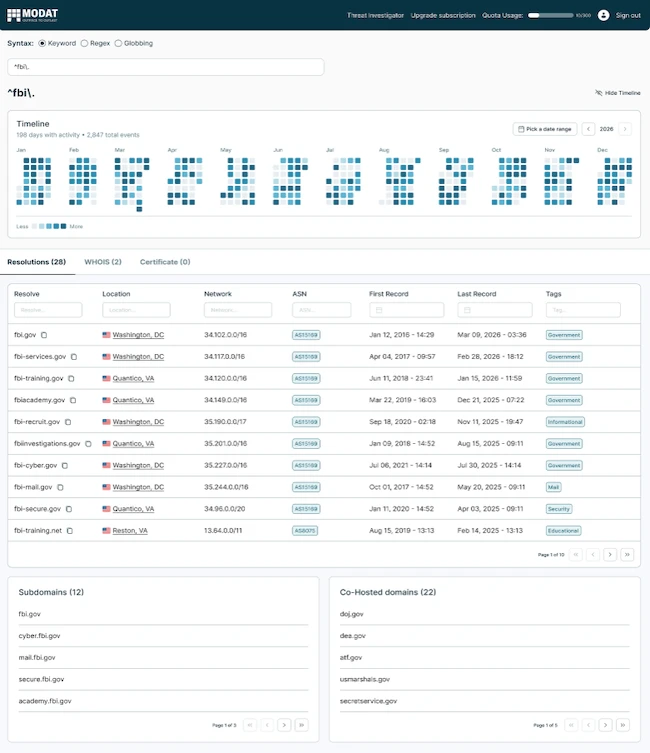
Modat Passive DNS

Threat intelligence, threat hunting, exposure management, fraud and Security teams have long been forced to stitch together evidence across multiple tools and datapoints. Magnify eliminates that gap, building on its clustering-based device fingerprinting and geo-native scanning to surface infrastructure that conventional internet scanners miss.

Most internet intelligence platforms are built around a single primary signal, with other data types bolted on as secondary lookups. Magnify is built the other way around: every signal is a first-class pivot point.

With Passive DNS now native to the platform, an investigator can start from a domain and surface every IP that has hosted it, start from a TLS certificate and surface every domain it has secured, or start from a clustered device fingerprint and surface every host running the same software stack, all in the same query path. The result is an attacker-infrastructure graph that updates as the internet does, not a series of disconnected lookups that analysts have to assemble by hand.

Key capabilities of the Modat Passive DNS platform include:

  • Infrastructure pivoting: Move between IP, domain, TLS certificate, and clustered device fingerprint in a single graph, with relationships preserved rather than reconstructed across tools.
  • Real-time threat correlation: Automated correlation of newly observed domains and IPs with known indicators of compromise (IOCs), threat actor TTPs, and malware families.
  • Retrospective infrastructure analysis: Queryable Passive DNS alongside Magnify’s IP, device, and certificate timelines, so analysts can reconstruct the benign and the attacker’s full infrastructure lifecycle.
  • API-first integration: Seamless integration with leading SIEM, SOAR, and threat intelligence platforms via a robust REST API.

“Most internet intelligence tools were built one signal at a time, and it shows analysts spend more time stitching evidence together than acting on it,” said Soufian El Yadmani, CEO and Founder at Modat. “Magnify was designed from the start so that every signal, IPs, devices, certificates, and now Passive DNS, is a pivot point in the same graph. Passive DNS isn’t an add-on for us. It’s the fourth pillar that makes the picture more complete.”