

惯性聚合 高效追踪和阅读你感兴趣的博客、新闻、科技资讯
阅读原文 在惯性聚合中打开

推荐订阅源

G
Google Developers Blog
人人都是产品经理
人人都是产品经理
爱范儿
爱范儿
云风的 BLOG
云风的 BLOG
Last Week in AI
Last Week in AI
H
Hackread – Cybersecurity News, Data Breaches, AI and More
B
Blog
让小产品的独立变现更简单 - ezindie.com
H
Help Net Security
B
Blog RSS Feed
奇客Solidot–传递最新科技情报
奇客Solidot–传递最新科技情报
N
Netflix TechBlog - Medium
S
SegmentFault 最新的问题
The Cloudflare Blog
I
InfoQ
美团技术团队
博客园 - 三生石上(FineUI控件)
MyScale Blog
MyScale Blog
酷 壳 – CoolShell
酷 壳 – CoolShell
博客园 - 司徒正美
L
LangChain Blog
A
About on SuperTechFans
T
The Blog of Author Tim Ferriss
Y
Y Combinator Blog

Help Net Security

ChatGPT advanced account security adds passkeys and hardware keys Week in review: High-severity LPE vulnerability in the Linux kernel, cPanel 0-day exploited for months Automating Pentest Delivery: A Step-by-Step Guide - PlexTrac Open-source privacy proxy masks PII before prompts reach external AI services Shadow AI risks deepen as 31% of users get no employer training Identity is the control plane for distributed infrastructure AI traffic is getting bigger, louder, and less predictable New infosec products of the month: April 2026 cPanel zero-day exploited for months before patch release (CVE-2026-41940) Cisco releases open-source toolkit for verifying AI model lineage Met Police face criticism for using AI to spy on their own officers Nine-year-old Linux kernel flaw enables reliable local privilege escalation (CVE-2026-31431) Hacker with a special interest in breaching sports institutions ends behind bars - Help Net Security IP Fabric MCP server adds governance and control to enterprise AIOps workflows - Help Net Security Aqua Compass MCP server enables real-time investigation and containment of runtime threats - Help Net Security Google brings instant email verification to Android, no OTP needed - Help Net Security If cyber espionage via HDMI worries you, NCSC built a device to stop it - Help Net Security Apple fixes iPhone bug that let FBI retrieve deleted Signal messages(CVE-2026-28950) - Help Net Security GopherWhisper APT group hides command and control traffic in Slack and Discord - Help Net Security OpenAI tackles a bad habit people have when interacting with AI - Help Net Security A year in, Zoom's CISO reflects on balancing security and business - Help Net Security Scenario: Open-source framework for automated AI app red-teaming - Help Net Security GDPR works, but only where someone enforces it - Help Net Security Ransomware, fraud, and lawsuits drive cyber insurance claims to new peaks - Help Net Security Google’s Workspace Intelligence promises privacy while running on your data - Help Net Security Cyberattack on French government agency triggers phishing alert - Help Net Security Claude Mythos finds 271 Firefox flaws, Mozilla believes zero-days are numbered - Help Net Security Prove Identity Platform connects verification, authentication, and fraud prevention - Help Net Security New Mirai variants target routers and DVRs in parallel campaigns - Help Net Security Acronis GenAI Protection gives MSPs control over AI usage and data risks - Help Net Security
Planning a trip? Fake travel sites are multiplying this s...
Sinisa Markovic · 2026-06-16 · via Help Net Security

Cyberattacks against hospitality, travel, and recreation organizations rose 24% year over year, reaching an average of 2,291 incidents per organization each week in May 2026, according to Check Point.
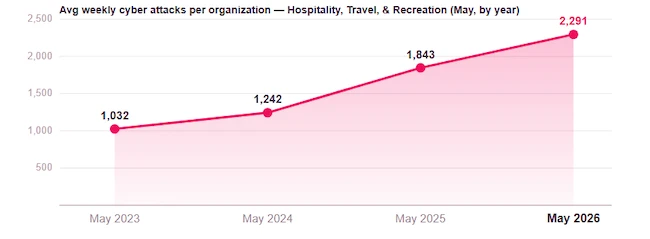
travel organizations cyberattacks

(Source: Check Point)

“The sector has more than doubled its attack volume since May 2023,” researchers noted, reporting a cumulative increase of 122% over three years.

According to the report, 47,318 travel-related domains were registered in May 2026, a 33% increase from the previous month. One in every 112 newly registered domains was already classified as malicious or suspicious.

“Many others remain dormant for now, waiting to be activated as summer traffic peaks.”

Check Point identified three coordinated bulk-registration operations during April and May. One involved more than 210 sequentially numbered hotel-themed domains using naming patterns such as hotel-stay[N].com and stay-hotel[N].com.

Another referenced American Express and Lloyds Travel Choice, combining terms such as “happytrip” and “travelchoice” on .ink domains. A third targeted the Fora Travel brand through 108 top-level domains, including .cruises, .miami, and .international.

The researchers also uncovered phishing sites masquerading as Booking.com, Airbnb, and Skyscanner.

One Booking.com-themed operation used fake login pages to steal credentials and payment card details, while an Airbnb-themed site targeted travelers planning trips to Canada with listings for destinations such as Montreal, Toronto, Vancouver, and Banff alongside imagery of the Canadian Rockies.

“The people behind fake booking sites plan around the summer surge just as carefully as legitimate businesses do, and they are ready well before most travelers start searching,” researchers concluded.