


惯性聚合 高效追踪和阅读你感兴趣的博客、新闻、科技资讯
阅读原文 在惯性聚合中打开

推荐订阅源

有赞技术团队
有赞技术团队
G
Google Developers Blog
T
Tailwind CSS Blog
让小产品的独立变现更简单 - ezindie.com
人人都是产品经理
人人都是产品经理
J
Java Code Geeks
P
Proofpoint News Feed
V
Visual Studio Blog
爱范儿
爱范儿
The Cloudflare Blog
博客园 - 叶小钗
V
V2EX
freeCodeCamp Programming Tutorials: Python, JavaScript, Git & More
M
MIT News - Artificial intelligence
Microsoft Security Blog
博客园 - 聂微东
H
Help Net Security
B
Blog
OSCHINA 社区最新新闻
OSCHINA 社区最新新闻
博客园 - 【当耐特】
量子位
宝玉的分享
宝玉的分享
WordPress大学
WordPress大学
钛媒体:引领未来商业与生活新知
钛媒体:引领未来商业与生活新知

Help Net Security

Your work apps are quietly handing 19 data points to someone ChatGPT advanced account security adds passkeys and hardware keys Week in review: High-severity LPE vulnerability in the Linux kernel, cPanel 0-day exploited for months Automating Pentest Delivery: A Step-by-Step Guide - PlexTrac Open-source privacy proxy masks PII before prompts reach external AI services Shadow AI risks deepen as 31% of users get no employer training Identity is the control plane for distributed infrastructure AI traffic is getting bigger, louder, and less predictable New infosec products of the month: April 2026 cPanel zero-day exploited for months before patch release (CVE-2026-41940) Cisco releases open-source toolkit for verifying AI model lineage Met Police face criticism for using AI to spy on their own officers Nine-year-old Linux kernel flaw enables reliable local privilege escalation (CVE-2026-31431) Hacker with a special interest in breaching sports institutions ends behind bars - Help Net Security IP Fabric MCP server adds governance and control to enterprise AIOps workflows - Help Net Security Aqua Compass MCP server enables real-time investigation and containment of runtime threats - Help Net Security Google brings instant email verification to Android, no OTP needed - Help Net Security If cyber espionage via HDMI worries you, NCSC built a device to stop it - Help Net Security Apple fixes iPhone bug that let FBI retrieve deleted Signal messages(CVE-2026-28950) - Help Net Security GopherWhisper APT group hides command and control traffic in Slack and Discord - Help Net Security OpenAI tackles a bad habit people have when interacting with AI - Help Net Security A year in, Zoom's CISO reflects on balancing security and business - Help Net Security Scenario: Open-source framework for automated AI app red-teaming - Help Net Security GDPR works, but only where someone enforces it - Help Net Security Ransomware, fraud, and lawsuits drive cyber insurance claims to new peaks - Help Net Security Google’s Workspace Intelligence promises privacy while running on your data - Help Net Security Cyberattack on French government agency triggers phishing alert - Help Net Security Claude Mythos finds 271 Firefox flaws, Mozilla believes zero-days are numbered - Help Net Security Prove Identity Platform connects verification, authentication, and fraud prevention - Help Net Security New Mirai variants target routers and DVRs in parallel campaigns - Help Net Security
Gmail’s end-to-end encryption comes to mobile, no extra a...
Anamarija Pogorelec · 2026-04-10 · via Help Net Security

Google has expanded Gmail client-side encryption to Android and iOS devices, allowing users to engage with their organization’s most sensitive data on mobile devices while ensuring data remains compliant with sovereignty and compliance requirements. This feature is available for Enterprise Plus users with the Assured Controls or Assured Controls Plus add-on.
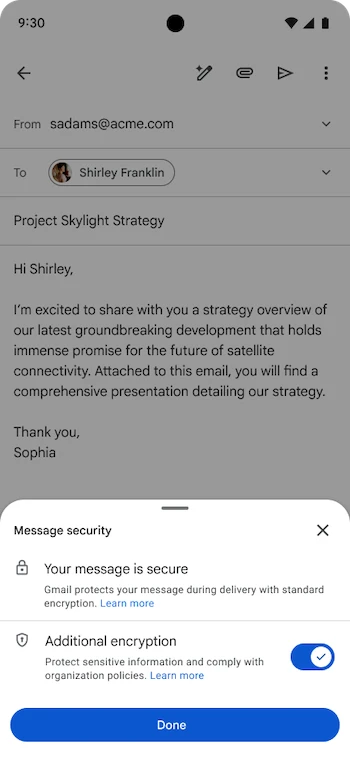
Gmail E2EE

Composing a E2EE message in Gmail (Source: Google)

With this update, users can compose, send, and read encrypted messages directly in the Gmail app. There is no need to install additional applications or switch to external mail portals. The experience remains consistent with standard Gmail workflows, which supports adoption across teams working on mobile devices.

Users with a Gmail E2EE license can send encrypted messages to any recipient, regardless of the recipient’s email address or provider. Messages sent to Gmail users appear as standard email threads in the Gmail app, maintaining a familiar inbox experience. Recipients who do not use the Gmail app can securely access messages through a web browser and reply from there, independent of their device or email service.

“This launch combines the highest level of privacy and data encryption with a user-friendly experience for all users, enabling simple encrypted email for all customers from small businesses to enterprises and public sector,” the company said.

Getting started

For organizations, admins need to enable mobile access for client-side encryption in the Admin Console so users can use E2EE on Android and iOS devices.

End users can enable encryption while composing a message by selecting the lock icon and choosing additional encryption. They can then write messages and add attachments as usual.