






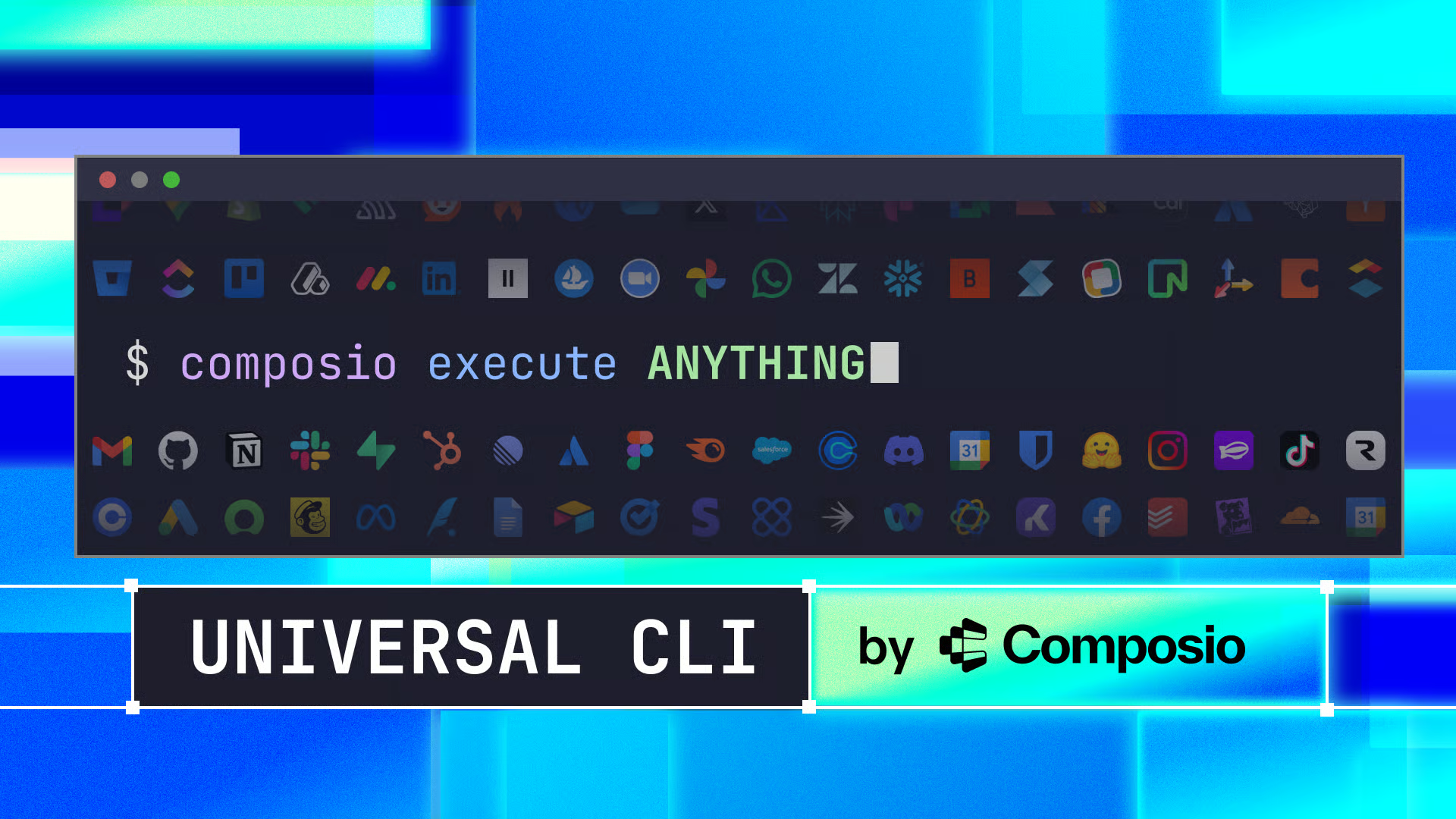
Composio turns agents into operators. 1,000+ tools with just-in-time tool calls - your agent gets exactly what it needs, when it needs it. Managed OAuth that fires on intent, not config files. Sandboxed code execution. Persistent file systems your agent can browse across sessions.
We aren't another connector library. We're the execution layer your agent is missing.
And we meet you wherever your agents live. MCP server for Claude Desktop, Cursor, and Notion AI. Python and TypeScript SDKs for OpenAI, LangChain, CrewAI, and beyond. And now: the Composio CLI - manage toolkits, authenticate apps, execute actions, and generate type-safe code directly from your terminal.
Three entry points. One execution platform. Zero lock-in.
Used by both hyperscalers and startups.
Your agent decides what to do. We handle the rest.
Two years ago, the idea of a one-person billion-dollar company sat somewhere between prediction and provocation. Today, it looks less like a thought experiment and more like an emerging edge case of a deeper shift. The cost of building and operating a company has collapsed faster than most people have adjusted for.
The clearest way to understand this shift is not through personalities or headlines. It is through infrastructure, and at the center of that shift are AI agent runtimes.
The defining change between 2025 and 2026 is not better chat interfaces. It is the transition from AI as a tool to AI as an operator.
Traditional LLM workflows required constant human prompting and supervision. The new stack reduces that dependency.
Agent runtimes can:
Execute multi-step workflows without interruption
Interface directly with local systems and external services
React to triggers across communication channels
Maintain state across long-running tasks
This is where projects like OpenClaw enter the picture, not as isolated breakthroughs, but as early signals of a broader pattern.
OpenClaw reached over 300,000 GitHub stars in record time, surpassing projects like React and Linux in velocity. It demonstrated what happens when execution, not suggestion, becomes the default. It turns requests into completed actions, often without requiring a human in the loop once deployed.
A growing ecosystem of tools including Cursor for AI-assisted coding, autonomous task agents, orchestration frameworks, and deployment layers like NVIDIA’s NemoClaw now combine into something that looks less like software and more like an operational workforce.
This is the shift: software is no longer just a tool, it is labor.
The single-founder stack is no longer hypothetical. It is composable today:
Development: AI-assisted coding environments like Cursor reduce build time and maintenance overhead to near zero
Execution: Agent runtimes like OpenClaw handle workflows, integrations, and background processes
Distribution: Automated growth systems manage outreach, content generation, and analytics loops
Operations: Back-office tasks such as support, billing, and reporting are handled by autonomous agents
What previously required a team of engineers, operators, and support staff can now be orchestrated by one person coordinating systems.
The constraint has shifted.
It is no longer “How many people can you hire?” It is “How effectively can you design and manage systems?”
A billion-dollar company has traditionally required scale across three dimensions: product, distribution, and operations. Each based on headcount.
Agent-driven infrastructure compresses all three.
Product iteration is faster because development cycles are shorter
Distribution scales programmatically through automated pipelines
Operations run continuously without proportional increases in cost
This leads to a structural change in economics:
Marginal cost per additional user approaches zero
Fixed costs shift toward compute rather than payroll
Revenue scales without linear increases in complexity
There are already examples of products reaching millions in ARR with teams under five. The trajectory from there to extreme scale is no longer constrained by hiring, it is constrained by system design.
Under these conditions, the solo billion-dollar outcome is no longer improbable. It is a leverage question.
OpenClaw is best understood as an early, visible example of this leverage in practice.
Its significance is architectural. It shows how a single runtime can sit at the center of a workflow, coordinating tasks that previously required multiple roles, from engineering execution to operational follow-through.
It also proved something else. The project was maintained with effectively zero payroll and modest compute spend, while still reaching massive adoption.
The bottleneck is no longer building capability. It is orchestrating it.
That distinction matters. The tools to build a high-functioning, low-headcount company already exist. What is still emerging is the discipline required to use them effectively.
The solo model is powerful, but fragile.
Decision-making is centralized
Strategic blind spots are harder to catch
There is no redundancy for failure or fatigue
For many companies, the endpoint will not remain a single individual. A small, tightly coordinated team augmented by agents offers more resilience without sacrificing leverage.
The one-person unicorn is best understood as a boundary case, not the default outcome.
The important shift is not that every founder will build alone. It is that headcount is no longer the primary driver of capability.
This changes how companies are started, how they scale, and how they are valued.
Early-stage funding shifts from salaries to infrastructure such as compute and orchestration
The $1B solo company is not a trend. It will signal that the relationship between people, software, and scale has fundamentally changed.
此内容由惯性聚合(RSS阅读器)自动聚合整理,仅供阅读参考。 原文来自 — 版权归原作者所有。