





Sign up to see the future, today
Can’t-miss innovations from the bleeding edge of science and tech
Astronomers using the James Webb Space Telescope have discovered a new type of cosmic monstrosity: a “black hole star.”
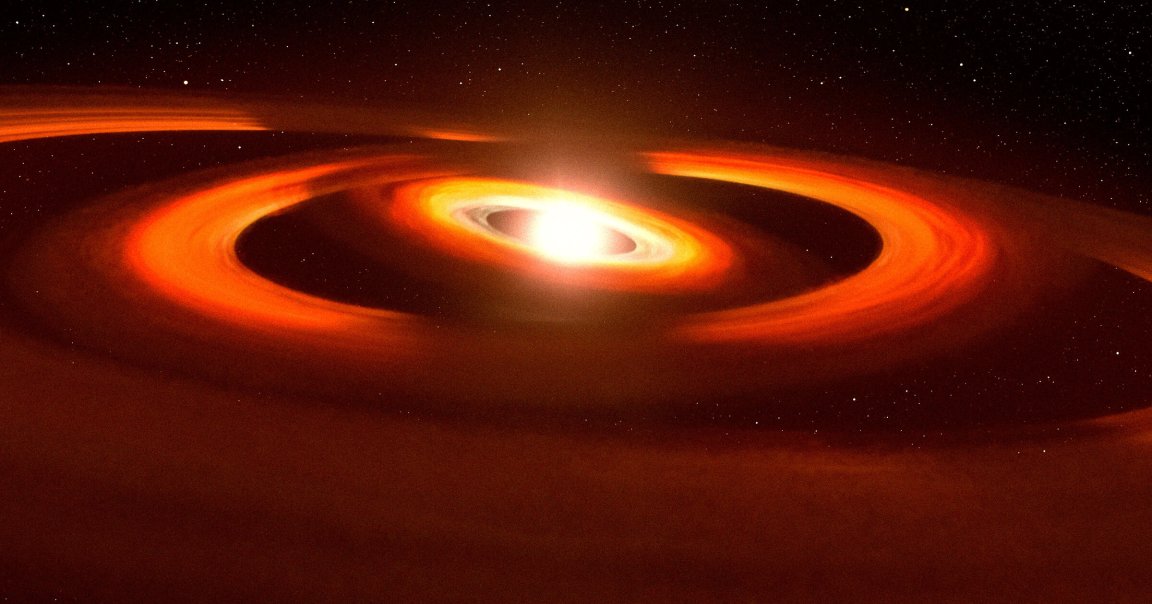
The glowing red object, dubbed MoM-BH*-1, is 100,000 times more massive than our Sun and is trapped in a shell of gas so thick that it looks like a star the size of the entire solar system. But unlike an actual star, it’s not fusion powering its center, but a black hole constantly devouring matter.
As detailed in a new study about the findings published in the journal Nature, the black hole at the object’s center is releasing 100 billion times more energy than any known star. And it’s ancient, having formed less than 700 million years after the Big Bang.
The object, astronomers say, is utterly peerless.
“It is a very special thing to find an object with no comparison given the vast stores of data on billions of stars, galaxies, and black holes that we have in our archival databases,” lead author Rohan Naidu, an astronomer at the University of Hawai’i, told Gizmodo. “MoM-BH*-1 is one in a billion!”
The existence of black hole stars was first hypothesized nearly two decades ago — originally conceived as “quasi-stars” — and received renewed interest when the James Webb first came online in 2022 and discovered hundreds of unexplained “little red dots” littering the early universe.
These crimson objects are so dense and massive that they defied our understanding of physics, being too large to be stars but too compact to be galaxies. If there was a supermassive black hole at the heart of them, none of them were producing telltale x-ray emissions that would be expected.
Theories abounded, but the idea of a black hole star became one of the most appealing candidates: their ultra-dense shell of gas could block the x-rays from escaping. In May, the black hole star idea gained more credence when another team of astronomers said they detected x-rays coming from one of these objects, demonstrating that a black hole indeed resided at their center.
Naidu’s team made the discovery while trying to put together why the one of the hundreds of LRDs the Webb discovered exhibited a strange drop-off in the brightness of its light below certain wavelengths. This behavior is normally seen with young stars whose light gets filtered through dust in their nascent atmosphere, but the observations didn’t show any signs of dust.
Instead, they ran simulations showing that a dense layer of hydrogen could produce the same effect, with a central black hole explaining its overpowering brightness.
If their findings are borne out, the discovery of MoM-BH*-1 suggests that the other Little Red Dots are black hole stars, too.
“Every little red dot is consistent with being a black hole star, embedded in a generic early galaxy,” Naidu said in a statement about the work. “But what is special about MoM-BH*-1 is, the black hole star is essentially completely outshining its surrounding host galaxy, such that we’re seeing pure black hole star light.”
More on astronomy: Scientists Discover Massive Alien “Exosatellite”