


Sign up to see the future, today
Can’t-miss innovations from the bleeding edge of science and tech
When a star explodes, it typically leaves behind some sort of remnant: an exposed, ultra-dense core, for example, or even a black hole.
But one massive star, hundreds of times heavier than our Sun, self-destructed so catastrophically that it left behind no remnant whatsoever, astronomers report in a new study awaiting peer review and highlighted by Phys.org
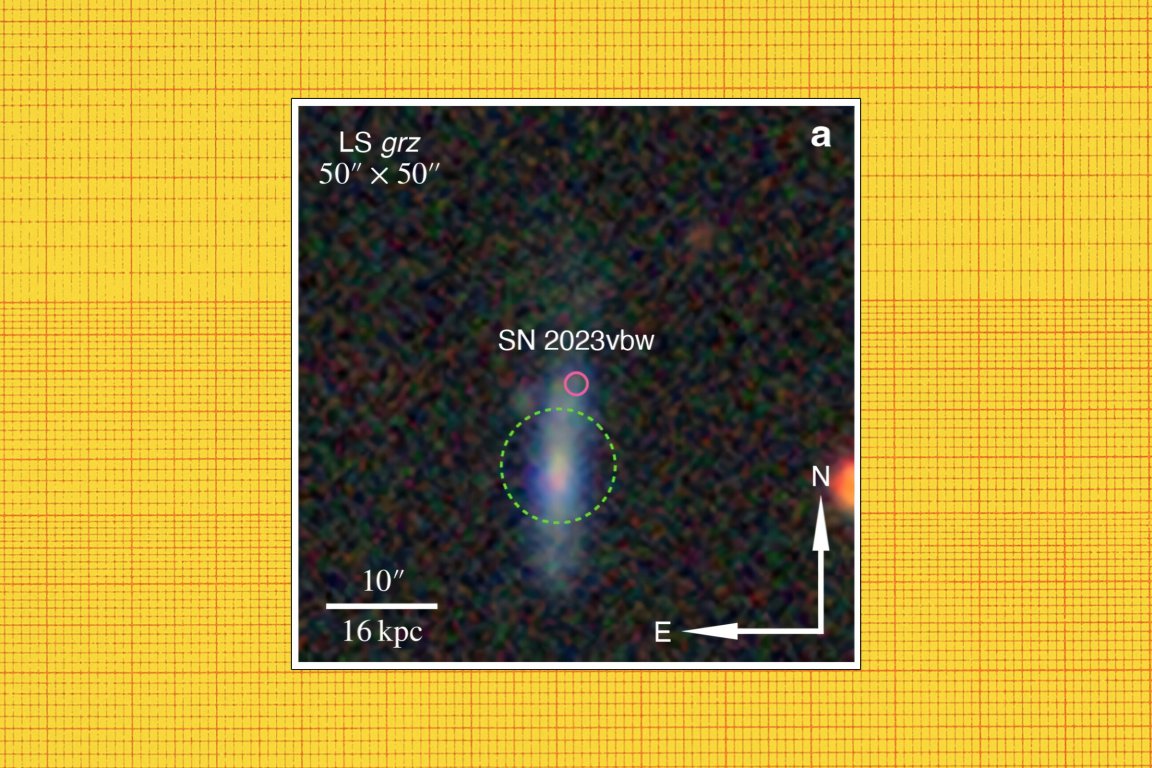
First detected in 2023 in a dwarf galaxy some 1.3 billion light years away, the blast is now believed to be an elusive class of explosion called a pair-instability supernova. Over the course of 190 days, the object, dubbed SN 2023vbw, steadily peaked in brightness, after which it rapidly tapered off. This stands apart from the light curve astronomers see with a more typical Type II supernova, which appears as light quickly spiking and plateauing.
To produce such a blast, the now-vanished star would’ve had to be enormous. The astronomers believe it was a class known as a blue supergiant, which are some of the brightest and hottest stars in the cosmos. Based on the amount of material it ejected upon exploding, the astronomers estimated that the deceased titan was at least 170 — and perhaps as much as 350 times — more massive than the Sun.
These stars’ deaths are suitably epic. In a typical Type II supernova, a star that’s at least eight but up to fifty solar masses runs out of fuel at its core, becomes unable to sustain the nuclear reactions that exert outward pressure, and near-instantly collapse under their own gravity. A huge burst of energy follows, and what’s behind will be a dense object like a white dwarf or a black hole.
But in stars that are as incredibly massive as blue supergiants, their cores burn so hot that they start blasting out gamma rays. While these gamma rays provide outward pressure, if they’re too energetic, they’ll start turning into electrons and positrons upon colliding with the star’s outer layer, and stop providing pressure.
If the star is also low in certain heavy metals, this leads to a partial collapse that snowballs in a sustained series of thermonuclear explosions that rip the star apart so viciously that no remnant survives. As such, some astronomers believe that pair-instability supernovas could cause a theoretical “upper mass gap” in black holes masses, since the stars massive enough to form them are completely obliterated when dying, though this view is being challenged.
All told, if their findings are borne out, the astronomers have serendipitously stumbled on a clear look at one of the rarest stellar deaths in the universe.
More on astrophysics: Scientists Spot What Appears to Be a Ring-Shaped “Planet Factory” Deep Out in Space