


Sign up to see the future, today
Can’t-miss innovations from the bleeding edge of science and tech
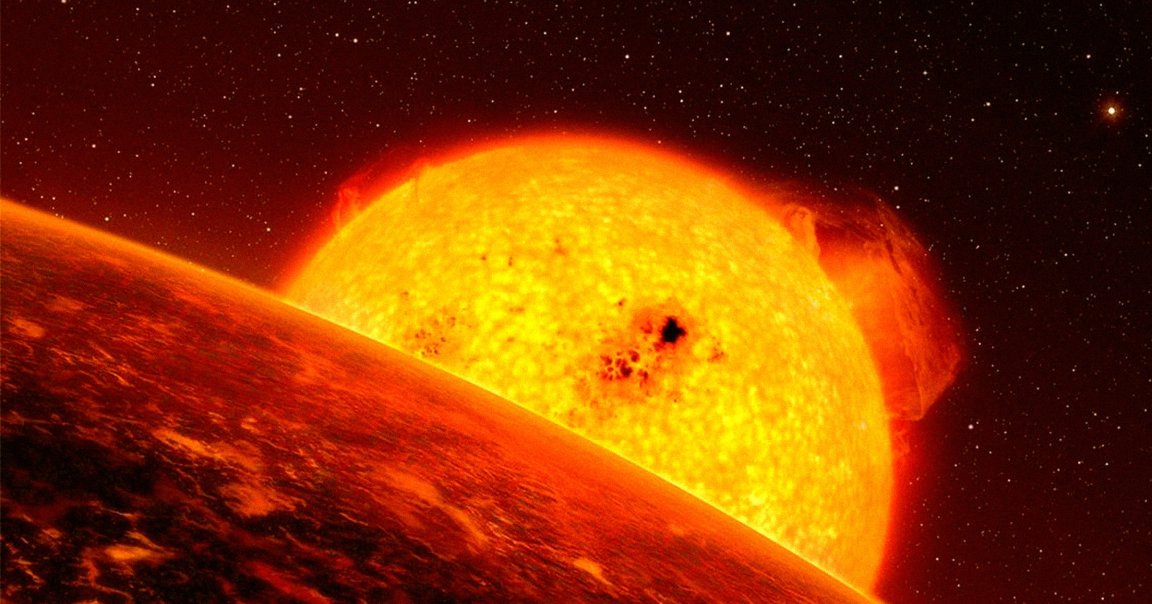
In something like five billion years from now, our Sun is expected to run out of hydrogen fuel, expanding into a red giant that will eventually either engulf the Earth or send it spiraling outwards, an all but guaranteed end of all life on our pale blue dot.
But there may be a way for humanity to survive past the Sun’s demise even without having to leave our planet, as independent researcher Gabriel Harry outlines in a paper accepted for publication in the Journal of the British Interplanetary Society.
It’s admittedly extremely far-fetched, but it’s a fun thought experiment that he argues could result in Earth staying habitable for another “9.1 million billion years.” Who could possibly argue against that?
In an accompanying piece for Phys.org, Harry lays out his daring plan. First, he proposes blocking out the Sun to keep the Earth from burning to a crisp by placing a “large sunshade at the Lagrange point 1, which is a “gravitational balancing spot between the Sun and Earth.”
“We’d need to cover a huge 70-degree area of the sky to ensure the red giant would be eclipsed,” he wrote. It would indeed be immense: it’d need to be roughly 434,000 miles in radius, tied to a carbon tether 1.2 million miles in length.
To provide the warming radiation that was now being blocked, Harry suggests sending fusion reactors some 4,000 miles deep into Jupiter’s atmosphere to produce energy, which would then have to be transmitted via laser back to the Earth.
And to move the Earth away from the self-destructing Sun, Harry thinks we could “redirect an asteroid to fly close to Earth’s surface a million times, with the gravitational slingshot effect gradually transferring energy to increase Earth’s orbital distance.”
Moving it that far away would stop the Earth’s tectonics and nutrient cycles, something Henry images could be solved by “sinking [4 pounds] of antimatter” into the Earth’s core per day.
Fast forwarding some four to five billion years, and any surviving humans would need to move the entire solar system out of the way of an incoming Andromeda galaxy, which is currently on a collision course with the Milky Way, Harry argues. To do so, he suggested firing a “beam of hydrogen just above or below the Sun’s north or south pole” to generate a “gravitational slingshot effect.”
In all, Harry’s galaxy-brain proposal would allow humans to stay alive without having to cover interstellar distances — something that would require a “million times” more energy — or terraforming a new planet. Because, after all, what’s better than staying right here, a comfortable place organic life has called home for around four billion years already?
“By building and maintaining the safeguards, for 9.1 million billion years, life on Earth would enjoy comfortable geology, security, seasons, days and starry nights — until, in a hundred trillion years, the last star fades out and the night sky turns dark,” Harry on Phys.org.
More on the Sun’s death: Earth Will One Day Die, But We Could Survive By Moving Here