








Sign up to see the future, today
Can’t-miss innovations from the bleeding edge of science and tech
Astronomers say they’ve created an entire synthetic universe which uncannily reproduces the properties of our real one.
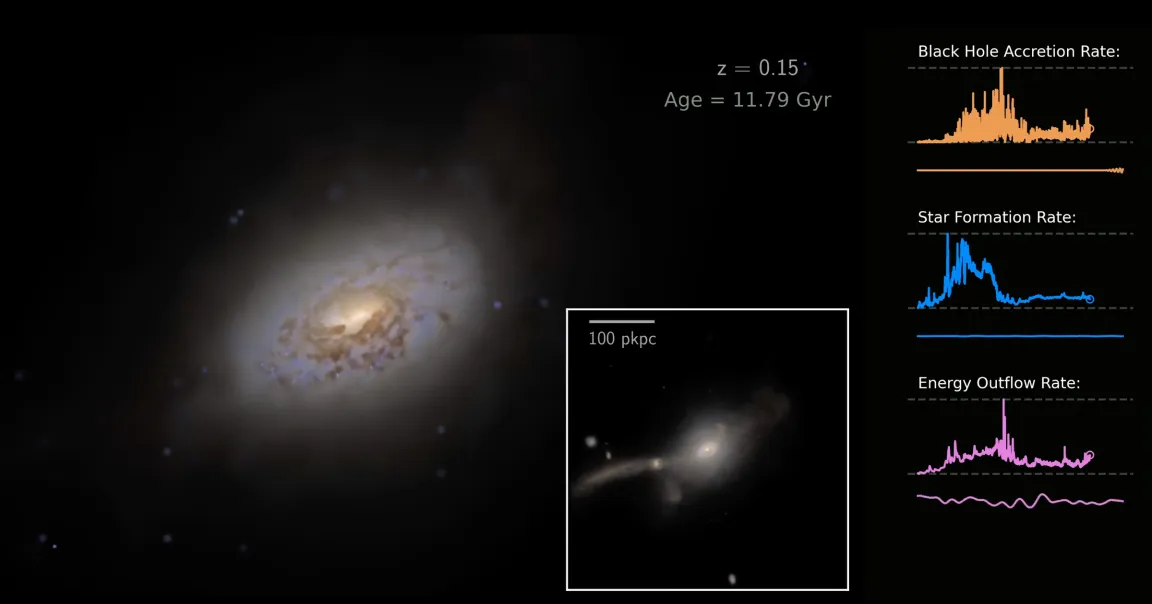
The point of the feat, which was detailed in a new study published in the journal Monthly Notices of the Royal Astronomical Society, wasn’t to play god, but to test the standard cosmological model. Nonetheless, the researchers couldn’t resist basking in the glory of their impressive creation, dubbed the COLIBRE project.
“It is exhilarating to see ‘galaxies’ come out of our computer that look indistinguishable from the real thing and share many of the properties that astronomers measure in real data such as their number, luminosities, colors and sizes,” said coauthor Carlos Frenk, a physicist at Durham University, in a statement about the work.
“What is most remarkable is that we are able to produce this synthetic universe purely by solving the relevant equations of physics in the expanding universe,” Frenk added.
The similarities here are a good thing for cosmologists, who can let out a sigh of relief. The researchers say their virtual universe demonstrates that the standard model can explain galaxy formation even better than previously thought — a welcome source of respite, as recent discoveries, including those made with the James Webb Space Telescope, have poked holes in the prevailing model.
The team says its synthetic universe is the first large volume simulation to model cold gases and cosmic dust inside galaxies, the free-floating material that coalesces to form stars. Previous simulations imposed a hard cut off on gasses colder than 10,000 degrees Fahrenheit, because at these low temperatures they were too complex to model.
But with enough brain and computing power, the researchers overcame this obstacle. The international team spent nearly ten years building the COLIBRE model, which they ran on the COSMA8 supercomputer at Durham University, taking 72 million CPU hours to complete the largest simulation. It will take several more years to deeply analyze the troves of data the simulations have yielded.
So far, the simulations closely align with observations of both the early and our present day universe, which crucially includes the masses of some of the first galaxies. But the researchers concede the model doesn’t explain the James Webb’s discovery of what’s come to be known as the “Little Red Dots,” a class of luminous and apparently mega-massive objects spotted peppering the cosmos when it was less than a billion years old, but are nowhere to be found today. Theories range from unprecedentedly compact galaxies to a previously unseen stage of supermassive black hole evolution.
“Some early JWST results were thought to challenge the standard cosmological model,” coauthor Evgenii Chaikin of Leiden University acknowledged in the statement. But “COLIBRE shows that, once key physical processes are represented more realistically, the model is consistent with what we see.”
More on space: Physicists Have a Major Problem With the Universe