







Sign up to see the future, today
Can’t-miss innovations from the bleeding edge of science and tech
There’s a fresh twist in the mystery of the “little red dots.” Astronomers say they’ve found a new specimen, which they’re calling an “X-ray dot,” that suggests these crimson specks are a type of never-before-seen — and improbably extreme — stage of supermassive black hole evolution.
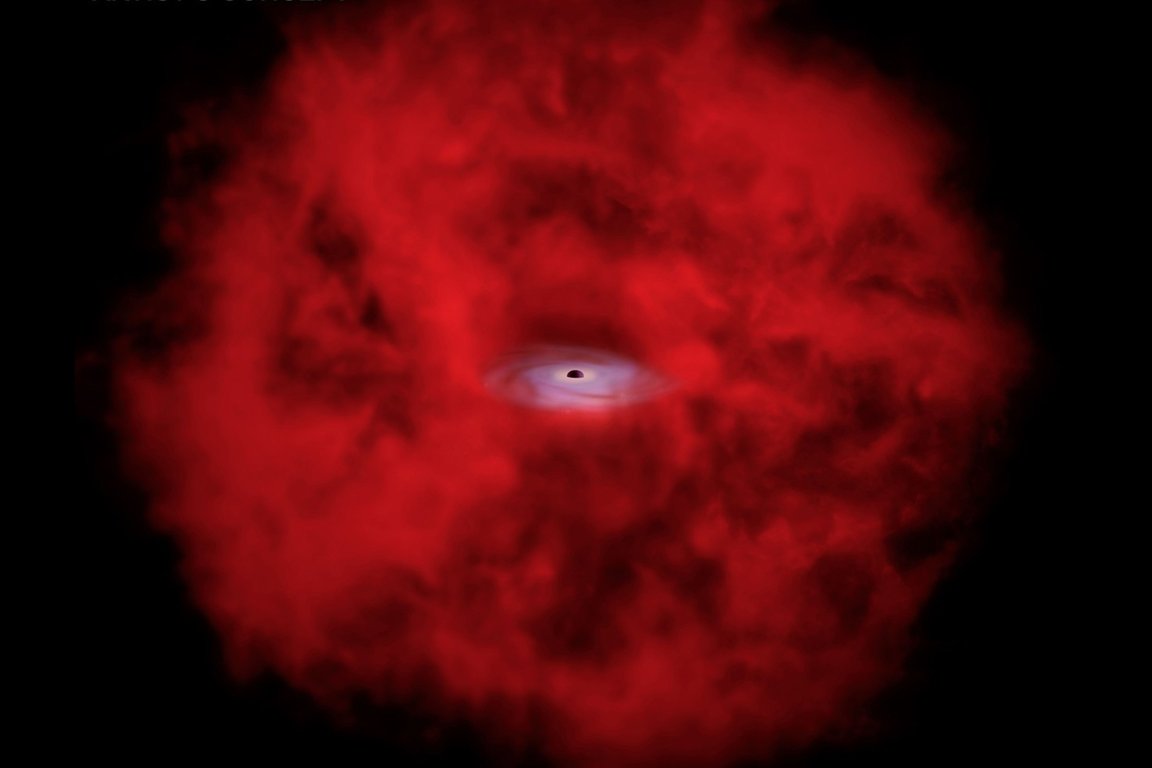
The breakthrough, which they report in a new study published in The Astrophysical Journal Letters, came from data taken by NASA’s Chandra X-ray Observatory. By comparing old Chandra images with new ones taken by the James Webb Space Telescope, they found that one little red dot was emitting x-rays, a telltale emission of black holes. An official artist’s impression, above, portrays it as resembling a giant evil eye surveilling the cosmos.
“Astronomers have been trying to figure out what little red dots are for several years,” lead author Raphael Hviding of the Max Planck Institute for Astronomy in Germany said in a NASA statement. “This single X-ray object may be — to use a phrase — what lets us connect all of the dots.”
The little red dots are a class of luminous and unbelievably massive objects that existed in the universe’s infancy, but are nowhere to be seen today. Until the James Webb Space Telescope came online in 2022 and began peering into the ancient universe with unprecedented clarity, no one even knew they existed. Most reside around 12 billion light years away, with some spotted when the universe was less than a billion years old.
The dots have evaded scientists’ attempts at a simple explanation ever since. They’re too massive to be stars, clearly, but also too compact to be a galaxy at only a few hundred light years across. Many astronomers suspected that some kind of rapidly growing supermassive black hole must be at the heart of them, but until now, none of the hundreds of little red dots showed even the faintest trace of x-ray emissions. They were also strangely dim; a feasting supermassive black hole typically surrounds itself in a swirling ring of hot matter, like water circling a drain, which shines intensely.
But the discovery of the “X-ray dot” changes things. It adds considerable credence to the idea that the little red dots are what some astronomers are calling a black hole star, in which a supermassive black hole imprisons itself in a cloud of gas so dense that it resembles the outer layers of a stellar object. The dense cloud would also obscure the black hole’s emissions, explaining their absence.
“If we confirm the X-ray dot as a little red dot in transition, not only would it be the first of its kind, but we may be seeing into the heart of a little red dot for the first time,” co-author Hanpu Liu of Princeton University in New Jersey said in the NASA statement. “We would also have the strongest piece of evidence yet that the growth of supermassive black holes is at the center of some, if not all, of the little red dot population.”
More on space: Scientists Detect Atmosphere on Planet-Like Object Beyond Pluto