







Sign up to see the future, today
Can’t-miss innovations from the bleeding edge of science and tech
Satellites perform a delicate dance to maintain their orbit, by locking themselves to a speed just fast enough to counteract the downward pull of gravity.
To stop their orbit from decaying too much, satellites use small in-space thrusters, which broadly speaking, fall into two categories: chemical or electric. The former uses a combustible fuel source that gets accelerated through a nozzle, while the latter uses electrical energy to convert propellant into kinetic energy.
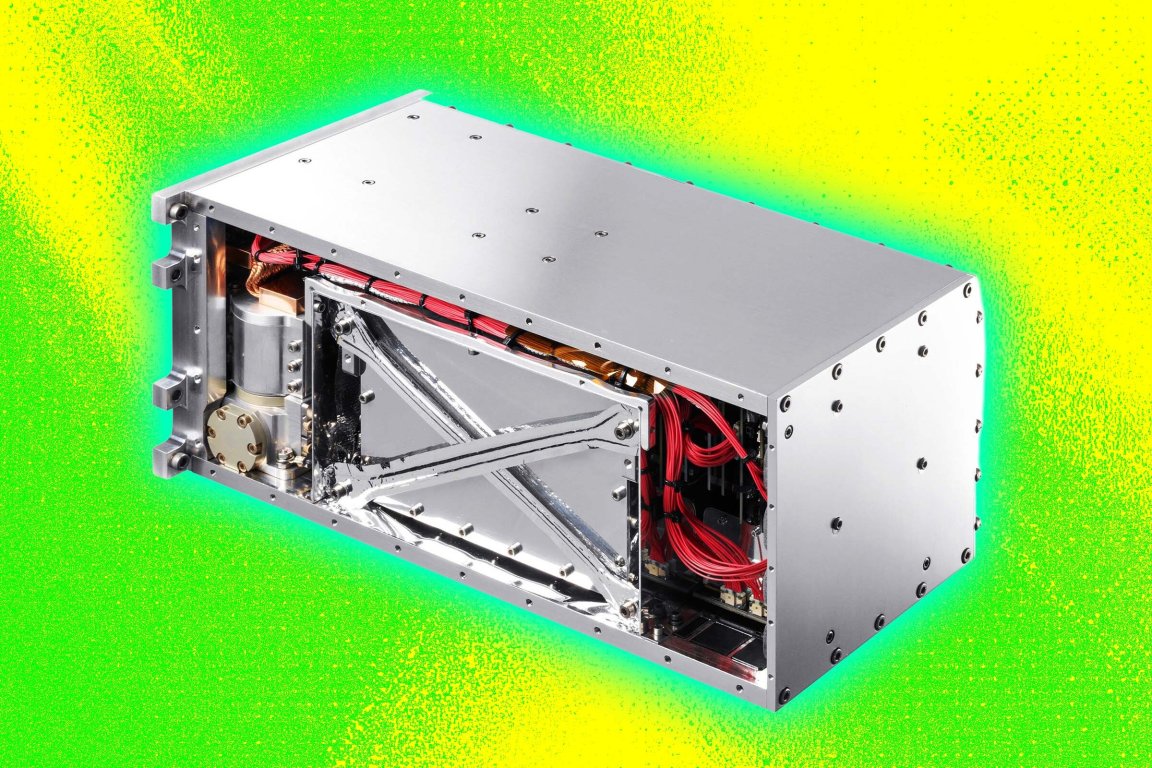
Now, New Zealand space startup Zenno Astronautics says it’s tested an entirely new type of thruster that, unlike either of those conventional technologies, uses superconducting magnets to maintain a satellite’s orbit and orientation. As Space.com reports, the magnets convert solar energy directly into momentum, effectively harnessing the Earth’s magnetic field itself.
“Energy is the one thing that is abundant in space, and you can use it to energize the magnet to create a magnetic acceleration device,” Zenno Astronautics CEO and founder Max Arshavsky told the site. “It gives you acceleration without fuel.”
The company’s “Supertorquer” system, attached to a Mira satellite developed by Impulse Space, was launched into space as part of a SpaceX rideshare mission in November.
“It’s a technology that allows a spacecraft to not tumble violently in space and point in the right direction,” Arshavsky told Space.com.
When the spacecraft needs to move, superconducting coils draw energy from a solar powered battery.
“The unit has multiple superconducting magnets that are positioned in different axes,” Arshavsky added. “When we power up the magnets, they generate a magnetic field, which interacts with Earth’s magnetic field, and because we can control the magnetic field on the satellite, we can control the way in which it turns with respect to Earth.”
During its test last fall, the Supertorquer successfully altered the Mira satellite’s orientation on command, just as designed.
For superconducting magnets to work, they have to be cooled to extremely low temperatures. On Earth, that requires cryogenic liquids, which are ill-suited for a satellite. Even in space, the satellite is warmed up to around 68 degrees Fahrenheit by the Sun’s rays, which meant that Zenno had to get creative.
Using a heat pump, the extensively insulated magnet system expels heat to allow the coils to power up at temperatures as low as 77 kelvin, or -321 degrees Fahrenheit. Zenno claims its cooling system is highly efficient, drawing only up to 48 watts at peak.
The startup has some ambitious plans and is hoping to scale up the system to enable future spacecraft to perform docking maneuvers or even help propel them to the Moon or Mars by exclusively relying on solar power. How feasible those lofty plans will turn out to be remains to be seen, but the startup is optimistic.
Arshavsky even suggested that superconducting magnets could create “umbrellas of magnetic fields” that could “shield people in space” from harmful levels of radiation.
More on satellite thrusters: NASA Fires Up Futuristic Plasma Thruster Designed to Take Us to Mars