





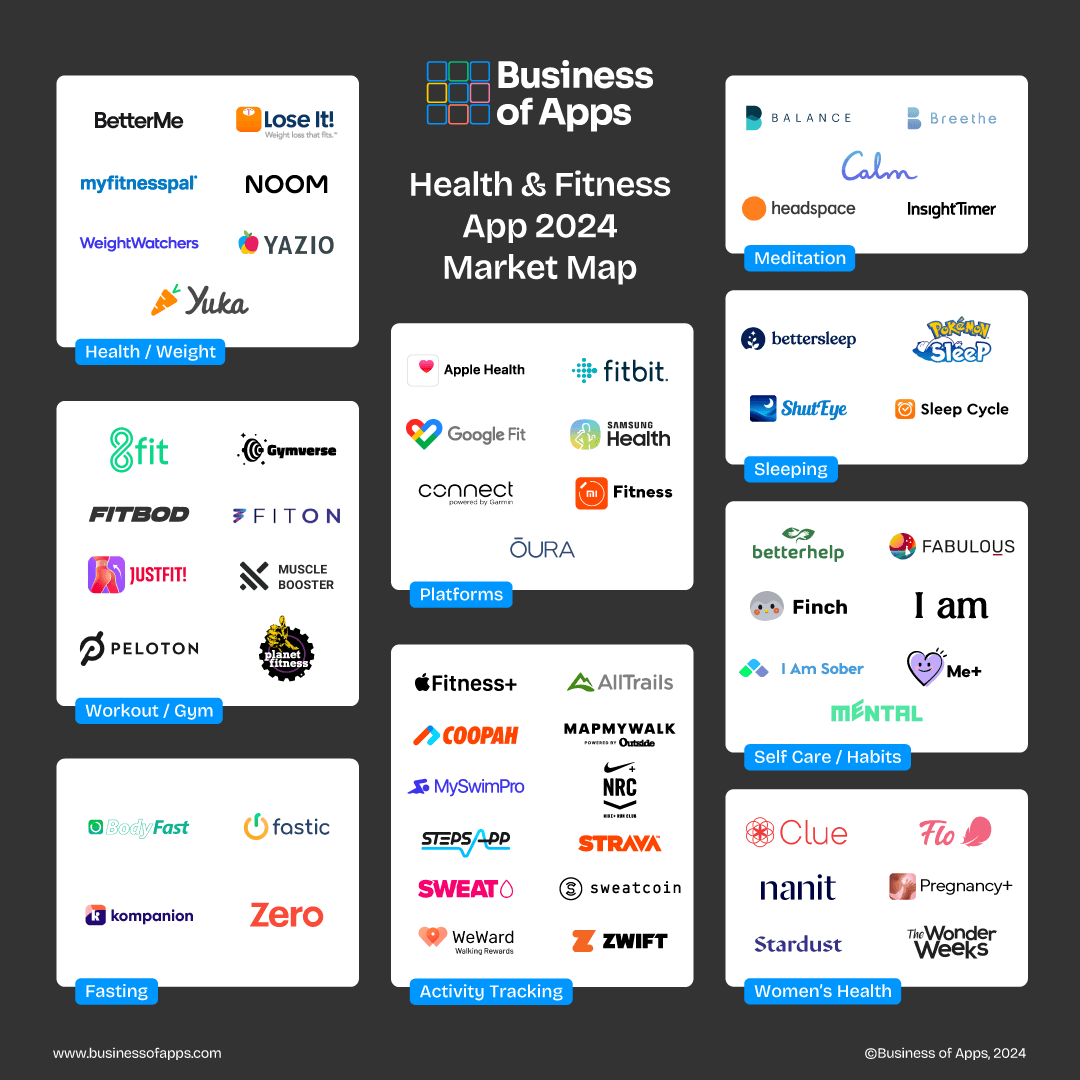
The Health & Fitness App Market Map 2024 is now live and available to download. This infographic categorizes the health and fitness app sector into distinct subsectors and identifies the key players in each subsector.
With over 600 million users and $4.4 billion revenue, the health and fitness app sector is a popular category with lots of room for growth. While it has seen a slight downturn since the pandemic, many of the health and fitness habits picked up during that time have remained a part of people’s lives.
Quite a lot of the key apps in this sector are still startups and independent, such as Strava, AllTrails, Flo and Oura. It is also a low-cost app sector, as indicated by development houses such as Leap Fitness and Enerjoy operating several dozen popular health and fitness apps.
- Advertisement -

The gap between a 65% and 90%+ privacy opt-in rate can mean $525,000 in lost revenue annually for a 100K DAU app — and most teams have no idea where they stand.
This guide breaks down the true cost of consent debt, why the average app sits at just 80% opt-in, and the exact tactics top performers use to consistently hit 90%+: prompt timing, banner design, vendor list optimization, and more.
At the same time, plenty of users are accessing single feature apps instead of using a platform to track everything, as shown by the popularity of apps like MySwimPro, Yazio, and Sleep Cycle. This makes potential consolidation of the market into a few platform apps unlikely, as users are looking for targeted services.
The sector can be broken down into three main pillars: health, fitness and wellness. It can then be broken down further, for example fitness into activity tracking and workouts, health into calorie counters and fasting, and wellness into meditation and sleeping.
To download the Health & Fitness App Market Map 2024 as a PDF check out the link.
此内容由惯性聚合(RSS阅读器)自动聚合整理,仅供阅读参考。 原文来自 — 版权归原作者所有。