



惯性聚合 高效追踪和阅读你感兴趣的博客、新闻、科技资讯
阅读原文 在惯性聚合中打开

推荐订阅源

Microsoft Azure Blog
J
Java Code Geeks
量子位
腾讯CDC
C
Check Point Blog
小众软件
小众软件
IT之家
IT之家
I
InfoQ
Hugging Face - Blog
Hugging Face - Blog
Stack Overflow Blog
Stack Overflow Blog
让小产品的独立变现更简单 - ezindie.com
GbyAI
GbyAI
Apple Machine Learning Research
大猫的无限游戏
大猫的无限游戏
博客园_首页
S
SegmentFault 最新的问题
The Cloudflare Blog
阮一峰的网络日志
阮一峰的网络日志
aimingoo的专栏
aimingoo的专栏
P
Proofpoint News Feed
钛媒体:引领未来商业与生活新知
钛媒体:引领未来商业与生活新知
Google DeepMind News
T
Tailwind CSS Blog
Martin Fowler
Martin Fowler

Business of Apps

Agentic AI is coming for the app growth playbook [online event] As app discovery expands to ChatGPT, AppTweak launches AI Visibility for Apps Apps in Motion is bringing the best app operators to NASDAQ on April 8 Up your AI game at Business of Apps London 2026 The Business of Apps newsletter is evolving Early bird ticket sale for Business of Apps London ends this week Smadex unveils unique CTV Pause Ads via OpenGlass partnership Build your network at Business of Apps London 2026 Why smaller apps should rethink TV and connected TV for UA Influencer marketing gains traction among AI apps AI agents are becoming the new junior marketers Inside the key themes driving app growth at Business of Apps London 2026 Where is App Store Optimization heading in 2026? [webinar series] From social-first brand to subscription-led app, inside Mob’s rise to the UK’s leading recipe app Apps capture larger share of health and fitness market revenue in 2025 Upcoming RealityMine webinar to highlight blind spots in first-party app data From ad network to scalable performance ecosystem, EVADAV announces a newly enhanced corporate structure The biggest apps and brands are in for Business of Apps London 2026 Diversification takes centre stage in app user acquisition Super early bird ticket sale for Business of Apps London ends this week App-to-web monetisation moves into the mainstream Latest speakers confirmed for Business of Apps London 2026 Agentic coding drives number of iOS apps to highest level ever Smadex and Anzu bring performance and clickability to intrinsic in-game advertising Consumer spending on apps surpassed games for the first time in 2025 The Business of Apps London agenda is now live with more than 70 speakers Opening keynote announced for Business of Apps London ChatGPT was the most downloaded app in 2025, supplanting TikTok Want to speak at Business of Apps London? Branch’s “How I Grew This” episodes land on the Business of Apps podcast
Simulation games are most cost-effective for user acquisi...
Nayden Tafradzhiyski · 2023-04-20 · via Business of Apps

Simulation games are the most cost-effective in terms of user acquisition, with a cost of $0.59 per install according to a new report from Liftoff, the growth acceleration platform. By comparison, lifestyle games are significantly more expensive with a cost of $1.32 per install, which is more than twice the cost. 

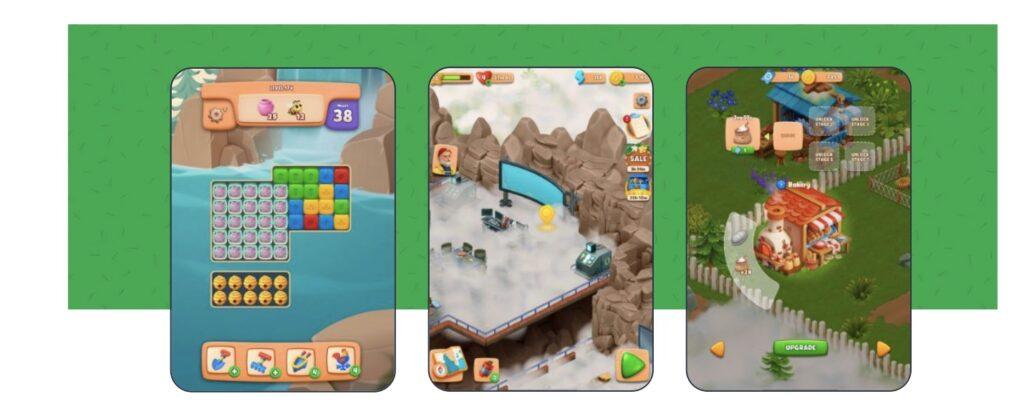
Simulation games are cheapest

User acquisition costs are a significant factor in the mobile gaming industry, as acquiring new users is essential for the success of a game. At just $0.59, simulation games are the best deal per install.

Despite the higher cost, lifestyle games had a comparable return on investment after seven days, with an 8.3% return, compared to 8.5% for simulation games.

- Advertisement -

Is your privacy opt-in rate costing you $525,000 a year?

The gap between a 65% and 90%+ privacy opt-in rate can mean $525,000 in lost revenue annually for a 100K DAU app — and most teams have no idea where they stand.

This guide breaks down the true cost of consent debt, why the average app sits at just 80% opt-in, and the exact tactics top performers use to consistently hit 90%+: prompt timing, banner design, vendor list optimization, and more.

Download the Guide.

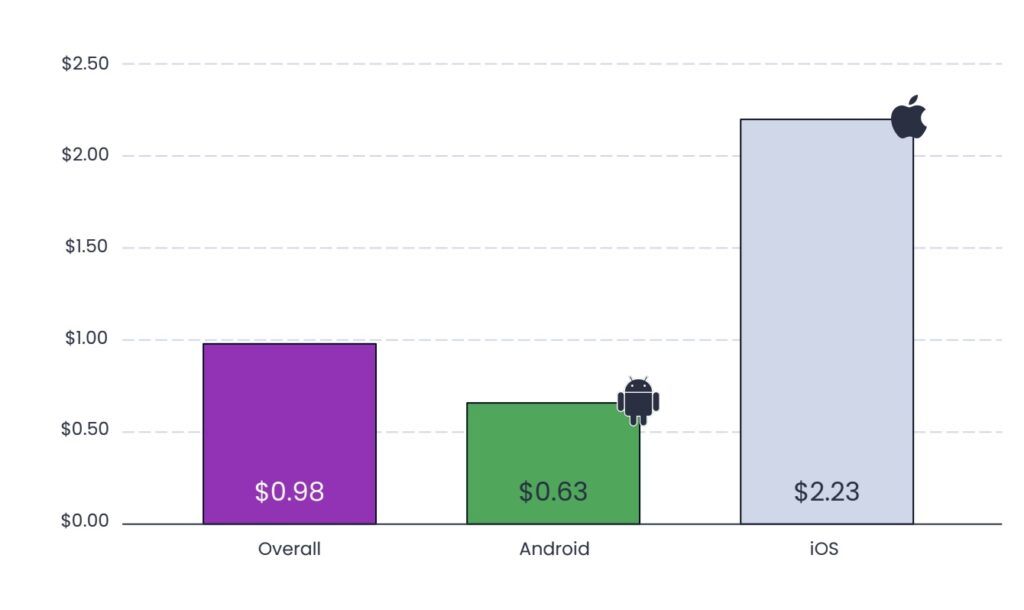
From 2022 to 2023, the overall average CPI was around $1. Android users are still significantly cheaper to target than iOS users at an average of $0.63 compared to $2.23, respectively.

Android has lowest CPI
Source: Liftoff

However, seven-day ROAS rates were similar on the platforms with iOS offering a slightly better return on day seven at 7.8% compared to 7% on Android.

But hyper casuals drive installs

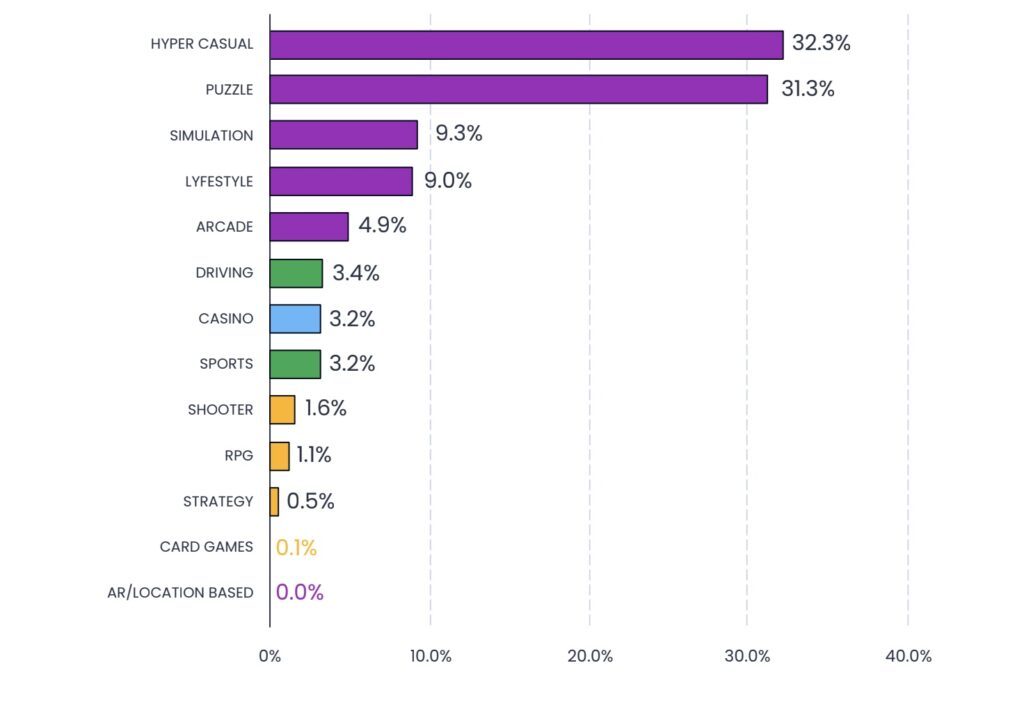
Although their popularity has decreased, hyper casual games continue to be the most prominent catalyst for game installations across all categories, accounting for 32.3% of total installs. Puzzle games closely follow at 31.3%. Other noteworthy genres that drive approximately 9% of total installations each include simulation and lifestyle games.

Total download market share for the hyper casual genre has fallen from 50% in Q1 2021 to just over 30% in Q1 2023 because of the impact of IDFA on monetisation models. 

Hyper casuals lead for installs
Source: Liftoff

“As consumer spend continues to fluctuate, mobile game marketers and developers are focusing less on scaling quickly and more on steady revenue growth,” says Joel Julkunen, Head of Analytics at GameRefinery, a Liftoff company.

“To succeed in this climate, it’s important to tap into revenue-driving trends that are proving to be a hit with casual gamers. By adopting the latest trends, such as hybrid elements and competitive events, casual game developers can continue to boost engagement and retention while providing enticing opportunities for advertisers.”

North America boasts the highest average cost per install (CPI) by a considerable margin, standing at $3.59, which is more than triple the CPI for Europe, the Middle East, and Africa. However, it also records the highest day 7 return on ad spend (D7 ROAS) at 8.1%. In contrast, Latin America has the lowest CPI, with just $0.55 per install. Despite this, it records the lowest D7 ROAS at 4.8%.

Key takeaways

  • Simulation games are the most cost-effective in terms of user acquisition at $0.59 per install 
  • Android users are significantly cheaper to target than iOS users at an average of $0.63 compared to $2.23, respectively
  • Hyper casuals account for 32.3% of total installs