






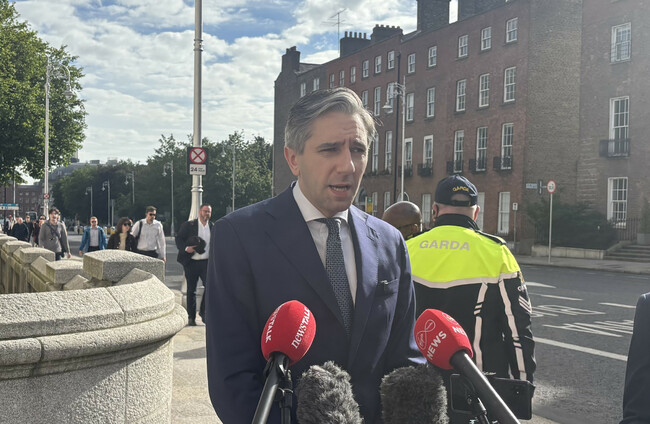
TÁNAISTE SIMON HARRIS said some local authorities are doing an “appalling” job at collecting the derelict sites levy as he prepared to bring the proposal for a new replacement tax to Cabinet.
The new tax, the derelict sites tax, is payable by owners of derelict sites and will be collected by Revenue rather than local authorities, as is the case for the current levy.
The current levy is charged at 7% of a property’s market value, which continues to apply until the site is no longer deemed derelict, and unpaid levies attract interest of 1.25% per month.
The new tax is not expected to be lower than that rate. It will be self-assessed and backed by Revenue enforcement powers.
Harris has been outspoken in his criticism of local authorities that fail to collect the levy owed by these site owners.
Speaking to reporters before Cabinet this morning, Harris said he was “aghast” at the responses from some councils when following a recent investigation by RTÉ Investigates on the matter.
He dismissed criticism from the Association of Local Government, a national body representing county and city councillors, that there are limitations in legislation on the government’s side.
“In 2024, in the full year, 11 local authorities collected zero euro and zero cent. Now, there aren’t 11 local authorities in the country that don’t have dereliction issues,” he said.
Harris acknowledged that ultimately it is on the government to tackle the housing crisis, but he said “we’ve just had enough”.
“We’re just going to bring in a derelict sites tax, and we’re going to collect it ourselves through revenue,” he said. The Tánaiste said he hopes the new tax will come in during 2027.
At present, city and county councils are required to chase the owners of properties to collect that money from them.
The idea is that the financial penalty imposed will encourage owners to either sell their derelict site or to bring it back into use themselves.
However, most councils don’t actually collect the money that’s owed, with unpaid levies totalling around €32 million at the start of the year.
Harris said the tax is intended to change behaviour rather than as a money-gathering exercise.
“It’s very clear that this is a tax that’s about behavioural change, and by making it clear that we’re no longer going to ask nicely at a local level, but we’re going to ask the Revenue commissioners to make sure this is collected,” Harris concluded.
It was a busy morning outside Government Buildings as the Taoiseach, Tánaiste, and five other ministers stopped to take questions from the media. Today’s Cabinet agenda has a “real focus on housing”, the Tánaiste said.
Housing Minister James Browe stopped to speak on legislation on the registration of short-term lets that he is bringing to Cabinet. Transport Minister Darragh O’Brien discussed the bill providing for the removal of Dublin Airport’s passenger cap, which is to be approved today.