




惯性聚合 高效追踪和阅读你感兴趣的博客、新闻、科技资讯
阅读原文 在惯性聚合中打开

推荐订阅源

Martin Fowler
Martin Fowler
Jina AI
Jina AI
J
Java Code Geeks
Microsoft Security Blog
Recent Announcements
I
InfoQ
L
LangChain Blog
The Cloudflare Blog
IT之家
IT之家
博客园 - 叶小钗
Apple Machine Learning Research
B
Blog
A
About on SuperTechFans
Cyber Security Advisories - MS-ISAC
Last Week in AI
Last Week in AI
Blog — PlanetScale
Blog — PlanetScale
罗磊的独立博客
云风的 BLOG
云风的 BLOG
Microsoft Azure Blog
Engineering at Meta
Engineering at Meta
F
Fortinet All Blogs
博客园 - 聂微东
美团技术团队
博客园_首页

TheJournal.ie

Court told Eleanor Donaldson placed bugging device in her husband’s car over fears of affair TD says she's been left with 20cm scar after skin cancer diagnosis Homelessness: Record number in emergency accommodation, including new high for children Blue Origin rocket explodes during test launch John Gibbons: The planet is burning, but Ireland still isn't taking climate change seriously 'Truly devastating': Tributes paid to Masuma Sohrabi after stabbing in Clifden Mother and carer: You don't appreciate public services until your child needs them to survive Left or right? Sinn Féin's fence-sitting may be about playing the long game Gavan Reilly: Gerry Hutch and his 30% vote in Dublin Central's best-heeled area Gavan Reilly: The Gerry Hutch 37.1% share of the vote in the shadow of the IFSC Ebola on the rise: Why the latest outbreak should concern all of us Ireland's data centre energy drain: How Big Tech added €1.4bn to household electricity bills Living with myeloma: 'I chose not to fight this blood cancer, but to instead live alongside it' Alberta’s separation bid: How Canada’s next political crisis could come from within Kelly Earley: Militarism might be Ireland’s next economic disaster Raising them right: Ireland has a dog poo problem, and we parents are sick of stepping in it Money Diaries: A recently graduated digital journalist on €35K living in Dublin Global tech job losses: Is ‘AI-washing’ the new trend nobody wants to call out? Down on the farm with a difference: This is what happens when animals are allowed to feel safe Surrealing in the Years: Some shameful Irish attitudes take a leaf out of Israel's book Motoring: Should we trust self-driving cars? The physio is in: Ireland is growing older, but are we moving enough to age well? Tech dubbed 'creepy': AI smart glasses are here, but our privacy laws have not caught up Larry Donnelly: The polls point one way for Friday but byelections rarely follow the script The war on human thought: Educational institutions must take back control from AI The Bee Guy: World Bee Day won't save our little bee friends Kelly Earley: Could Mountjoy Square be Dublin’s most important park? Money Diaries: How is your spending and saving going? Would you like to keep a diary for us? Rearing them right: Should modern parents bring back ‘the man’? Ireland's energy future: What if the real failure here is that we stopped thinking bigger?
Child psychotherapist warns of the rise of loneliness amo...
https://www.thejournal.ie/author/sophie-finn/ · 2026-06-17 · via TheJournal.ie

"Community structures are weaker than those of previous generations. Time spent together is often replaced with time spent in part, and there's a significant challenge for the next generation to maintain meaningful connection," Noctor said (file photo). Alamy Stock Photo

Growing up in Ireland

Dr Colman Noctor said the overall findings from 20 years of research from the Growing Up in Ireland study show the importance of connection and community for children – two things he said are increasingly eroding in Ireland.

CHILDREN AND YOUNG people are struggling with loneliness and a lack of social connection, a leading child and adolescent psychoanalyst has warned.

Colman Noctor said the overall findings from 20 years of research from the Growing Up in Ireland study show the importance of connection and community for children – two things he said are increasingly eroding in Ireland. 

Minister for Children Norma Foley launched the anniversary campaign of Ireland’s national longitudinal study of children and young people today at the Royal College of Physicians in Dublin.

Speaking at today’s event, Noctor said that the key evidence from Growing up in Ireland is that children thrive when they have connection, belonging, strong relationships and community in their lives.

But Noctor said that as our society is now “increasingly individualised”.

“Community structures are weaker than those of previous generations. Time spent together is often replaced with time spent in part, and there’s a significant challenge for the next generation to maintain meaningful connection,” he said.

Noctor said that in his clinical work with children and young people, anxiety has been the main issue presented over the last 10 years. But he said that in the last two years this has been replaced by loneliness for those aged 18-24.

He said the challenge to improve social connection will only grow in the next 20 years due to the development of technologies like AI.

Time capsule
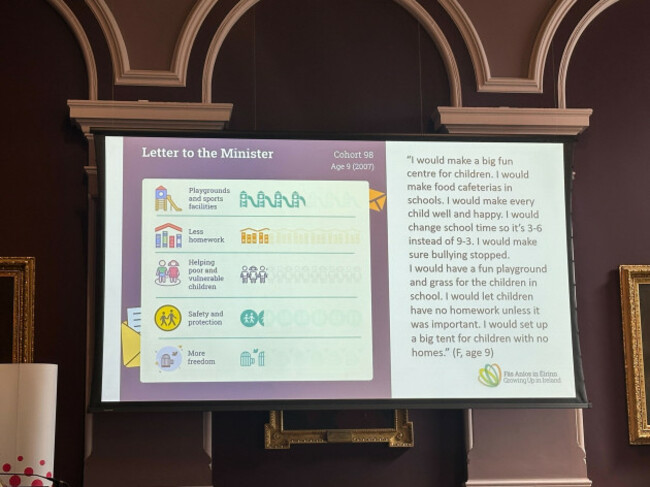
IMG_4327 A letter from a 9-year-old girl from 2007 which was put in a time capsule was shown at the launch. The Journal The Journal

Noctor pointed to letters written by nine-year-old children in 2007 for a time capsule to highlight the importance of connection and community. The children were asked to write about what could be done to improve childhood in Ireland, and the most common answer was more playgrounds and facilities.

During today’s launch, senior researcher of the study, Aisling Murray, highlighted an answer from a 9-year-old girl in particular, who said she wanted a “a big fun centre for children” and a “playground and grass”.

“We need to protect the spaces for young people to gather in the real world. She was onto something 20 years ago that we are really starting to realise,” Noctor said.

The Growing up in Ireland study, which is jointly run by the Department of Children and the Central Statistics Office, aims to inform public policy in Ireland.

It has surveyed 32,000 children and young people – three generations of children in Ireland: those born in 1998, 2008 and 2024.

The study follows the same children over time to see the impact of key transition points in their lives and provides insights into these children’s physical health, mental health and education.

Speaking at the event, Norma Foley praised the study and said it has been important for “giving a voice to the children and young people of Ireland”.

“When we get it right for children, we ultimately get it right for society”.

New research

IMG_4328 Since the study began in 2006, 32,000 children and young people have taken part in an effort to inform public policy in Ireland. The Journal The Journal

Charlotte Silke presented the latest study coming from the Growing up in Ireland data, which highlighted the factors that help improve outcomes for vulnerable children.

For the study, children were grouped into categories which assessed their vulnerability at age nine, and were then evaluated until the age of 25 to see how their early lives impacted their wellbeing. 

Silke said the study shows that early vulnerability shapes wellbeing outcomes. 

Over one in four children were struggling at age 25, meaning they have poorer than average functioning across wellbeing domains.

40% of children in at risk groups at age nine were categorised as struggling at age 25, in comparison to only 24% of the children identified as being in a low risk group.

However, Silke said these findings also show that early adversity does not mean a child’s trajectory is fixed, as well over half of those in at risk groups aged nine were doing well at 35.

The author said protective factors like high levels of educational attainment, stronger teacher support, better peer relationships, less fighting between parents and children and participation in extracurriculars were all associated with a greater likelihood of doing well aged 25.

Silke said these findings highlight the importance of short-term and sustained support for all children.

Readers like you are keeping these stories free for everyone...

A mix of advertising and supporting contributions helps keep paywalls away from valuable information like this article. Over 5,000 readers like you have already stepped up and support us with a monthly payment or a once-off donation.